Category: 7 Sentences That Keep You Stuck

  • Maximize Your Ideas: The Case for Content Multiplication

    Maximize Your Ideas: The Case for Content Multiplication

    I Used to Think Reusing an Idea Was Cheating

    There’s a specific guilt that shows up right around the third time you post some version of the same idea in one week, a little voice that sounds suspiciously like a teacher checking for plagiarism, asking whether you’re actually being lazy right now, dressed up as a system. I felt that voice constantly when I started multiplying instead of creating from scratch every time. I want to talk about it, because I don’t think I’m the only one who’s felt vaguely fraudulent doing this.

    Where the guilt actually comes from

    I think it comes from a rule nobody stated out loud but everyone absorbed anyway: new content is virtuous, and reused content is a shortcut, and shortcuts are for people who aren’t willing to put in the real work. I believed some version of that for a long time, which is strange in hindsight, because I don’t apply that standard to literally anything else. Nobody thinks a chef is cheating for cooking the same excellent dish twice. Nobody thinks a musician is cheating for playing the same song at two different shows. But post the same idea on two platforms, in two formats, and some part of your brain quietly files it under “getting away with something.”

    I did the actual audit on this feeling and it did not survive contact with logic, but it survived contact with logic for a surprisingly long time regardless, because guilt doesn’t require evidence, just a comfortable, familiar shape.

    The reframe that actually worked

    Here’s what finally moved the needle for me: nobody experiences my content the way I do. I see the same idea nine times because I’m the one making all nine versions. My actual audience sees, at most, one or two of those nine — a clip here, an article there, a newsletter they happened to open. To them, it isn’t repetition. It’s just the one piece of content they encountered, doing its job, once, the way any single post is supposed to.

    The guilt was a symptom of being the only person in the room who’d seen behind the curtain. Everyone else just sees the show.

    What I had to actually admit to myself

    The uncomfortable truth is that “new content every time” was never actually a virtue. It was a constraint I’d mistaken for a value, and a genuinely exhausting one. Making something new from scratch isn’t more honest than multiplying a good idea properly — it’s just more expensive, and I’d confused the expense for integrity, the way you might mistake a harder workout for a better one even when it’s just worse programming.

    A good idea, treated with real care and turned into several honest, distinct pieces of work, isn’t a shortcut. Writing an actual standalone article instead of just slapping a transcript online, cutting a clip that stands on its own instead of just trimming for length — that’s still work, real work, just not work I have to invent fresh raw material for every single time.

    Where I landed

    I still get a flicker of the old guilt occasionally, usually late at night, usually right before I post the fifth thing that traces back to Monday’s notes. I let it pass through without acting on it now, the way you’d let a familiar, slightly annoying song play out instead of turning it off. It’s not information. It’s just an old habit of thought that hasn’t caught up to how I actually work anymore.

    The chef doesn’t feel guilty about the second plate. I’m working on it.


    Ready to stop treating good ideas like single-use plastics?

    Get The Content Multiplication System and build a workflow that makes the most of your work

  • Building Profitable Businesses: Lessons from Passion Projects

    Building Profitable Businesses: Lessons from Passion Projects

    Why Your Passion Projects are Costing You Your Future

    There is a popular sentiment on the internet: “The boring business paid my mortgage. The cool startup paid for my therapy.”

    We live in a culture that romanticizes the high-growth tech startup. We are told to “think big,” chase VC funding, and disrupt industries. But out in the real world, the data points to a different reality: the most profitable businesses are often the most mundane.

    When I transitioned from a software career to entrepreneurship, I tried to launch an artisanal candle company out of passion. It failed because it lacked a foundation. The businesses that actually make money don’t rely on inspiration; they rely on three structural pillars:

    1. Recurring Demand: Don’t educate the market. Find a need that grows back (grass, dirty offices, tax deadlines).
    2. Healthy Margins: Skip high-volume, low-margin traps. Services with low overhead provide the economic buffer you need to survive.
    3. Repeatability: If your business requires you to be a creative genius every single day, it’s not a business; it’s a high-stress job. Build systems that work even when you’re tired.

    Status doesn’t pay the rent. Cash flow does. Stop chasing “cool” and start chasing “reliable.”

  • Break Free from Clichés: Rewrite Your Life Story

    Break Free from Clichés: Rewrite Your Life Story

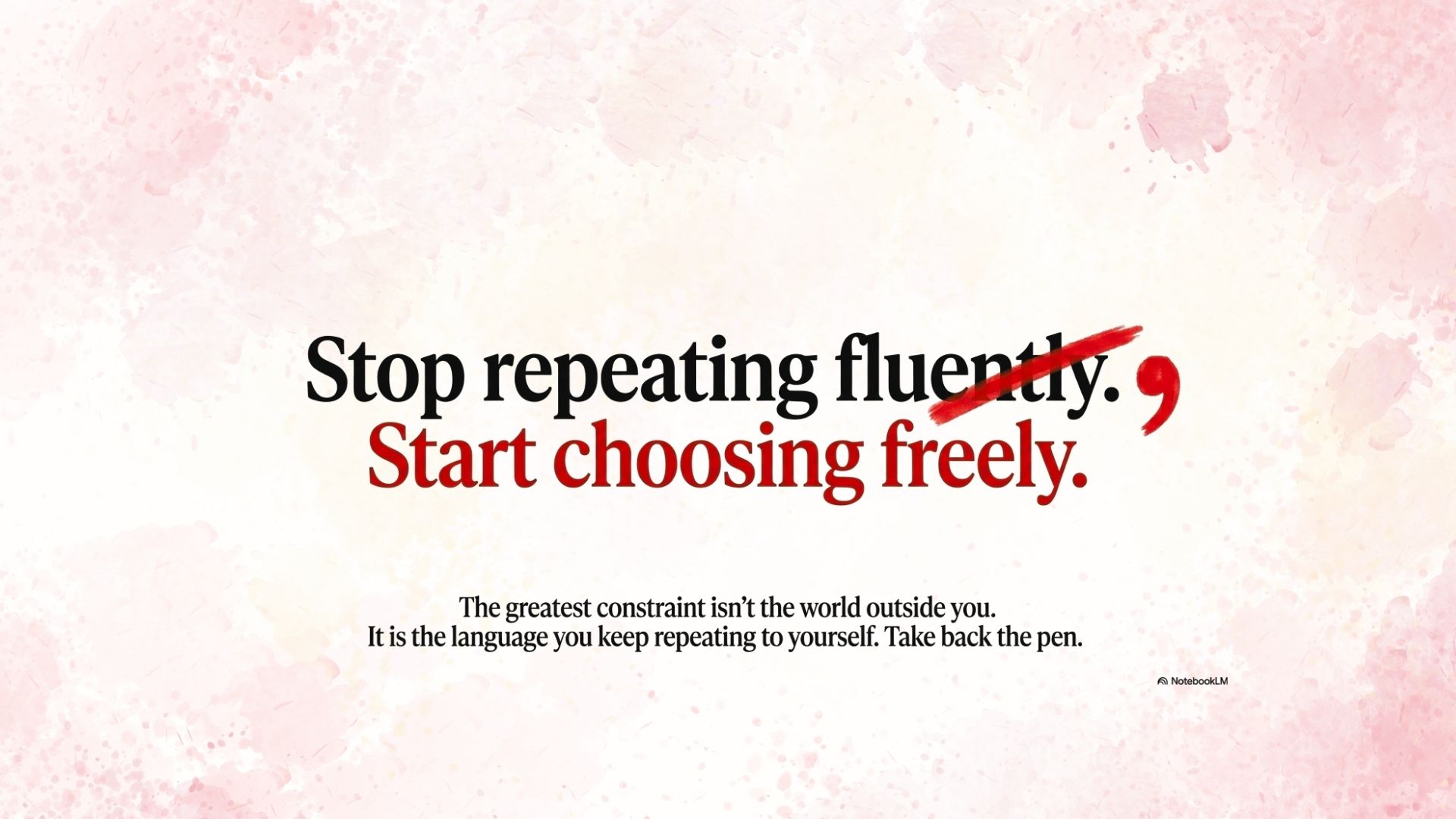
    You believe you are choosing freely, but most of the time, you are simply repeating fluently,,. We all carry “invisible scripts”—those socially approved clichés like “everything happens for a reason” or “it is what it is”—that act as beautiful excuses for staying exactly where we are,,. For the high-achiever, this is the ultimate “self-trick”: you have become so efficient at reframing your discomfort into “wisdom” that you have lost the ability to hear the actual data your life is trying to send you,,,.

    These clichés are incomplete truths; they offer a false sense of “narrative coherence” while keeping you quietly constrained,,,. They allow you to narrate your hurt with such composure that the world calls it strength, but your nervous system knows it is just passive endurance,,,. You aren’t being “resilient”—you are just suppressing elegantly,,.

    True growth begins when you pause before the borrowed sentence completes itself,,. It starts when you stop using language to “soften chaos” and start using it to define your boundaries,,. Self-authorship is the act of finishing the sentence yourself—moving from a life that is merely “functional” to one that is finally alive,,,.

    Stop living a borrowed sentence. It’s time to rewrite the ones that trap you.

    Watch the latest episode of the Diary of Cliches Podcast here!

  • Understanding Emotional Bypassing: Why It Harms You

    Understanding Emotional Bypassing: Why It Harms You

    You’re Turning Off the Check Engine Light

    High-functioning people are masters of the “Great Self-Trick”: the ability to narrate their own hurt with such composure that the world mistakes it for strength. But let’s be honest—you aren’t being resilient; you’re just turning off the diagnostic bulb.

    Every time you reach for a cliché like “Just stay positive” or “Everything happens for a reason” to neutralize a difficult moment, you are practicing emotional bypassing. You are silencing the vital data your engine needs to survive. Emotions are data, not obstacles. Anger signals an injustice; frustration signals a misalignment; sadness tells you that something actually mattered.

    When you reframe your pain before you’ve even felt it, you aren’t evolving—you are suppressing elegantly. You are building a life that looks coherent on paper but feels “quietly constrained” in reality. Stop calling your endurance “wisdom” and stop calling your silence “maturity”. Your internal alarm system is screaming for a reason. Are you going to keep driving until the engine fails, or are you finally ready to pause and listen to the truth?

    Watch the full episode of the Diary of Cliches Podcast here!

  • The Danger of Living on Autopilot: Break Free

    The Danger of Living on Autopilot: Break Free

    You think you’re in the driver’s seat of your own life, but the truth is more unsettling: you are likely just a very talented narrator for a script you didn’t write.

    Most high-achievers pride themselves on their autonomy, yet they spend their days “repeating fluently” inherited cultural reflexes while calling it wisdom. We reach for “socially approved sentences” like “it is what it is” or “everything happens for a reason” because our brains prefer narrative coherence—a story that makes sense—over the raw, chaotic data of the truth. These clichés are the ultimate “self-trick”: they allow you to narrate your hurt with such composure that the world calls it strength, when it is actually just endurance disguised as maturity.

    But at what point does your realism become self-abandonment?

    True self-authorship begins with a deliberate interruption. It’s the power to pause before the inherited sentence completes itself and ask two diagnostic questions:

    1. “Where did this sentence originate?”
    2. “Does it still apply?”

    If your life feels “coherent—and still constrained,” you aren’t living; you’re just performing a role in a story that someone else authored. Reclaiming your life doesn’t require a loud rebellion; it requires the quiet courage to stop being a passive narrator and start being an active agent who defines their own meaning.

    Which sentence has been quietly running your life—and what would change if you finally stopped repeating it?

    Watch the full episode of the Diary of Cliches Podcast here!

  • Stop Waiting: Claim Your Agency Now

    Stop Waiting: Claim Your Agency Now

    In the world of high-achievers, we are taught that patience is a moral virtue and that composure is rewarded. We tell ourselves that “good things come to those who wait,” internalizing a “quiet meritocracy” where we expect our excellence to eventually be “interpreted correctly” by an authority or a system.

    But here is the provocative truth: Resentment is the receipt for the time you spent waiting for someone else to validate your worth.

    When you outsource your agency to the clock, you aren’t practicing “emotional intelligence”—you are practicing passive resignation. While you stay quiet to keep the peace and play the role of the “strong one,” you are privately paying for that “forced pleasantness” with a slow erosion of your self.

    The cost of this script is a life that feels “coherent—and still constrained,” where you are “repeating fluently” the habit of endurance instead of choosing freely to assert your value. True evolution begins when you realize that “good” things come faster and more accurately to those who define what “good” looks like before they ever begin waiting.

    Stop waiting for the universe to reward your silence. Authorship begins when you stop calling your resentment “patience” and start calling it data

    Watch the latest episode of the Diary of Cliches Podcast