Category: writing

  • The Confusing Pain of Being ‘Almost There’

    The Confusing Pain of Being ‘Almost There’

    Speaking to the high-achiever who’s busy but still feels stuck or behind.

    There is a specific, disorienting pain that belongs exclusively to the high-achiever. It is the feeling of being perpetually busy, yet somehow still behind.

    You are the one who reads the books, attends the seminars, and implements the systems. Your calendar is full. Your effort is unquestionable. You are, by all objective metrics, “doing the work.” You’re not lazy; you’re one of the busiest people you know.

    And yet, you still feel the frustrating, confusing sense of being stuck. You look at your peers—or the successful authors you admire—and wonder, “If I’m working this hard, why isn’t the needle moving? Why is the sales dashboard still silent? Why does my entire effort feel like it’s disappearing into a void?”

    This is the confusing pain of being “almost there.”

    It’s easy to look at that feeling and conclude that the problem is a deficit of effort or, worse, a fundamental flaw in your talent. The mind whispers, “If I’m this busy and still stuck, the mistake must be me.”

    But the truth is far more liberating: Your problem isn’t a lack of effort. It’s a failure of signal.

    The high-achiever’s trap is focusing on the performance—on being the best, the most comprehensive, the most “good.” You’ve built a masterpiece of quality. But the marketplace doesn’t respond to volume or mere quality; it responds to connection.

    You’ve poured all your energy into the production of your work, but not enough into the translation of its relevance. Your book’s signal is generic—it says, “I am a high-quality book.” But what the reader scrolling needs is a shout of recognition: “I see your specific, confusing pain of feeling busy-but-behind, and I have the map out.”

    The key to breaking this cycle of busy invisibility is to shift your focus from Performance to Service. Stop trying to sell the product of your work, and start using your platform to speak directly to that specific, exhausting pain point you solve.

    Your busyness is your proof of effort. Your silence is your instruction for clarity. The moment you clarify the signal to connect with the high-achiever who is tired of being “almost there,” your effort stops disappearing and starts transforming.

  • Stop the Scroll: Tips for Compelling Book Titles

    Stop the Scroll: Tips for Compelling Book Titles

    Analyzing what makes a signal irresistible in a crowded feed.

    In the current attention economy, your book has a new and more dangerous competitor than any other author: the endless scroll.

    The problem is not that readers are actively rejecting your book; it’s that they are barely seeing it. Your book exists inside an environment of overwhelming choice and perpetual distraction. Every phone swipe, every notification, every new piece of content is an appeal for attention.

    This is the reality of the marketplace. Your masterpiece, the thoughtful, well-edited book you poured your heart into, is competing against vacation photos, breaking news, and quick-hit entertainment. It is competing against distraction, and distraction is relentless.

    This introduces the Distracted Scroll Test:

    If a potential reader is scrolling quickly—not searching for a solution, but merely trying to ignore the noise—does your book’s presentation offer an immediate, clear, and emotional reason for them to stop?

    If your book requires the reader to slow down, click, and evaluate its quality, it has already failed the test. The modern reader will not accept the burden of translation. Your book must be instantly and relentlessly recognizable.

    Consider the difference in signals on a crowded feed:

    • Invisible Signal: A book cover featuring a calming landscape and a polite title, such as The Quiet Path to Self-Improvement. It suggests quality and a good topic, but it offers no specific, immediate reason to interrupt the scroll. Its message is generic and easily ignored.
    • Irresistible Signal: Another book, on the same fundamental topic, is titled, Why You’re Still Tired: The High-Achiever’s Guide to Reclaiming 3 Hours a Day. This signal is a shout of recognition. It names a specific, painful struggle (being tired despite being high-achieving) and promises a concrete result.

    The irresistible signal doesn’t rely on being “good.” It relies on being relevant to the point of being magnetic. It doesn’t ask the reader to buy a product; it interrupts their state of distraction to shout, “This is for you right now.”

    Your book’s presentation—your title, subtitle, and cover—must function as a clear, simple invitation that cuts through the noise. Stop designing for the reader who is actively searching, and start designing for the distracted reader who needs to be stopped cold by the emotional truth of your work. That immediate, specific signal of relevance is the only true lever for visibility.

  • Are You Selling an Inventory List or an Emotional Journey?

    Are You Selling an Inventory List or an Emotional Journey?

    A challenging essay on auditing your current book description for emotional connection.

    When a potential reader lands on your book’s sales page, they are asking a single, silent question: How will this change my life?

    The mistake most authors make is responding to this question with an inventory list.

    Your book description—the single most important piece of marketing copy you have—is often written like a course syllabus or a table of contents. It details the features: “This book covers X, Y, and Z steps to a better life.” It is factually correct. It is logical. And in the attention economy, it is functionally invisible.

    This is because readers do not buy information; they buy transformation. They are not looking for a list of what your book contains, they are looking for a clear promise of what your book will help them change or achieve.

    The moment a reader decides to buy is not a logical evaluation of chapters. It is an emotional imperative. It happens when something in your description makes them feel seen, understood, and hopeful.

    The Core Audit: Logic vs. Emotion

    Take a hard, honest look at your current book description and ask yourself this challenging question: Are you selling an inventory list, or are you selling an emotional journey?

    • The Inventory List focuses on the book’s contents. It uses phrases like: “You will learn,” “Chapter 3 discusses,” “Included are.” This language makes the reader think, I’ll have to do a lot of work to absorb this information. It relies on logic, but logic is easily dismissed.
    • The Emotional Journey focuses on the reader’s before and after. It names their hidden pain points and promises an emotional result. It uses phrases like: “If you’ve ever felt this way,” “You’re tired of seeing this number,” “Finally understand why,” “Move from confusion to clarity.” This language makes the reader think, This person knows my struggle, and this book is the map. It relies on emotional recognition, which is an irresistible call to action.

    The True Test of Connection

    If your description primarily uses the phrase “this book” instead of describing the “you,” you are selling a product instead of a bridge.

    Readers don’t care that your book has ten chapters. They care that you understand the isolating silence they feel after hitting ‘publish.’ They don’t need a summary of your content; they need an emotional anchor that promises them a change in their inner world.

    To shift your description from an inventory list to an emotional journey, stop explaining and start connecting. Write directly to the person who is feeling the most pain your book is designed to solve. When they read your words, the decision to buy won’t be a purchase; it will be a moment of self-recognition.

  • Breaking the Invisible Barrier in Book Presentation

    Breaking the Invisible Barrier in Book Presentation

    How a vague title or description creates a psychological wall.

    When I reflected on my own journey after publishing Diary of Cliches and staring into that silent void, I realized something deeply uncomfortable. My failure wasn’t in the writing; I had focused entirely on the book as an end in itself.

    I had not focused on the critical next step: helping readers recognize themselves inside it. I operated on the dangerous assumption that the book was good enough to simply speak for itself.

    But books do not exist in isolation. They exist inside perception.

    Readers do not experience your intention; they experience your presentation. Your months, sometimes years, of inner work are distilled into a title, a cover, and a description. If that presentation does not immediately communicate relevance and a clear path to solving their problem, they cannot see the bridge between their life and your work.

    This creates an invisible barrier. The barrier is not a flaw in your content. It is psychological. It is the gap between what your book means to you, the author, and what readers believe it means for their life.

    Closing this gap is not about changing your truth or simplifying your message. It is about translating it into the reader’s language of pain, desire, and immediate relevance.

    The Untranslated Menu

    Imagine you’ve poured your soul into creating a masterpiece—a Michelin-star meal of craft and intention. That meal is your book. Now imagine the restaurant menu only lists the ingredients in a foreign language.

    Your intention is to nourish and delight, but the reader, looking only at the menu (your book’s presentation: title, cover, description), cannot translate it into relevance for their own life. They move on, not because the meal isn’t good, but because the presentation created an invisible barrier of confusion and irrelevance.

    This is the invisible barrier that keeps the most brilliant work invisible. By using vague, broad, or purely descriptive language, you force your reader to guess your value. You place the burden of translation on the person scrolling by, and in the attention economy, that is a burden they will never accept.Your book’s truth is locked behind its presentation. To break through the barrier, you must ensure that your external elements—title, subtitle, cover, and description—are a clear, well-labeled bridge, communicating the immediate, practical problem your book is solving for them. Only then can a searching reader finally see the solution they desperately need.

  • Understanding Zero Sales: A Call for Connection

    Understanding Zero Sales: A Call for Connection

    A raw, personal story about the fear of the “zero sales” number and what it really signifies.

    There is a moment every author reaches, but few talk about. It is an isolating, silent ritual of the soul.

    It usually happens late at night. The house is quiet, the digital world is asleep, and you are alone with your doubt. You open your laptop. You log into your sales dashboard. You tell yourself not to expect anything, you steel your heart against disappointment.

    And still, you hope. You refresh the page.

    Then you see it. Zero sales. Or one. Or the same quiet, indifferent number you saw yesterday. The number does not change, but in that moment, something inside you shatters a little.

    I know this moment intimately. I lived it after publishing my very first book, Diary of Cliches. It wasn’t just disappointing; it was a profound, disorienting silence. Because you did everything right: you poured your heart into the writing, you polished the prose, you went through the months of editing and publishing. You created value. And yet, the marketplace responded with an empty, echoing void.

    That zero is a vacuum that sucks all the creative energy out of you. It’s not just a sales figure; it becomes a judgment. The mind, searching for an explanation, immediately asks the most dangerous question: Was I wrong? Was this effort a mistake?

    This is the moment the great illusion takes hold—the belief that the problem lies in the quality of the book.

    But here is the truth that finally set me free from that 3 AM panic: That zero is not a judgment of your worth. It is simply a signal of disconnection.

    The problem is not that readers saw your book and rejected it. The problem is that your book’s signal is not piercing the noise of the attention economy to be recognized by the people who need it. That zero is not a statement about the content you created; it’s a reflection of the bridge you have yet to build.

    It has nothing to do with your talent, and everything to do with perception, psychology, and connection. Once you stop fearing the number and start seeing it as an immediate call for more clarity in your signal, everything changes. The zero sales number becomes an instruction, not a verdict.

  • Transforming Fear into Conviction in Writing

    Transforming Fear into Conviction in Writing

    A quiet confession.

    Writing a book is not merely a professional act; it is a profound, personal exposure. It is months, sometimes years, of your inner life made visible to the world. And when the launch is met with silence, the mind, in its search for an explanation, often bypasses all logical analysis and lands on the most dangerous question of all:

    Am I good enough for this book?

    This question of self-worth is the silent killer of author careers. It is far more debilitating than the fear of a bad review, and it is exponentially more important than the book’s objective quality. Because while the marketplace is often indifferent to quality, it is ruthlessly responsive to conviction.

    The brutal truth is that a book of flawless quality can still be invisible if the author is quietly, internally convinced they are a fraud.

    The Internal Leakage of Self-Doubt

    The doubt you carry—the secret fear that you are not qualified, not experienced, or simply not enough—does not stay internal. It leaks into your book’s signal, creating an Invisible Barrier that repels connection.

    It manifests as:

    1. The Hesitant Signal: Your promotional language is passive and apologetic. You whisper your value instead of shouting your relevance, sending a signal that says, “I’m not fully convinced this is necessary.”
    2. The Unconfident Price: You fall into the Hesitant Price Trap, setting a low price that reflects your own fear of asking for the value you provide, and the reader unconsciously registers this as low conviction.
    3. The Pedestal Retreat: You overcompensate by hiding your vulnerabilities and trying to speak from an Expert’s Pedestal. This eliminates the emotional bridge of shared experience—the Authority of Clarity—that readers desperately need to trust you.

    The marketplace does not buy what you are; it buys what you project. If your inner voice is questioning your fundamental worth, your external signal will be shaky, vague, and easily ignored.

    The Shift from Worth to Service

    The breakthrough is realizing that the question Am I good enough? is the wrong question entirely. It forces you into a paralyzing cycle of self-judgment.

    The right question is: “Is this book necessary for the person who needs it?”

    The moment you shift your focus from your own internal worth to the desperate, specific need of the reader, you break the cycle. You stop selling your ego and start offering a map. You stop trying to prove your worth and start committing to an act of service.Your worth as an author is not a prerequisite for the book’s success. Your commitment to the reader’s transformation is. Embrace the truth of your scars, speak from the hole you climbed out of, and let the sheer conviction in your book’s necessity—not your own perceived quality—be the only signal you send. That courageous, honest commitment to service is the only thing that transforms anxiety into an unshakeable connection.

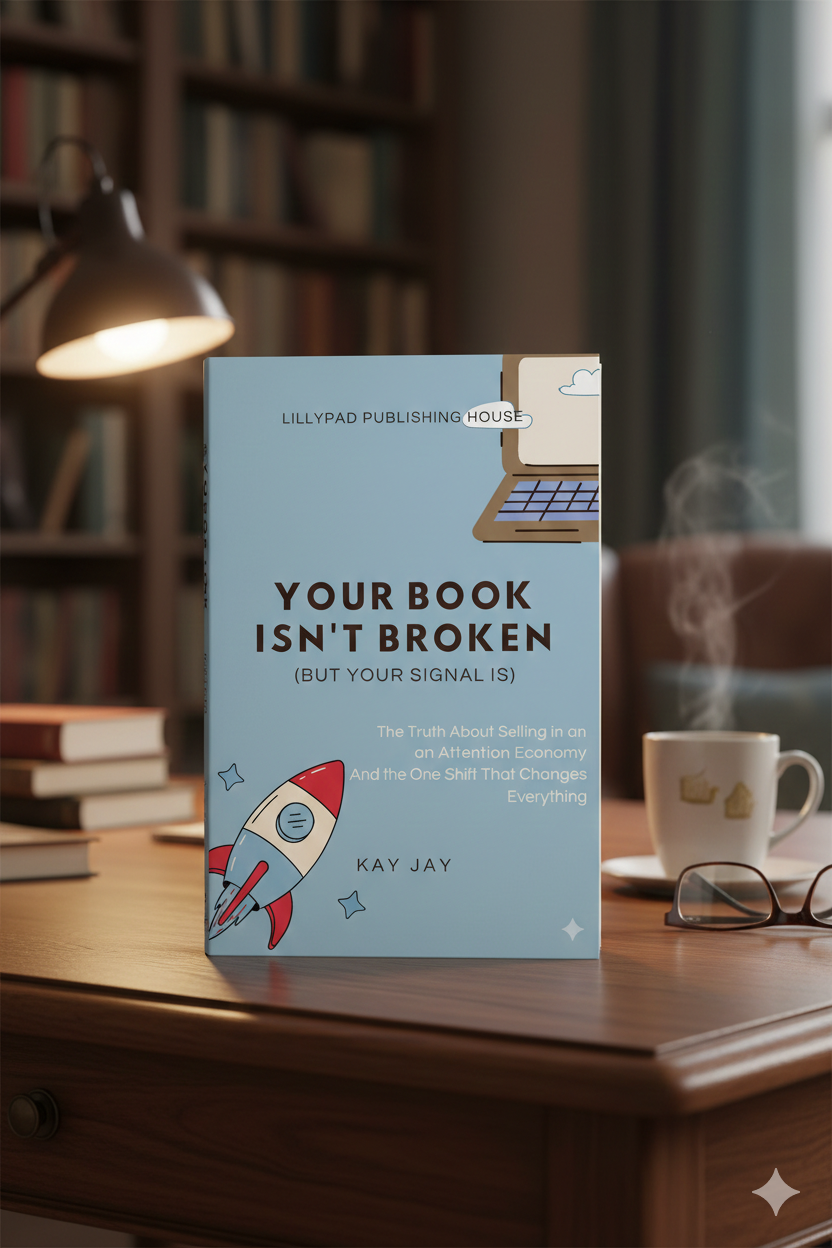
    The Intentional Author

    A book titled 'The Intentional Author' by Kay Jay, featuring a blue cover with illustrations of a rocket and a laptop, placed on top of two stacked brown hardcover books.
  • Avoiding Vague Promises in Your Book Titles

    Avoiding Vague Promises in Your Book Titles

    The single mistake that renders a book invisible.

    When an author begins their journey, the intention is always pure: to help as many people as possible. This generous, expansive goal often translates into a dangerous strategic mistake: creating a Vague Promise.

    A Vague Promise is a book signal (title, subtitle, description) that is too broad, too generic, and too inclusive. It attempts to encompass a massive audience—everyone who is interested in “success,” “happiness,” or “financial freedom.” It is the title that is nice and polite, but utterly indistinct, such as A General Guide to Personal Improvement.

    The logic seems sound: The broader the promise, the more potential readers. But in the attention economy, the opposite is true. A book that tries to help everyone ends up helping no one, because its signal is lost in the noise.

    The Failure of Generic Relevance

    Readers are no longer searching for general information; they are searching for a precise solution to a specific, painful, and often embarrassing problem. They are looking for a guide who knows their exact struggle.

    When a reader encounters a Vague Promise, their distracted, noise-filtering brain makes an immediate, unconscious deduction:

    1. Vague Signal: This is too broad. It doesn’t know my specific pain.
    2. Vague Relevance: If it’s for everyone, it’s probably not specifically for me.
    3. Vague Value: It must be diluted content that won’t give me the concentrated solution I need.

    The silent cost of the vague promise is the elimination of recognition. The book fails to interrupt the scroll with the magnetic shout of, “I know exactly how you feel.” Instead, it offers a polite whisper of, “This is a book about a good topic.”

    The key to visibility is not expansion, but compression. You must compress your massive idea into a precise, targeted, emotionally resonant signal.

    • The Vague Promise: How to Achieve Financial Success.
    • The Clear Promise: Taming Your First Real Paycheck: A Millennial’s Guide to Not Feeling Broke.

    The Clear Promise names a specific audience and a specific emotional pain point. It transforms the book from a generic product into an irresistible, personal map. The moment you are brave enough to narrow your focus—to articulate the one specific, secret problem you solve—you stop being invisible. Because in the attention economy, the sharpest signal is the one that cuts through the noise. Stop trying to help everyone, and start speaking directly to the one person who needs to be seen.

    Before You Publish Your Next Book, Read This

    A cozy desk scene featuring a lamp illuminating a book titled 'Before You Publish Your Next Book, Read This,' surrounded by stacks of books, a steaming mug, and a feather quill, with soft lighting and a rainy backdrop.
  • Unlocking Your Book’s True Potential: The Power of Origin Stories

    Unlocking Your Book’s True Potential: The Power of Origin Stories

    The gravity that meaning creates.

    Every author has a moment—a flash of anger, a surge of clarity, a quiet despair—that is the true, unedited genesis of their book. For most, that moment happens long before the first word is typed, and it is almost always rooted in a profound personal need.

    This Origin Story is the single most powerful tool you have to break the silence. When you draft a promotional post or write a book description, the irresistible signal is not what your book is, but why you wrote it.

    For me, the moment came at 2 AM, staring at the Zero Sales number on my dashboard for Diary of Cliches. It wasn’t just disappointment; it was a disorienting, isolating grief. In the silence, my mind started asking the dangerous, desperate questions: Was I not good enough? Was this entire effort a mistake?

    The world offered no answers, only marketing tricks and empty promises of instant success. I searched for a map, a guide that spoke to the human side of the struggle—the shame, the confusion, the isolation. And I couldn’t find it.

    I wrote 7 Reasons Nobody Is Buying Your Book And How to Fix It because I had to give a definitive answer to the question that haunted me: The problem was never the book itself; it was my relationship with visibility, value, and connection.

    That is the single sentence that explains the book’s fundamental meaning.

    I wrote this book because I couldn’t find the map to escape the silence, and I needed to stop the next author from feeling the same profound, isolating shame.

    This shift from a transactional Product Post to a transformational Purpose Post changes everything. When you share the specific, painful reason you wrote the book, you are no longer selling a guide; you are offering a bridge to the person who is currently living inside your past pain.Your purpose is your gravity. It is the magnetic force that attracts the right readers. Find your single sentence. Share your origin story. The moment you articulate your Why, the signal becomes clear, and your book’s meaning becomes irresistible.

    7 Reasons Nobody Is Buying Your Book

    A cozy indoor setting featuring a book titled '7 Reasons Nobody Is Buying Your Book (And How to Fix It)' by Kay Jay, placed on a wooden table with a laptop, glasses, a cup of coffee, and a notebook. Soft lighting creates a warm atmosphere.