
Category: Diary of Cliches

  • The books we read and how they shape our lives – Part 4

    The books we read and how they shape our lives – Part 4

    The reading of all good books is like a couple conversation with the finest(people) of the past centuries.
    ~ Descartes

    Robert Greene and his books “48 Laws of Power”, “Laws of Seduction”, “Mastery”, “Laws of human nature” – gave a whole new light to my cerebral world.

    Robert Greene entered my life at a pivotal moment. I was hungry for knowledge, especially knowledge about the human condition. Greene’s controversial “48 Laws of Power.”, while some might scoff at its Machiavellian undertones, offered a fascinating, if ruthless, dissection of power dynamics. It wasn’t about blind manipulation, but about understanding the intricate dance of influence and persuasion.

    Greene’s laws, presented as historical anecdotes and philosophical insights, became a thought experiment, a way to analyze the complexities of human interaction. This newfound awareness spilled over into “The Laws of Seduction.” Greene’s exploration of the art of seduction wasn’t just about romantic conquest; it was about understanding human desire and the power of influence in a broader sense. He dissected the tactics of historical figures, from Casanova to Cleopatra, offering a glimpse into the psychology of attraction and persuasion. Whether I agreed with his methods or not, Greene’s work forced me to confront my own blind spots, the ways I might be unknowingly wielding (or succumbing to) power in my daily interactions.

    But Greene wasn’t just about power plays. His book “Mastery” offered a refreshing perspective on the pursuit of excellence. It wasn’t a quick-fix self-help manual, but a historical exploration of how great minds, from Leonardo da Vinci to Benjamin Franklin, honed their craft. Greene emphasized the importance of deliberate practice, lifelong learning, and a relentless pursuit of knowledge. This resonated deeply with my desire for self-improvement and a yearning to find my own path to mastery in whatever field I chose to pursue.

    Robert Greene’s books weren’t always comfortable reading. They challenged my assumptions, forced me to question my motives, and exposed the darker sides of human nature. But within those challenges lay a wealth of knowledge, a new way of understanding myself and the world around me. His work wasn’t a rulebook for life; it was a thought-provoking conversation starter, a way to approach the human experience with a newfound sense of awareness and strategic thinking. It was a whole new light on my cerebral world, one that illuminated the complexities of power, seduction, and the relentless pursuit of mastery.

    Sylvia Plath lifted me during a dark time and brought out the writer in me.

    Sylvia Plath wasn’t just a poet; she was a kindred spirit, a voice that echoed the turmoil and raw emotions churning within me. I stumbled upon her work during a particularly dark time, a period where the world felt muted and devoid of color. But as I delved into her poems, a spark ignited within me.

    Plath’s words weren’t sugar-coated comfort. They were brutally honest, laced with anger, despair, and a flicker of defiant hope that resonated deeply. Poems like “Daddy” and “Mad Girl’s Love Song” mirrored the tempestuous emotions I was grappling with – grief, rage, and a yearning to be heard. Yet, amidst the darkness, there was a searing beauty, a mastery of language that painted vivid pictures of the human experience in all its complexity.

    Reading Plath wasn’t just cathartic; it was inspiring. Her ability to transform raw emotions into powerful poetry awakened a writer within me that I never knew existed. The way she wielded words, the imagery she conjured, ignited a fire in my own soul. Suddenly, the jumbled mess of emotions swirling inside me didn’t feel like a burden; it felt like potential, raw material waiting to be shaped into something meaningful.

    Plath’s influence wasn’t about blind imitation. It was about finding my own voice, a voice that could express the complexities of being human, the darkness alongside the light. It was about channeling my experiences, both joyful and painful, into words that could resonate with others. She became a guiding light, a testament to the power of vulnerability and the transformative potential of art.

    So, yes, Sylvia Plath lifted me during a dark time. But more importantly, she showed me a way to turn that darkness into something beautiful, something that could connect me to the world around me in a profound and lasting way.

    But it was Women Who Run with the Wolves and the works of Dr. Estes who picked me up while at rock bottom.

    Despite the fascinating insights gleaned from Robert Greene, there was a hollowness that his books couldn’t quite fill. They were brilliant, yes, but they felt detached from the raw, emotional core I was still grappling with. Then, like a beacon in the darkest night, I rediscovered Clarissa Pinkola Estés and her transformative work, “Women Who Run with the Wolves.” This book wasn’t just another self-help manual; it was a lifeline thrown to me at rock bottom.

    Estés’ words resonated deep within my soul, weaving together myths, fairytales, and case studies to paint a powerful picture of the Wild Woman archetype within us all. This Wild Woman, the one who craved freedom, creativity, and a connection to instinct, had been buried beneath layers of societal expectations and past hurts. But Estés’ message was clear: the Wild Woman wasn’t something to be feared or suppressed; she was a vital part of my being, a source of strength and resilience waiting to be reawakened.As I devoured the book, a long-dormant fire ignited within me. Estés’ stories mirrored my own struggles – the yearning to break free from constraints, the desire to embrace my true, unfiltered self.

    With each chapter, I felt a piece of the Wild Woman rise from the ashes, a flicker of defiance replacing the crippling self-doubt. This wasn’t just intellectual understanding; it was a visceral experience, a reconnection with the powerful, instinctual force that resided within me.Estés’ work wasn’t a quick fix, but a map – a map to reclaiming my wild nature, my creativity, and my voice. It was a reminder that even in the depths of despair, the Wild Woman waits, ready to guide us back to wholeness.

    Women Who Run with the Wolves” wasn’t just a book; it was a turning point, a catalyst for healing and self-discovery. It picked me up when I was at rock bottom and showed me the path towards becoming the woman I was always meant to be.

    Empowered by “Women Who Run with the Wolves,” I dove headfirst into Clarissa Pinkola Estés’ other works, each one deepening my connection with my Wild Woman. In “The Gift of Story,” Estés explored the profound wisdom embedded in traditional tales, urging to listen not just to the plot, but to the whispers beneath the surface. These stories, passed down through generations, held the key to unlocking my own inner wisdom, the stories that only my soul could truly tell.

    Untie the Strong Woman” was a revelation. Estés painted a powerful portrait of the Blessed Mother archetype, a fierce protector and nurturer who resides within us all. This wasn’t about weakness or dependence; it was about the strength it takes to nurture ourself and others, to cultivate compassion alongside courage. Reading this book felt like a homecoming, a recognition of the nurturing spirit that had always been a part of me, but perhaps overshadowed by the Wild Woman’s roar.”The Faithful Gardener” offered a soothing balm during moments of doubt. Estés’ exploration of the cyclical nature of life, with its inevitable periods of growth and decay, provided solace. It was a reminder that hardship wasn’t a sign of failure; it was fertile ground for renewal. Like a faithful gardener tending to a beloved plot, I learned to cultivate resilience, to nurture my inner garden even in the harshest seasons.

    With each book, Estés’ message resonated even deeper. The Wild Woman, the Blessed Mother, the Faithful Gardener – these weren’t separate entities; they were facets of the same powerful feminine force within me. I was learning to embrace all aspects of myself – the fierce independence, the nurturing compassion, and the unwavering faith in my own ability to grow and blossom.

    Clarissa Pinkola Estés’ work became more than just a literary exploration; it became a lifelong companion on my journey of self-discovery. My words, woven with wisdom and empathy, offered a guiding light as I navigated the complexities of being a woman, a wild soul carving my own path in the world. And as I continued to explore the complex web of my inner landscape, I knew, with unwavering certainty, that the Wild Woman, forever awakened, would always be by my side.As my connection with my Wild Woman deepened through Estés’ teachings, the world around me began to shift. The spark of creativity she ignited fanned into a flame. I found myself drawn to artistic expression, perhaps dusting off an old paintbrush, enrolling in a writing class, or letting music flow freely through my fingers. This wasn’t just about creating something beautiful; it was about giving voice to the Wild Woman within, expressing the raw emotions and vibrant experiences that had shaped me.

    The newfound confidence I gained wasn’t about arrogance or dominance. It stemmed from a deep sense of self-acceptance. I embraced my quirks, my flaws, and my unique perspective. The need for external validation began to fade, replaced by a quiet inner knowing, a trust in my own voice and intuition.

    This newfound self-assuredness spilled over into my relationships. Boundaries, once blurry, became clear. I no longer tolerated disrespect or inauthentic connections. The Wild Woman within me craved genuine connections, built on mutual respect and shared passions. I started attracting people who valued my strength and authenticity, creating a support system that nurtured my growth.

    The journey wasn’t always smooth sailing. There were days when doubt crept in, the whispers of insecurity trying to regain control. But I was equipped now. Estés’ words became a mental shield, reminding me of the Wild Woman’s strength and resilience. I learned to navigate these challenges with grace, using them as opportunities for further growth.

    As I ventured further on this path of self-discovery, I realized the impact it had on others. The Wild Woman’s spirit, once dormant within me, was now a beacon for others. I became a source of inspiration, a testament to the transformative power of embracing one’s true self. I mentored the younger women in my family, shared my experiences through writing and art, and simply led by example, radiating authenticity and inner strength.

    The journey with Clarissa Pinkola Estés wasn’t a destination; it was a continuous exploration. But with each step, I felt a deeper connection to myself, to the Wild Woman who roared within. I was no longer lost at sea, adrift in a current of self-doubt. I was the captain of my own ship, charting my course with newfound confidence, guided by the unwavering light of my Wild Woman’s spirit.

    As my exploration of my Wild Woman deepened with each of Estés’ works, I discovered new dimensions to this powerful archetype. “The Creative Fire” ignited a passion for innovation and exploration. Estés delved into the cyclical nature of creativity, exploring periods of dormancy followed by bursts of inspiration. Learning to identify these cycles allowed me to nurture my creative spark, even when faced with creative blocks. It was a reminder that the Wild Woman craved not just self-expression, but the constant push to break boundaries and explore new frontiers.

    Seeing in the Dark” offered a different kind of strength – the courage to face the shadows within. Estés explored the power of dreams and intuition, guiding me to navigate the murky waters of the subconscious. This wasn’t about dwelling on darkness; it was about using it as a source of self-knowledge. By acknowledging my fears and vulnerabilities, I learned to integrate them into my wholeness, emerging with a newfound sense of inner peace.

    The Power of the Crone” challenged societal perceptions of aging. Estés painted a powerful portrait of the Crone archetype – the wise woman, the keeper of stories, the one who embraces the natural cycle of life. Reading this book felt like a liberation, a rejection of the pressure to cling to youth. Instead, I embraced the wisdom and strength that came with experience, the Crone within becoming a source of guidance and inner power.

    Estés’ lesser-known works, like “How to Be an Elder” and “The Radiant Coat,” offered further pearls of wisdom. “How to Be an Elder” explored the responsibility that comes with experience, the importance of mentoring younger generations and sharing my hard-won knowledge. “The Radiant Coat” delved into the concept of crossing thresholds, the courage it takes to step into new phases of life, leaving behind the familiar and embracing the unknown.

    With each book, Estés’ message resonated even deeper. The Wild Woman, the Blessed Mother, the Faithful Gardener, the Crone – these weren’t separate entities; they were a harmonious orchestra playing the symphony of my being. I learned to tap into each archetype as needed, a master conductor of my own inner world.

    Clarissa Pinkola Estés’ work became my compass, a guiding light on my journey of self-discovery. Her words, woven with wisdom and empathy, offered a constant source of support as I navigated the complexities of life. And as I continued to explore the ever-evolving landscape within, I knew, with unwavering certainty, that the Wild Woman, forever awakened, would always be my fierce companion, leading me towards a life of authenticity, purpose, and ever-blooming growth.

    Then “The One” found me. My love affair with Richard Bach’s books continues.Just when I thought my literary odyssey had reached its peak, fate, or perhaps the synchronicity of the universe, intervened.

    On my visit home to my parents and family after a long period of isolation during the Covid lockdown, nestled amongst a stack of well-loved paperbacks in my parent’s house in my childhood room, was a title that sent a thrill through me: “The One” by Richard Bach. It felt like a homecoming, a reunion with a familiar voice after a transformative journey. After delving into Estés’ profound exploration of the feminine, I craved the soaring themes of purpose and connection that Bach had first ignited within me.

    Cracking open the book, I was swept away by a story that transcended the boundaries of the physical world. The concept of a single, perfect soulmate resonated on a deep level, a yearning that mirrored my own search for connection. Bach’s lyrical prose and philosophical musings sparked a renewed sense of optimism within me. Perhaps, after all the introspection and self-discovery, I was finally ready to find “The One,” not just romantically, but in all aspects of my life – a soul connection, a teacher, a friend who resonated with the truest version of myself.

    The book wasn’t just a fluffy fantasy; it was a call to action. Bach’s message about following your intuition, about recognizing signs and synchronicities, resonated deeply. He urged readers to shed societal expectations and embrace the extraordinary possibilities that awaited those who dared to believe. As I turned the final page, a newfound sense of purpose bloomed within me. My journey wasn’t over; it was just beginning. The one, in whatever form it took – a romantic partner, a creative project, a life-changing experience – was out there, waiting to be discovered.

    With a heart brimming with anticipation and a spirit ignited by Bach’s words, I embarked on a new chapter. This time, I wasn’t just reading about love and connection; I was actively seeking it, eyes wide open to the possibilities that the universe held. And who knows, maybe somewhere along the way, I’d encounter not just “The One,” but countless “Ones” – soul connections, experiences, and opportunities that would continue to shape me into the person I was meant to be.Books haven’t just been entertainment; they’ve been mirrors reflecting my emotions, guides leading me towards growth, and comforters during difficult times.

    This is just a glimpse into my literary adventures. As I continue on my path, I know there are countless more books waiting to be discovered, waiting to shape the next chapter of my story.

    What about you? Share your own stories of how books have impacted your life in the comments below!


  • The books we read and how they shape our lives – Part 3

    The books we read and how they shape our lives – Part 3

    Books that Shape us!

    Ann Patchet gave me dreams while I was trying to sleep!

    Now, sleep wasn’t always my companion during this literary odyssey. Some books, like the one I was about to delve into, were so captivating they kept me up way past my bedtime. Ann Patchet’s “Bel Canto” wasn’t a lullaby; it was a whirlwind. The story, a fictionalized account of a hostage crisis, unfolded with a captivating blend of suspense and surprising tenderness.

    Here I was, bleary-eyed but utterly enthralled, as a group of hostages and their captors formed unexpected bonds amidst the chaos.”Bel Canto” wasn’t just a thrilling story; it was a meditation on the power of human connection. Patchet’s characters, from the high-powered businessmen to the young guerilla fighters, transcended their initial roles and revealed surprising depths of humanity.

    The book forced me to confront my own prejudices, reminding me that empathy can bloom in the most unexpected places. As I devoured chapter after chapter, sleep became a distant memory. “Bel Canto” wasn’t just keeping me awake; it was sparking my imagination, filling my dreams with operatic arias and whispered conversations across language barriers. It was a testament to Patchet’s masterful storytelling that a story about confinement could feel so expansive, so full of possibility. Finally, bleary-eyed but exhilarated, I finished the book. The world outside my window seemed a little brighter, a little richer, thanks to the dreams “Bel Canto” had woven.

    Of course, there was the Twilight Series that kept me engaged when my mind was numb. And then there were Uglies and beauties to keep my inner child occupied. And a whole lot of faeries and vampires that year that kept my mind occupied.

    Admit it, there were times when my brain just needed a break. That’s when the sparkly vampires and dystopian romances waltzed in. Stephenie Meyer’s “Twilight” series wasn’t exactly highbrow literature, but it was undeniably captivating. The forbidden love story between Bella and Edward, human and vampire, scratched a melodramatic itch I didn’t even know I had. Let’s be honest, sometimes you just need a good, angsty escape into a world of supernatural swooning.And then there was Scott Westerfeld’s “Uglies” series.

    This dystopian YA saga, where beauty was currency and conformity was king, tapped into my rebellious teenage spirit. Following Tally Youngblood’s journey from wanting to fit in to embracing her “ugly” side was a thrilling reminder to celebrate individuality, even (or maybe especially) when it’s deemed undesirable.That year became a whirlwind of fantastical creatures and forbidden love.

    From the sparkling vampires of “Twilight” to the shapeshifting werewolves and brooding faeries in other series, my imagination ran wild. These stories, while not always the deepest, provided a welcome escape from the heavier themes I’d been grappling with. They were pure, unadulterated fun, a reminder that sometimes the best way to recharge your mind is to lose yourself in a world entirely different from your own. And who knows, maybe amidst the glitter and fangs, there were hidden messages about self-acceptance and defying expectations.

    But hey, even if not, they were a heck of a good time.

    The power of the Subconscious mind gave me a direction when I was lost in the sea of soul suffering.

    Ah yes, that period. Lost in a sea of soul suffering. It felt like I was adrift, tossed by the waves of grief, confusion, and a yearning for something more. Then, a book called “The Power of the Subconscious Mind” appeared, a beacon in the storm. With a healthy dose of skepticism, I cracked it open.The book delved into the power of our subconscious, that vast inner ocean beneath the surface of our conscious thoughts. The idea that we could tap into this wellspring of potential, to use its power to heal and guide us, was intriguing. Maybe, just maybe, there was a way to harness this unseen force and navigate my way out of the darkness.

    The book wasn’t a magic bullet, but it offered a framework, a set of tools to explore my inner world. It spoke of the power of positive thoughts and affirmations, of visualization and the incredible potential of the human mind. As I read, a flicker of hope ignited within me. Perhaps I wasn’t just a passive victim of circumstance. Perhaps I had the power to influence my own reality, to use my subconscious mind as a compass to steer me towards a brighter future.

    The journey wasn’t easy. There were days when doubt and negativity threatened to pull me under again. But with each step, with each positive affirmation, I felt a shift. The sea of soul suffering didn’t vanish entirely, but it no longer felt like the only current. The power of the subconscious mind, once a theoretical concept, became a tangible force guiding me towards calmer waters. It wasn’t a quick fix, but it was a start, a newfound belief in my own ability to heal and grow.

    Eckhart Tolle and the Power of Now snapped me out of my Soul Inertia and gave wind to my dreams.Stuck in the soul-sucking quicksand of inertia, I desperately needed a lifeline. Enter Eckhart Tolle’s “The Power of Now.” This book wasn’t just another self-help tome; it was a jolt to the system, a wake-up call that shattered the trance of negativity. Tolle’s message of present-moment awareness resonated deeply. He urged me to stop dwelling on the past or worrying about the future, and instead, to focus on the only thing that truly matters: the now.

    It felt radical, almost counter-intuitive. Here I was, drowning in a sea of “what ifs” and “should haves,” and Tolle was telling me to focus on the breath, on the sensations in my body, on the present moment. Slowly, though, a shift began to occur. As I practiced mindfulness, the grip of negativity loosened. The constant mental chatter quieted, and a sense of calm settled over me.”The Power of Now” didn’t erase my past or my worries about the future. But it gave me a tool to deal with them – the power of present-moment awareness. With each mindful breath, I felt a renewed sense of possibility. Those dreams I’d pushed aside, suffocated by anxieties, began to resurface. They weren’t nebulous wisps anymore; they were starting to take shape, fueled by the newfound clarity and focus Tolle’s teachings had instilled in me.”The Power of Now” didn’t just snap me out of soul inertia; it gave wind to my dreams. It was a reminder that even in the midst of challenges, there is always the power of the present moment, and within it, the potential to create a future filled with possibility.

    Then I found “Hippie” quite randomly as I ventured on another adventurous wild ride!

    My love affair with literature wouldn’t be complete without a sprinkle of his magic. Coelho offered a different kind of enchantment. His books, like “Hippie,” were like stepping into a vibrant kaleidoscope of experiences.”Hippie” wasn’t your typical coming-of-age story. It was a wild ride through 1970s counterculture, a time of rebellion, self-discovery, and a yearning for something more. The protagonist’s journey mirrored my own in a way – a yearning to break free from societal constraints and explore different ways of being.

    Coelho’s vivid descriptions and relatable characters painted a picture of a generation searching for meaning and connection, a sentiment that resonated deeply within me.

    But Coelho wasn’t just about reliving a bygone era. His stories, like “The Alchemist,” offered timeless messages about following your dreams and listening to your heart. His characters, flawed and relatable, embarked on journeys of self-discovery that served as potent reminders to stay true to yourself, even when the path gets challenging. His books weren’t always profound, but they were always engaging, weaving tales of adventure, love, and personal growth with a touch of magical realism that left a lingering aftertaste.

    Coelho’s works were like pit stops on my literary journey, offering a refreshing change of pace and a burst of vibrant energy. They reminded me that self-discovery wasn’t always about deep introspection; sometimes it was about getting lost in a captivating story, letting your imagination run wild, and allowing the characters’ journeys to spark new reflections within yourself. Coelho offered the unexpected detours, the moments of pure joy and wonder that made the entire odyssey even richer.

    Zen and the Art of Motorcycle Maintenance was a splendid reading experience!Looking back, “Zen and the Art of Motorcycle Maintenance” feels like a turning point in my literary journey. It wasn’t just a story; it was a conversation starter, a philosophical spark plug that ignited a whole new way of thinking.

    Pirsig’s exploration of quality – that elusive, ineffable essence that makes something truly good – resonated deeply within me. Here I was, grappling with questions about meaning, purpose, and the very nature of existence, and Pirsig offered a framework, a way to approach these complexities. His blend of philosophical musings and motorcycle anecdotes might seem unconventional, but it worked. As I followed his introspective journey across the American landscape, I found myself reflecting on my own internal road trip.The book wasn’t about providing easy answers; it was about asking the right questions.

    Pirsig’s exploration of the “fuzzies” – those intangible aspects of life that bring meaning – challenged me to identify my own “fuzzies,” the things that truly mattered to me. Was it the thrill of a new adventure, the satisfaction of a job well done, the deep connection with loved ones? Reading the book became an exercise in self-discovery, a way to peel back the layers and uncover the core values that guided my life.

    Zen and the Art of Motorcycle Maintenance” was much more than just a good read; it was a catalyst for change. It opened my eyes to new ways of thinking, challenged me to define my own “quality,” and set me on a path of continuous exploration, both literary and personal.

    Zen and the Art of Motorcycle Maintenance” wasn’t without its challenges. Pirsig’s writing style could be dense at times, and his philosophical arguments weren’t always easy to grasp. But the effort was worth it. The book pushed me outside my comfort zone, forcing me to confront my own assumptions and beliefs. It was a reminder that the journey of self-discovery is never a smooth ride, but the destination – a deeper understanding of myself and the world around me – was an incredibly rewarding one.

    Of course, countless sleepless nights were spent lost in the magical world of Harry Potter, no matter what spirit or physical age I was at the time! Hogwarts became a periodic refuge, a place where friendship, bravery, and a good dose of magic conquered all. But as I evolved, the fantastical elements of Harry Potter began to give way to something a little more…absurd.

    Enter “The Hitchhiker’s Guide to the Galaxy” by Douglas Adams. This quirky, hilarious sci-fi adventure became my new go-to for late-night reading. Its witty observations on life, the universe, and everything offered a fresh perspective, reminding me to never take things too seriously.

    As my taste in literature evolved, so did the themes that resonated with me. While fantasy and humor remained constants, I found myself drawn to works that tackled more complex issues. Margaret Atwood’s “The Handmaid’s Tale” offered a chilling glimpse into a dystopian future, sparking conversations about feminism and social control.On the other hand, Khaled Hosseini’s “A Thousand Splendid Suns” painted a heartbreaking yet hopeful portrait of resilience in the face of war and oppression.These deeper dives into human nature and societal issues balanced out the lighter reads. But there was still room for pure escapism!

    Pride and Prejudice” by Jane Austen transported me to a world of witty banter and blossoming love, while Neil Gaiman’s “American Gods” served up a fantastical blend of mythology and modern life.

    The older I got, the more I gravitated towards non-fiction. “Born a Crime” by Trevor Noah provided a hilarious and poignant look at growing up in a multi-racial South Africa. “Sapiens: A Brief History of Humankind” by Yuval Noah Harari offered a mind-blowing exploration of our species’ journey. These books challenged my perspectives and broadened my understanding of the world.

    Looking back, it’s clear that books haven’t just been a source of entertainment; they’ve been a conversation with myself, evolving as I have. They’ve provided comfort, challenged my thinking, and opened doors to new worlds, both real and imagined. The best part? This journey is far from over. There are countless more stories waiting to be discovered, waiting to leave their mark on my ever-evolving soul.

    (To be continued…)

  • You can heal your Depression

    You can heal your Depression

    We can heal our depression

    We are in a second pandemic as an after-effect of the first one – Depression.

    There is no substitute for therapy and a steady inner dialogue with yourself.

    Here are some other ways that can help you get out of the hopelessness, jump out of your funk and get on with life. Most of these have worked for me.

    To start with…. keep your posture erect… and your head held high. Depression is not something to be ashamed of.

    Shame is neither created nor destroyed. It’s passed on from one to another.

    Shame on those who perpetuated this shame…

    1. Milk and Bananas

    I have a special connection to milk and bananas that correlates to my grandmother. But holistically speaking, bananas have the right amount of sugar and potassium to help regulate mood. Milk has calcium that helps strengthen bones, keep the spine erect and regulate energy flow throughout the body.

    2. Fragrances

    Fragrances reach sensory areas quickly and in magical ways. They bring out happy memories and quickly uplift the spirit.

    3. Flowers

    Flowers show beauty in simple and tender ways. A smile from your little bud in the morning can uplift your spirit instantly.

    4. Animals

    I sometimes go into a trance just watching my pup be. She has an aura about herself that spreads divine energy around her. Animals truly live for themselves and spread joy in its purest form just by being true to their nature.

    5. Yoga

    Yoga is often times misunderstood and treated like ‘exercise’.

    Yoga is a way to connect your mind to your body and make her talk. It’s surrendering to mother earth and releasing your energies in her. Letting her hold you and flow through you. Yoga does not just uplift the spirit, it awakens the soul.

    6. Meditation

    This one is tricky especially when depressed. To sit with your own rotten thoughts and make an attempt to quiet them, is the last thing you want to do.

    Affirmations and deep breathing help in such cases. They give you a jumpstart that is needed to jolt the mind out of the loops that it’s running in.

    “My mind is in my body. My heart is in my reality.”

    This affirmation quickly helps connect with the Now.

    Saying Om loudly and making it vibrate internally (mmmmmmmmm) will raise your vibrations and help get you moving.

    7. Foods

    Try foods that you loved as a child. Specific things that made you happy, mom/grandmom made a certain way, had a specific smell, texture, etc. Food is the quickest way to awaken your inner child and experience joy.

    8. Books

    When you are depressed, the last thing you want to do is read something that will invoke thoughts….make you do things that maybe you are not quite ready for.

    Here are some books that might feed the soul.

    ⁃ Mastery of Life by Ralph Waldo Emerson – This book has five essays that capture the profoundness of life. While his essay on Compensation is the most talked about to resolve money matters, I found his essay on Self-Reliance and Fate especially insightful.

    ⁃ Women who run with the wolves by Clarissa Pinkola Estes – If life or your existence does not make sense to you, or maybe you feel like an outsider in your own community do read this one.

    ⁃ Joyous body by Clarissa Pinkola Estes – This book helps understand the deep-rooted being called Body and how important her role is not just for us but also as a conscious being with its own intelligence that serves the entire planet. It refers to the body as your consort, your companion in the magical experience of Life.

    ⁃ The Kama Sutra of Vatsyayana by Sir Richard Francis Burton – This book talks about the science of sexuality through various feminine and masculine archetypes. It correlates sexuality to talents, hobbies, vocation, etc and helps understand the role of sex in your holistic being. A lot of emotional pain perpetuates into our Sacral Chakra which is the hub of our individuality (femininity/masculinity). We sometimes hold energy blocks in our Sacral Chakra that not just block us away from our inner experience but also block us from experiencing the World in its entirety.

    9. Last and not the least, having suicidal thoughts while depressed is very very common. Do not panic. Confide your thoughts in your trusted person beforehand and have their number on speed dial. If you don’t have a trusted person or a therapist, please have one.

    Let’s not die from depression. It can be cured.

    Let’s treat depression with the love it deserves. In my experience, depression is a blessing from Divine Timing…. a call for Transformation.

    ❤️

    #letsheal

    #everydayismentalhealthday

  • Behind The Pages: How My Personal Journey Inspired ‘Diary of Cliches’

    Behind The Pages: How My Personal Journey Inspired ‘Diary of Cliches’

    When I set out on the journey of writing ‘Diary of Cliches’, it began as more than just an attempt at creating another book. For me, this labor of love was an exploration of the self — a cathartic experience that unfolded into an interactive journey for all who turned its pages.

    As we venture through each chapter, readers are met with snippets of my own transformation. At the core of this introspective memoir is my personal battle with relationships, emotions, and growth. They are not merely stories but lessons woven intricately into every word, making it not just my narrative but a saga that many may find comfortingly relatable.

    “Dairy of Cliches” uniquely pivots around universal themes like self-discovery, personal evolution, navigating complex webs of relationships, coping with raw emotions such as anger, guilt, and most importantly, setting and refining life’s goals.

    Each theme emerges from my chronicles sharply mirroring my own trials and triumphs. As I paint vivid portraits of my emotional battles, I infuse each passage with prompts, nudging readers towards self-reflection and presenting opportunities to dissect their feelings and aspirations just as I did, the Diary being my confidant, my companion, my partner in crime.

    The brilliance of “Diary of Cliches” lies in its ability to inspire readers to embark on parallel journeys of self-discovery guided by my personal experiences while injecting their own path with their uniquely personalized discoveries. Its essence influxes elements such as identifying strengths and weaknesses and motivating person-specific goal setting.

    In the realm of relationships, whether they are familial connections or romantic involvements, the Diary’s words serve as lucid guidance bolstered by my touching anecdotes. The Diary gently motivates the reader turned co-author to navigate these tricky terrains with newfound understanding and resilience.

    Emotions – the most profound yet elusive aspect of our existence – find ample breathing space within “Diary of Cliches”. My explorations of my own anger and guilt pave the way for readers to confront and comprehend their own emotional patterns more effectively.

    In today’s fast-paced world, where each of us is incessantly running a thousand miles, “Diary of Cliches” acts as a comforting pit-stop. It creates an inviting oasis of self-reflection, pushing pause on the rampant race outside to focus on the enriching journey within.

    Whether you are at the precipice of self-discovery or have been steering through, “Diary of Cliches”

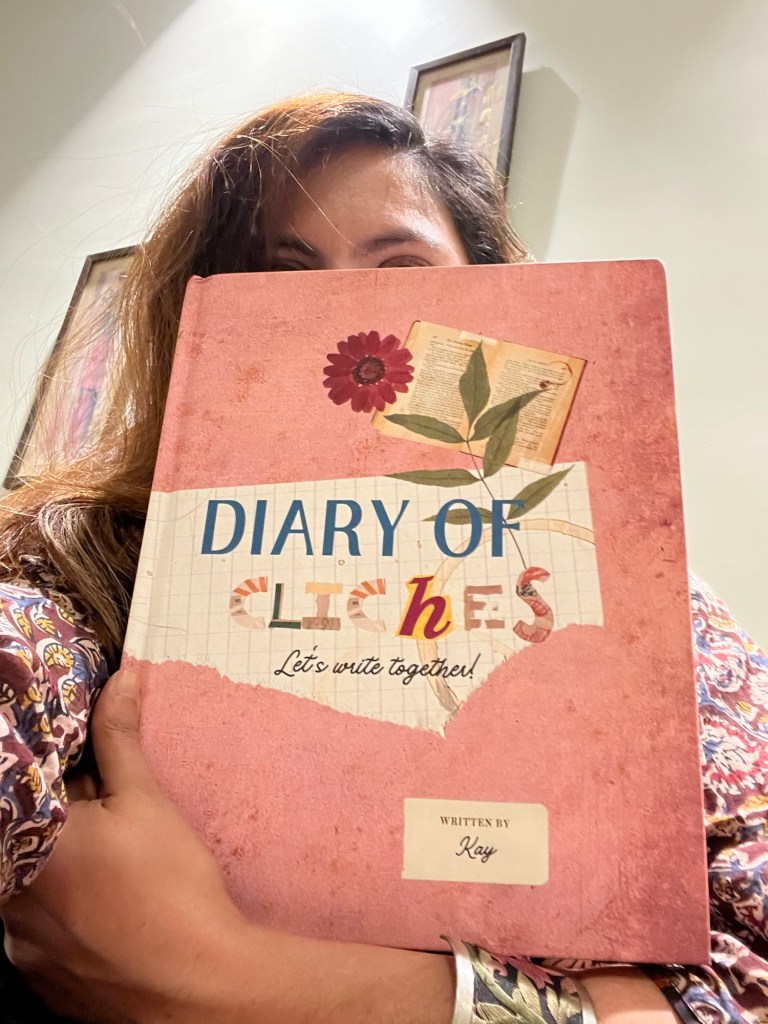
    Diary of Cliches now available on Amazon!

    Diary of Cliches: Let’s write together!

    Diary of Cliches: Let’s Write Together!

    Follow us on Instagram: Diary of Cliches

  • Diary of Cliches

    Diary of Cliches

    I had just landed the previous night. My boxes were all around the floor in my parents house. Everyone had finally gone to sleep after spending 2 sleepless nights tracking my flight and awaiting my arrival the third night. But sleep was nowhere in sight as far as I was concerned. 2023 had been a tumultuous year. And come October I had landed in my hometown Mumbai, with a life of the past eleven years packed in two suitcases that lay in an already cramped room which was going to be home for the next foreseeable future.

    As I sat amidst the chaos of unpacked boxes and familiar yet unfamiliar surroundings, a wave of emotions washed over me. The journey that led me back to Mumbai had been fraught with uncertainty and upheaval, yet here I was, back where it all began.

    Memories of the past eleven years flooded my mind, each one a chapter in the story of my life. From the bustling streets of the city to the quiet moments of reflection, Mumbai had been my constant companion through it all. And now, as I returned to its embrace, I couldn’t help but feel a sense of nostalgia mixed with apprehension.

    The room felt smaller than I remembered, the walls closing in on me as if to remind me of the weight of the decisions that had led me here. But amidst the chaos and uncertainty, there was also a glimmer of hope – a sense of possibility that whispered of new beginnings and fresh opportunities.

    As I unpacked my belongings and made this room my own, I knew that the road ahead would not be easy. There would be challenges to overcome and obstacles to face, but I was determined to embrace whatever the future held with courage and resilience.

    With each passing moment, the weight of the past began to lift, replaced by a renewed sense of purpose and determination. Mumbai may have changed in the years since I left, but one thing remained constant – its ability to inspire and challenge me in equal measure.

    And so, as the night stretched on and sleep continued to elude me, I found solace in the knowledge that I was exactly where I needed to be – back home in Mumbai, ready to embark on the next chapter of my life.

    At this time I picked up a diary. It felt worn with the pages of my past and looked at me as if wanting me to pick it up! It was trying to tell me something. Curiosity piqued, I reached out and gently lifted the diary from its resting place. As I ran my fingers over its weathered cover, I couldn’t help but wonder what secrets lay hidden within its pages. It was as if the diary held a silent invitation, urging me to unravel the mysteries of my past and explore the depths of my soul.

    With trembling hands, I opened the diary and was immediately greeted by the familiar scent of aged paper. Each page seemed to whisper a story of its own, a testament to the moments and memories that had shaped my life. As I turned the pages, I was transported back in time, reliving moments of joy, sorrow, and everything in between.

    There, amidst the ink-stained pages, I found fragments of myself – hopes, dreams, fears, and aspirations captured in delicate strokes of pen. It was as if the diary had been waiting patiently for my return, eager to reconnect me with the essence of who I once was and who I had yet to become.

    At that moment, I realized that the diary was more than just a collection of memories – it was a mirror reflecting the depths of my soul. It was a reminder of the journey I had undertaken, the lessons I had learned, and the person I had become along the way.

    With newfound clarity, I made a silent vow to honor the diary’s silent invitation – to embrace the past, live fully in the present, and embrace the future with open arms. In the pages of that worn diary, I found not only a connection to my past but also a roadmap for the journey ahead.

    As I embarked on this new journey with the old diary in hand, I felt a sense of liberation wash over me. It was as if the weight of the past had been lifted, and I was free to chart my course toward a brighter future. With each page I turned, I discovered new insights, unearthed forgotten dreams, and embraced the wisdom gleaned from years gone by.

    (more…)