In the world of high-achievers, we are taught that patience is a moral virtue and that composure is rewarded. We tell ourselves that “good things come to those who wait,” internalizing a “quiet meritocracy” where we expect our excellence to eventually be “interpreted correctly” by an authority or a system.
But here is the provocative truth: Resentment is the receipt for the time you spent waiting for someone else to validate your worth.
When you outsource your agency to the clock, you aren’t practicing “emotional intelligence”—you are practicing passive resignation. While you stay quiet to keep the peace and play the role of the “strong one,” you are privately paying for that “forced pleasantness” with a slow erosion of your self.
The cost of this script is a life that feels “coherent—and still constrained,” where you are “repeating fluently” the habit of endurance instead of choosing freely to assert your value. True evolution begins when you realize that “good” things come faster and more accurately to those who define what “good” looks like before they ever begin waiting.
Stop waiting for the universe to reward your silence. Authorship begins when you stop calling your resentment “patience” and start calling it data
What happens when the “Monkey Mafia” hijacks your dessert table—and your entire 20-year life plan hits a Mumbai-sized pothole?
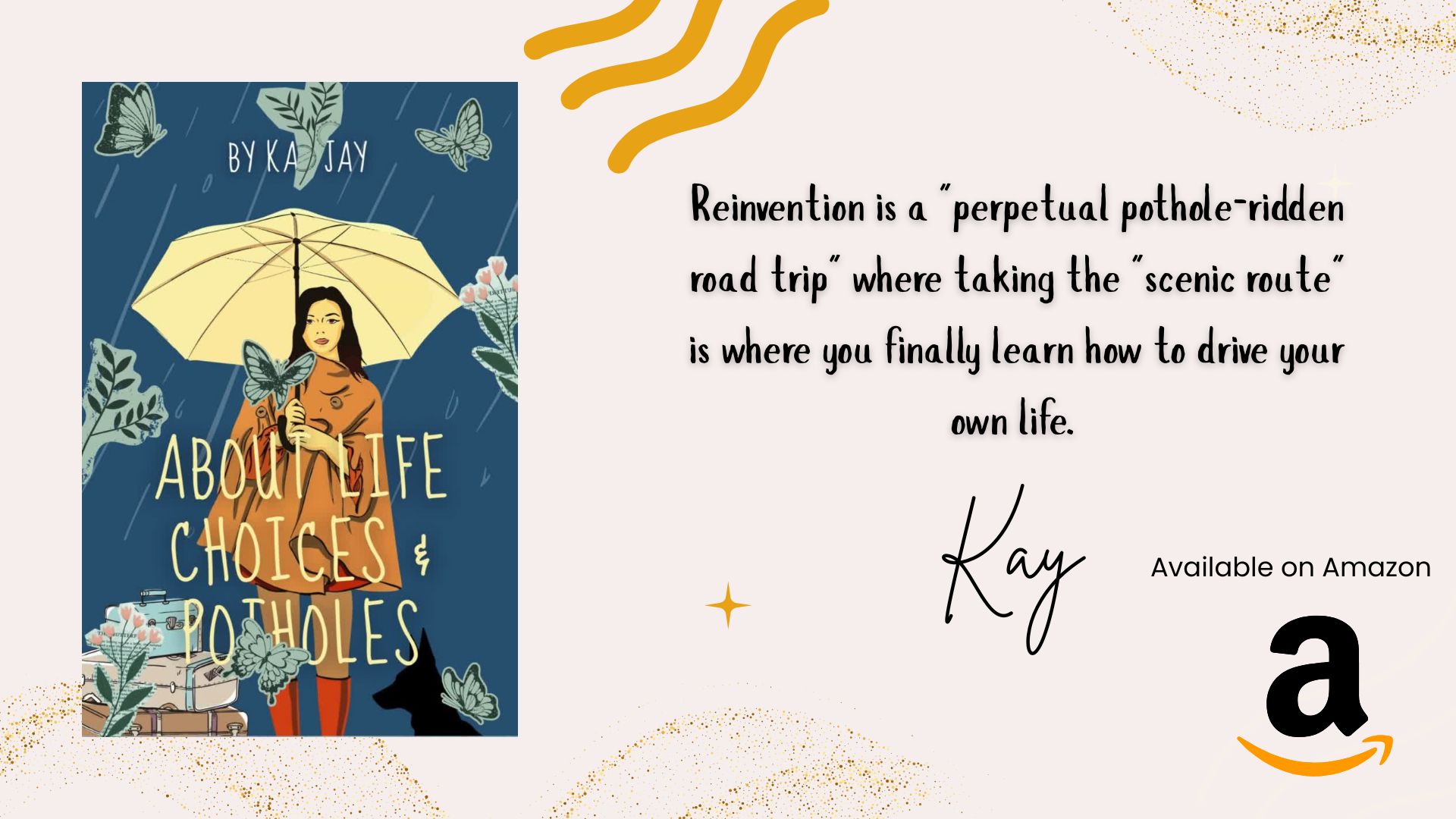
In this raw, satirical, and deeply provocative narrative, Kay Jay dives into the unfiltered truth of hitting a crater so deep it swallows your entire identity. From the high-stakes tech world of San Francisco to a rain-drenched Mumbai wedding invaded by cake-thieving primates, she explores the messy middle of reinvention after a sudden layoff reduces a two-decade career to a terrifying 60-day visa countdown.
Through generational clashes over “digital nonsense” and the soulful anchor of a rescue dog named Sauli, Kay Jay shares the hard-won wisdom that life’s detours are often the real story. This is more than a memoir; it is an invitation to the slow, patient work of belonging to yourself—a state found only after external labels like job titles and visas are stripped away.
If your corporate “badge of honor” was revoked tomorrow, who is the person left standing in the rubble?
For two decades, your identity was a fortress built on corporate efficiency, a high-stakes software career, and the heavy “badge of honor” of a government-issued visa stamp. Then, a single corporate email unplugs the console, reducing twenty years of building to a terrifying 60-day countdown.
In Who Would You Be Without Labels?, Kay Jay strips away the “shimmering mirage of belonging” to expose the raw, unfiltered truth of a total identity collapse. From the “digital abyss” of professional rejection to the “reverse culture shock” of returning to a home that no longer feels like yours, she navigates the messy middle of reinvention with sharp, satirical wit. This narrative challenges the societal scripts we are handed—the ones where success is measured by job titles and “real” work is only what can be touched, like bridges or dams.
Through the lens of life’s deepest “potholes,” Kay Jay shares the hard-won wisdom that these detours are not failures of intelligence, but profound invitations to find a new definition of success. It is an exploration of “presence without performance” and the slow, patient work of finally belonging to yourself.
If everything you use to define yourself was stripped away tomorrow, who is the person left standing in the rubble?
What happens when the 20-year roadmap you meticulously followed leads you straight into a Mumbai-sized crater?
After two decades of building a powerhouse tech career in San Francisco, a single corporate email unplugs the console, reducing a seasoned software engineer to a “temporary guest” on a terrifying 60-day visa countdown. Forced into a “reverse culture shock” where your own father dismisses your life’s work as “digital nonsense,” you are left navigating a total identity collapse amidst missing luggage, bureaucratic nightmares, and a “Monkey Mafia” hijacking your cousin’s wedding desserts.
But within the “digital abyss” of professional rejection, a high-strung rescue dog named Sauli becomes the soulful anchor that proves home isn’t a government-issued visa stamp or a physical location. The Detour Became the Destination is a raw, satirical, and unflinching exploration of the “messy middle of reinvention,” where life’s deepest potholes are revealed not as failures of intelligence, but as profound invitations to discover the person left standing in the rubble.
If your corporate “badge of honor” was revoked tomorrow, would you finally have the courage to belong to yourself?
For two decades, my life was a carefully constructed fortress built on the bedrock of a corporate title. In the high-stakes tech world of San Francisco, my job was not merely a source of income; it was my “badge of honor” and the primary justification for every choice I made. I used my position to validate my existence, from the exorbitant rent on my apartment to the years of therapy and countless sleepless nights I endured to keep climbing the ladder. I was a creature of structure, finding safety in the “constant hum of work responsibilities” that acted as a protective layer, keeping deeper heartaches at bay through sheer busyness.
Then, the “thunderbolt” hit. A corporate layoff—delivered via a sterile email beginning with the dreaded “We regret to inform you”—shattered my foundation. Suddenly, I was standing at the edge of an “existential abyss,” an ominous void of uncertainty and doubt. I was forced to confront a terrifying question: who was I outside of “KPIs and quarterly goals”?. Without the “life rafts” of meetings, emails, and presentations, I felt unmoored and adrift, a mere visitor in my own life.
The process of looking for a new anchor only deepened the crisis. I entered a “soul-crushing ritual” where I felt reduced to a “keyword-optimized resume” or a series of checkboxes on an online form. I was fighting against “endless algorithms” that chose my fate before I could ever have a human conversation, making me feel like a disposable “cog in a vast, impersonal machine”. Even when I returned to my roots in India, the “absurdity of resumes” followed me; interviewers viewed my international success with suspicion, treating my return as a “red flag” rather than an asset.
My sense of professional legitimacy was further hollowed out by the “Real Engineer” debate with my father. A mechanical engineer by trade, he dismissed my entire career as “digital nonsense” and an “imaginary profession” because it lacked a physical manifestation like a bridge or a dam. In his eyes, I wasn’t an engineer; I was just someone doing a “programmer’s job,” and despite my years in Silicon Valley, I felt like a failure.
I am now navigating what I call the “messy middle” of reinvention. It is a liminal space where I am simultaneously mourning the person I was while trying to figure out who I might become. I have had to learn that rebuilding a life happens one “small, inconsequential act at a time”—setting up a new workspace, learning the layout of a new neighborhood, or finding the perfect cup of chai.
I’ve realized that the “potholes” of job loss and identity crisis weren’t just obstacles; they were “unanticipated mentors” guiding me toward a deeper understanding of my own resilience. I am slowly unlearning the idea that my worth is tied to a zip code or a corporate title. Instead, I am doing the quiet, patient work of belonging to myself. Success, I’ve found, is not a final destination on a freshly paved highway, but the steady decision to keep showing up for yourself on the scenic, pothole-ridden route.
Speaking to the high-achiever who’s busy but still feels stuck or behind.
There is a specific, disorienting pain that belongs exclusively to the high-achiever. It is the feeling of being perpetually busy, yet somehow still behind.
You are the one who reads the books, attends the seminars, and implements the systems. Your calendar is full. Your effort is unquestionable. You are, by all objective metrics, “doing the work.” You’re not lazy; you’re one of the busiest people you know.
And yet, you still feel the frustrating, confusing sense of being stuck. You look at your peers—or the successful authors you admire—and wonder, “If I’m working this hard, why isn’t the needle moving? Why is the sales dashboard still silent? Why does my entire effort feel like it’s disappearing into a void?”
This is the confusing pain of being “almost there.”
It’s easy to look at that feeling and conclude that the problem is a deficit of effort or, worse, a fundamental flaw in your talent. The mind whispers, “If I’m this busy and still stuck, the mistake must be me.”
But the truth is far more liberating: Your problem isn’t a lack of effort. It’s a failure of signal.
The high-achiever’s trap is focusing on the performance—on being the best, the most comprehensive, the most “good.” You’ve built a masterpiece of quality. But the marketplace doesn’t respond to volume or mere quality; it responds to connection.
You’ve poured all your energy into the production of your work, but not enough into the translation of its relevance. Your book’s signal is generic—it says, “I am a high-quality book.” But what the reader scrolling needs is a shout of recognition: “I see your specific, confusing pain of feeling busy-but-behind, and I have the map out.”
The key to breaking this cycle of busy invisibility is to shift your focus from Performance to Service. Stop trying to sell the product of your work, and start using your platform to speak directly to that specific, exhausting pain point you solve.
Your busyness is your proof of effort. Your silence is your instruction for clarity. The moment you clarify the signal to connect with the high-achiever who is tired of being “almost there,” your effort stops disappearing and starts transforming.
A year ago, I had just moved back to my hometown, Mumbai, and was living with my parents after spending two decades in the United States, mostly in San Francisco.
It was a tough time. Many factors influenced my decision to move back in with my parents. They had just left our family home of 40 years for redevelopment purposes and had taken refuge in a rental, assuming that our new house would be ready in a couple of years.
Unfortunately, the developer responsible for redeveloping our apartment community backed out. To make matters worse, the landlord of the rental asked my parents to vacate the house prematurely.
Around this time, I lost my job in the United States. Given my job loss and the need to support my parents, moving in with them made sense.
During this period, my father began experiencing health issues due to the stress of moving and the loss of security at his age.
I had to expedite my relocation due to my job loss and limited resources to assist my parents. I also had to leave my beloved dog in the U.S. while I figured out my living situation; the rental we were living in was temporary, and relocating my big dog wasn’t feasible at that time.
By November 2023, I had moved back in with my parents. We were living in a rental, and the landlord was constantly calling us to vacate the house, while my father struggled with stress-related health problems. As a family, we had no sense of security other than being there for one another and taking each day as it came.
With the arrival of 2024 came new hope.
My father underwent surgery and began his recovery process. I found a way to transport my bundle of joy, my dog Sauli, from San Francisco to Mumbai.
While we still faced uncertainty regarding our living situation, things began to fall into place.
One day, my parents discovered their dream house while searching for a new place to live. However, it was beyond our purchasing capacity.
We came together to figure out how to make it work. My father had some assets, and I had some savings and other resources we could use.
It took time to liquidate assets, find the right buyers, and generate the funds needed for our dream house.
But we made it work.
As I write this, I’m sitting in our new house with my parents asleep in the next room. I pray they are sleeping peacefully after the stress of the past couple of years.
My beloved dog is curled up and sleeping soundly at my feet.
It is December 2024.
Did I picture this a year ago?
Not really. But I did pray for it, and my prayers were answered.
I generally don’t have the patience to sit down and read a book cover to cover.
I take my time absorbing it, breathing in it and completely internalizing it.. that is.. if I really like the book.
Here I am only talking about non-fiction. That’s been my genre lately.
So going back to this book I am reading – Focused Manifesting.
I picked this book around a time when nothing was working for me. No power of attraction. No amount of meditations. No amount of mindfulness techniques. To an extent where I had completely given up on life and had even stopped trying to push through my dreams.
It’s usually these times when a good book finds you. And that’s how Focused Manifesting found Me.
A few things that resonated in this book that have not really been written about anywhere else:
Effect of Pendulums – These are social, economic and existential factors whose combined effect acts as a moving pendulum that could affect our better judgements during our manifestations for ourselves. Eg: Family pressure, peer pressure, etc. This resonated with me a ton given I had just changed my living situation from living by myself to living with my family. Because of this change the social pendulum s had started acting against me.
Emotional Inertia – This one was a game-changer for me. I was caught in a past that was non-existential. But the emotions that I had gathered and stored into my psyche (emotions from the past) still had a combined effect on my present which was a huge obstacle in manifesting my dreams for the future.
I am still reading the book. But one thing I know for sure.. the right book had finally found me.
I spent a lot of time the past couple of years dealing with a broken heart. There was love that got lost, taken, or simply unreceived. And there I was left to fend for myself. Me and my broken heart.
Picture Credit: Pinterest
Dealing with a broken heart is like dealing with a beloved pet who is in pain. There is nothing much you can do besides accepting your brokenness and trying to push forward one day, one moment, one millisecond at a time.
At some point, you get tired of your pain. Your body feels fatigued. Your mind wants to give up. But there it is – your heart, still ailing, still aching.
Every time my heart ached, I felt love for the one she was aching for. Every time I felt love I felt betrayal. I felt like I was betraying myself for feeling love for the very person who broke my heart.
When I felt love my heart felt better. The pain alleviated. When I felt betrayal the heart hurt more. That’s where I got my answer. My heart did not want to feel betrayal, only love. Love for the person who had broken it. Love for the person who refused to receive it. Love for the person who ignored its presence.
So I decided to do justice. I decided to feel love in place of betrayal. I felt love and sent it forth to whoever it was meant for. I continued to do so until my heart stopped feeling pain. Now it only felt love.
Wasn’t it unfair that I was sending love from my heart to the very people who had broken it? No, it was not. It was healing.
I was being kind. In being kind to my heart I had extended my kindness to the ones my heart seeked. And my kindness had healed my pain.
As time passed, I began to realize that kindness was not a sign of weakness, but a profound strength. My heart, fragile and bruised, was learning to heal itself not by harboring resentment or bitterness, but by nurturing the very essence of love that it was built for.
This journey taught me that while not everyone may deserve our love, everyone deserves kindness. Kindness is an act of self-preservation as much as it is an act of generosity. By choosing kindness, I was choosing to protect my heart from further damage caused by negative emotions like hatred and resentment. I was choosing to rise above my pain and not let it define me.
In this process, I discovered a deeper sense of empathy and compassion. I understood that those who had caused me pain were also struggling with their own battles, their own fears, and insecurities. My kindness became a bridge, not to them, but to my own peace and healing. It allowed me to let go of the past and focus on the present, where I could cultivate happiness and contentment.
It wasn’t easy. There were days when my resolve wavered, when the weight of my sorrow felt too heavy to bear. But I reminded myself that healing is not a linear process. It’s a journey with ups and downs, and every step, no matter how small, was a step towards recovery.
Through this journey, I also learned to be kind to myself. I allowed myself to feel my emotions without judgment, to grieve, and to find solace in my own company. I practiced self-care, nurturing my body and mind with patience and love. Slowly, I started to see the world not through the lens of a broken heart, but through the eyes of someone who had survived and grown stronger.
The paradox of kindness is that while it may seem like you’re giving a part of yourself away, you’re actually enriching your own soul. The love I sent out into the world returned to me in the form of inner peace and strength. My heart, once broken, had become resilient. It had learned that love was not a finite resource, but an infinite wellspring that could heal and transform.
In the end, I came to understand that my journey was not just about overcoming heartache but about embracing a way of life that valued love and kindness above all. It was about recognizing the power of my own heart to heal itself and others. And in that realization, I found a profound sense of fulfillment and joy.
So, to anyone dealing with a broken heart, remember this: They might not deserve your love, but they sure deserve your kindness. In being kind, you heal not just your own wounds but contribute to a world that is in desperate need of more love and compassion. And in the process, you’ll find that your heart, capable of immense love, is also capable of immense strength.
Sometimes life balances you and sometimes you balance life. It’s a delicate dance of love, harmony and peace.
Picture Credit: Meta AI
I don’t believe there is any such thing called a work-life balance. Each deserves its own level of time, space and commitment.
In my twenty years of work-life I have come to realize that work is as much in a relationship with you as you are with it. The more you give your work the more work will give you in return. In my twenty years of work-life my work gave me a lot including the time I needed outside work.
There were times when all I did was work. Come weekends, come mornings, come nights, come evenings, come festivals I was working. Work needed me. So I gave it my everything.
But then there were times when my life needed me more than work. So my work made space for the rest of my life to take over. My work trusted me to leave it for a while to attend to the rest of my life. And so I did.
In this time when I had taken some time-off work I did everything I could to attend to the other areas of my life. My health, my family, my love, my relationships – I made time for all of it while work balanced my life for me. And then when I got back from my escapades work was there, to welcome me with open arms.
Then there were times when I needed time at home as much as I needed time with work. During these times work made sure to support me as I gave myself and my home the needed time while also fulfilling my work responsibilities. Work ensured that I had time to cook and clean and live a comfortable life while it stayed by my side.
Work has danced with me with finesse as I managed the delicate dance to love it with all my heart as I loved all else in life!
There is no such thing as work-life balance, each has its own space, time and commitment! And the more you give it their worth the more they both will give you back in return!