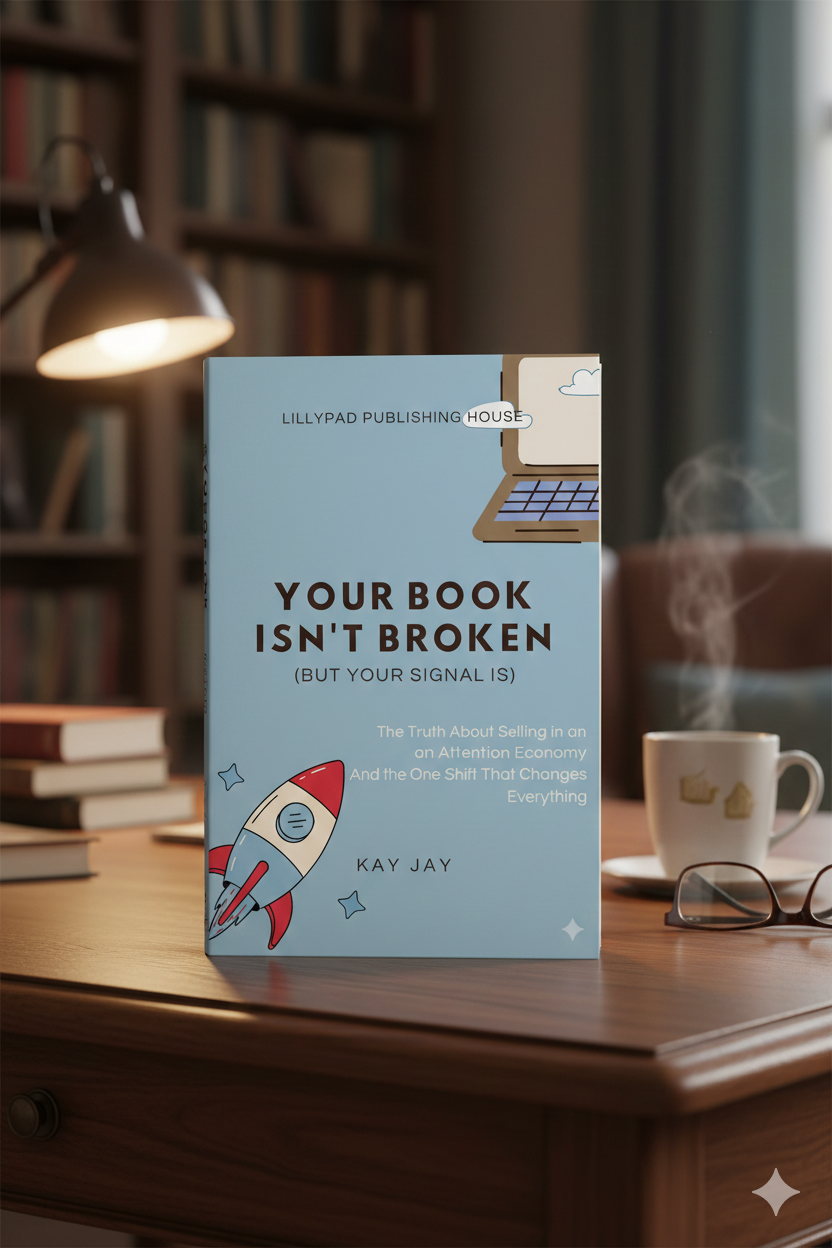
Author: Kay’s Corner

  • Don’t Sell the Product, Sell the Map

    Don’t Sell the Product, Sell the Map

    Framing the book as the guide you wish you had 10 years ago.

    When I was in the painful silence of my first book launch, trying to ‘market’ a finished product, my entire strategy was backwards. I was trying to sell a thing—a neatly bound collection of words—to people who didn’t yet know they needed it. I was trying to sell the product.

    The breakthrough, which fundamentally changed my relationship with visibility, came when I finally stopped looking forward and started looking backward.

    I reconnected with the version of myself who wrote that book—the one who was confused, hurting, and desperately searching for the very answers the finished book contained. I realized that the true power of my work wasn’t in its content, but in its function as a map.

    Your book is not a product on a shelf. It is a map—a detailed, hard-won guide to a destination you have already reached.

    The person scrolling past your book on the digital shelf is not looking for a product to consume. They are looking for a guide to a painful, confusing territory. They are looking for the map out of the struggle they are currently in.

    This is the core of the Map, Not Product shift:

    The Product Focus: “My book is out! It contains 5 essential steps to success.” (This is transactional and asks the reader to trust a stranger.)

    The Map Focus: “This book is the guide I desperately wished I had 10 years ago, when I was struggling with [specific pain point]. It’s the three steps I took to finally climb out of that hole.” (This is transformational and establishes immediate trust with a fellow traveler.)

    When you frame your book as the map you wish you had, you accomplish three things instantly:

    1. You validate the reader’s struggle. You prove that the confusion they are in is a recognizable, solvable place, not a personal failing.
    2. You establish authority based on experience, not just expertise. You are not a distant guru; you are the successful traveler who came back with the map.
    3. The sale becomes natural. The reader is not buying an object; they are buying the shortest, safest route out of their current pain.

    The deepest connection you can make is to the past version of your ideal reader. The one who is still lost and still searching. Stop selling the finished product to the market. Start sharing the map with the traveler. That act of service is the clearest signal your book can send, and it is the single most powerful shift that turns invisibility into recognition.

  • The Purpose Post: Sharing Why You Wrote the Book, Not Just What It Is

    The Purpose Post: Sharing Why You Wrote the Book, Not Just What It Is

    The gravity that meaning creates.

    When most authors launch a book, their promotional activity is focused on the What. What is the book about? What are the chapter titles? What are the features? This is the domain of the Performance Post, and it is a surface-level interaction that is easily ignored.

    To break the silence, you need to shift to the domain of the Why.

    The Purpose Post is not a product announcement; it is an act of translation. It takes the months or years of internal struggle, personal breakthrough, and sheer meaning that drove you to write the book, and makes that vulnerability visible to the reader.

    The moment you share your Why—the original wound, the question you couldn’t answer, the realization that changed everything for you—you create an immense gravity. You move the conversation from logic (“Should I buy this?”) to emotional resonance (“I feel the same way”).

    Why Purpose Trumps Product

    Readers don’t buy content. They buy the clarity and transformation that the content promises. And the most compelling proof of that transformation is the author’s own journey.

    • The Product Post (What): “My book is out! It contains the 5-step system for XYZ.” (This is transactional.)
    • The Purpose Post (Why): “I spent two years feeling stuck in XYZ, thinking my effort was a mistake. I wrote this book because I couldn’t find the map I needed. This is the one realization that finally changed everything for me, and I want you to have it too.” (This is transformational.)

    When you are brave enough to share the original pain and the internal shift that led to your book, you give the reader immediate, undeniable permission to trust you. They stop seeing a polished, impersonal product and start seeing a fellow human who is offering a bridge out of a struggle they share.

    The sale becomes a formality. The reader is not purchasing a book; they are enrolling in the journey you have just validated with your own story. The gravity of your genuine purpose is the clearest signal you can send in the attention economy. It is the proof that your book is not just good—it is necessary.

  • The Power of the Shared Secret in Writing

    The Power of the Shared Secret in Writing

    The secret thought your ideal reader is embarrassed to admit, and why your book needs to name it.

    Every author believes their book is about a topic. It’s about finance, or self-help, or leadership, or love. But the most powerful books—the ones that break the silence and move effortlessly into the world—are not about a topic.

    They are about a Shared Secret.

    The Shared Secret is the most private, most painful, and often most embarrassing thought your ideal reader carries, the one they would never admit in public, or even to their closest friends. It is the unsaid truth of their struggle.

    For the author of a book on productivity, it’s not “I need better time management.” It’s the secret thought: “I’m busy all day long, but I secretly suspect I’m a fraud who is still behind everyone else.”

    For the author of a book on money, it’s not “I need to learn to budget.” It’s the secret thought: “I make a good salary, but I still feel broke, and I’m ashamed to admit it.”

    This secret is the invisible barrier in marketing. Because the reader believes this pain is unique to them, they search for solutions using polite, generic language that hides the real problem. They search for “self-improvement” or “financial planning.”

    Your book’s presentation—your title, your description, your first social media post—must be the moment you name the secret. It must act as the key that unlocks the reader’s hidden shame.

    The moment you name the Shared Secret, the reader stops scrolling. They stop their logical evaluation. They experience a profound, emotional jolt of recognition. They realize: “I’m not alone. This person knows my struggle. This book is for me.”

    Why Naming the Secret Works

    When you name the secret:

    1. You Build Immediate Trust: You prove you’ve been where they are. You are no longer an outside expert; you are a fellow traveler who escaped the confusion.
    2. You Override Logic with Emotion: The purchase is no longer a logical choice (is this book “good”?). It becomes an emotional imperative (I need the map out of this shame).
    3. You Cut Through the Noise: While other books are politely describing their content (The Technical Label), your book is speaking directly to the reader’s soul (The Emotional Invitation).

    Your book contains the solution. But the reader will not step onto the bridge until you first prove you understand the specific, dark place they are trying to leave. Find the secret thought your ideal reader is embarrassed to admit. Name it with clarity, honesty, and compassion. In that moment of shared vulnerability, you stop selling a book and start creating an irresistible connection. The power of the Shared Secret is the true power of signal.

  • Why I Don’t Care If Your Book Is ‘Good’

    Why I Don’t Care If Your Book Is ‘Good’

    A provocative piece arguing that relevance trumps quality in the attention economy.

    Let’s get something out of the way. I don’t care if your book is “good.”

    In fact, the moment you tell me you’ve spent five years polishing every comma, obsessing over the historical accuracy, and refining the prose to a point of objective perfection—that’s the moment I start to worry for you.

    Because “good” is the most dangerous, comforting lie in publishing. It is the anesthetic that dulls you to the reality of the marketplace. It convinces you that your job is over when the manuscript is complete, and that the universe operates on a system of literary meritocracy.

    The brutal truth is this: Objective quality is a minimum entry fee, not a guarantee of success.

    The world is saturated with “good” books that are invisible. They sit quietly, technically flawless, utterly ignored. Meanwhile, books that are less polished, less comprehensive, and sometimes frankly less “good” by academic standards, reach millions of readers and transform lives.

    The marketplace, it turns out, is indifferent to objective quality. It does not reward craft consistently.

    It rewards relevance.

    A reader is not scrolling through a feed looking for a book that is objectively good. They are scrolling for a book that says, “I know exactly how you feel.”

    This is the heart of the argument: your book is not a piece of art to be judged; it is a tool for a specific transformation, a bridge out of a specific pain point. If your signal—your title, cover, and description—is focused on conveying how good the book is, it becomes polite, generic, and easily missed. It says, “I am a high-quality product.”

    But the irresistible signal is one that focuses entirely on the reader’s struggle. It doesn’t rely on being “good”; it relies on being magnetic. It’s the difference between a technical thesis and a direct, emotional shout of recognition.

    When you shift your focus from Quality (which serves your ego and your craft) to Relevance (which serves the reader’s immediate, specific need), everything changes. You stop asking, “How do I prove this is good?” and start asking, “How do I make the reader feel utterly seen in the first three seconds?”In the attention economy, the good book that is invisible is effectively a non-existent book. Don’t chase “goodness”—chase connection. Because a perfectly relevant book, even if imperfectly written, will always beat an objectively good book that doesn’t know how to shout its relevance.

  • Can You Love Someone and Still Let Them Go? What I Learned When I Did

    Can You Love Someone and Still Let Them Go? What I Learned When I Did

    Most of us are taught—quietly, early—that love and holding on are the same thing.

    That if love is real, it must insist.
    If it’s deep, it must ache.
    If it matters, it must try harder.

    So when a connection doesn’t stay, the reflex is automatic:
    Maybe it wasn’t love.
    Or worse—Maybe I wasn’t enough to keep it.

    I used to believe that too.

    Until I loved someone I couldn’t keep—and discovered that love didn’t disappear when the relationship did.

    It did something far more unsettling.

    It stayed.


    The moment love stopped asking for permission

    Letting go didn’t happen all at once.
    It wasn’t noble or spiritual or clean.

    It happened in fragments:

    • when I stopped rehearsing conversations that would never take place
    • when I stopped checking for signs
    • when I stopped bargaining with timing, fate, or silence

    And then one day, something unexpected occurred.

    The longing softened—but the love didn’t.

    That’s when I realized I had confused attachment for intimacy.

    Attachment needs proof.
    Love doesn’t.


    What letting go actually released

    I used to think letting go meant:

    • erasing feeling
    • replacing connection
    • becoming indifferent

    None of that happened.

    What let go was something else entirely:

    • the need to be chosen
    • the need to be mirrored back
    • the need for love to take a specific form to be valid

    What remained was quieter.
    Less dramatic.
    More honest.

    It wasn’t love that hurt—it was the grip around it.


    Love as presence, not possession

    There’s a version of love that tries to secure itself through outcomes:

    • labels
    • timelines
    • guarantees

    And then there’s another version—rare, unsettling, liberating—that exists without needing to arrive anywhere.

    That kind of love doesn’t disappear when the other person leaves.
    It integrates.

    It becomes part of how you listen.
    How you notice beauty.
    How you stay with yourself instead of abandoning yourself.

    This was the hardest lesson for me:
    Love didn’t ask me to follow someone else.

    It asked me to stay.


    The quiet union no one talks about

    We romanticize reunion.
    We don’t talk enough about inner union.

    The moment when:

    • you stop needing the other person to confirm the experience
    • you stop outsourcing meaning
    • you stop collapsing inward when something ends

    That’s not resignation.

    That’s maturity.

    And it changes how love moves through you forever.


    Why this kind of love doesn’t make headlines

    Because it’s not loud.

    It doesn’t perform devotion.
    It doesn’t announce sacrifice.
    It doesn’t demand resolution.

    But it does something far more radical.

    It frees you.

    This is the kind of love I explored more fully in Finding Noir—not as a story about staying, but as a story about what survives release. Not because love is meant to hurt, but because sometimes love outgrows the shape it first arrived in.


    A different question to ask

    Instead of asking:
    Can I let them go and still love them?

    Try asking:
    What part of me came alive because of this love—and can I keep that alive without holding on?

    That answer changes everything.

    And once you’ve felt it, you’ll never confuse love with possession again.

  • How to Communicate Your Book’s Value Effectively

    How to Communicate Your Book’s Value Effectively

    Using the analogy to prove the need for clarity in presentation.

    When I reflected on my own journey after publishing Diary of Cliches and staring into that silent void, I realized something deeply uncomfortable. My failure wasn’t in the writing; I had focused entirely on the book as an end in itself.

    I had not focused on the critical next step: helping readers recognize themselves inside it. I operated on the dangerous assumption that the book was good enough to simply speak for itself.

    But books do not exist in isolation. They exist inside perception.

    Readers do not experience your intention; they experience your presentation. Your months, sometimes years, of inner work are distilled into a title, a cover, and a description. If that presentation does not immediately communicate relevance and a clear path to solving their problem, they cannot see the bridge between their life and your work.

    This creates an invisible barrier. The barrier is not a flaw in your content. It is psychological. It is the gap between what your book means to you, the author, and what readers believe it means for their life.

    Closing this gap is not about changing your truth or simplifying your message. It is about translating it into the reader’s language of pain, desire, and immediate relevance.

    The Untranslated Menu

    Imagine you’ve poured your soul into creating a masterpiece—a Michelin-star meal of craft and intention. That meal is your book. Now imagine the restaurant menu only lists the ingredients in a foreign language.

    Your intention is to nourish and delight, but the reader, looking only at the menu (your book’s presentation: title, cover, description), cannot translate it into relevance for their own life. They move on, not because the meal isn’t good, but because the presentation created an invisible barrier of confusion and irrelevance.

    This is the invisible barrier that keeps the most brilliant work invisible. By using vague, broad, or purely descriptive language, you force your reader to guess your value. You place the burden of translation on the person scrolling by, and in the attention economy, that is a burden they will never accept.

    Your book’s truth is locked behind its presentation. To break through the barrier, you must ensure that your external elements—title, subtitle, cover, and description—are a clear, well-labeled bridge, communicating the immediate, practical problem your book is solving for them. Only then can a searching reader finally see the solution they desperately need.

  • What It Really Feels Like to Observe the Ego Without Trying to Kill It

    What It Really Feels Like to Observe the Ego Without Trying to Kill It

    For a long time, I thought spiritual growth meant silencing the ego.

    Transcend it.
    Outgrow it.
    Dissolve it into something quieter, purer, more enlightened.

    What I didn’t realize then was that this impulse—to get rid of the ego—is itself an ego strategy. A subtler one. More socially acceptable. But just as controlling.

    Real change didn’t begin when I tried to defeat the ego.
    It began when I sat down beside it.


    The ego isn’t loud. It’s repetitive.

    Contrary to how it’s often described, the ego doesn’t always shout.

    Most of the time, it loops.

    It repeats old conclusions:

    • “This is how love ends.”
    • “This is who I become when I’m abandoned.”
    • “This is the part of me that’s too much.”

    These aren’t thoughts you argue with.
    They’re thoughts you’ve lived inside for so long they feel like facts.

    Trying to kill the ego only makes these loops more entrenched. They go underground. They reappear as spiritual language, productivity, restraint, or emotional distance.

    Observation is what interrupts the loop.


    Observation doesn’t mean detachment

    This part is important.

    Observing the ego isn’t floating above your experience, dissociated and calm.
    It’s not spiritual bypassing.
    It’s not neutrality as performance.

    For me, observation happened most viscerally while resolving childhood trauma and doing shadow work.

    It felt like:

    • letting an old voice speak without correcting it
    • allowing a reaction to rise without justifying it
    • noticing the body tighten without rushing to relax it

    There was nothing elevated about it.

    It was intimate. Awkward. Human.


    When you stop making meaning, something loosens

    The biggest shift came when I stopped asking,
    “What does this say about me?”

    And instead asked,
    “Can I let this be here without turning it into an identity?”

    The ego thrives on meaning-making.
    It wants a narrative.
    A role.
    A moral.

    When you observe without extracting a conclusion, the ego loses its grip—not because you overpowered it, but because you stopped feeding it.

    The thought arises.
    The sensation passes.
    Nothing needs to be decided.

    That’s it.


    Triggers become teachers, not threats

    Here’s the real litmus test.

    If you’re truly observing the ego—not pretending to—you’ll notice it most clearly when you’re triggered.

    Not when you’re calm.
    Not when you’re alone.
    But when something hits an old wound and your system reacts before your mind can catch up.

    In those moments, observation looks like:

    • noticing defensiveness without acting it out
    • feeling shame without collapsing into it
    • sensing the urge to withdraw without obeying it

    You don’t win.
    You don’t fix.
    You stay.

    That staying is what rewires the pattern.


    Why this matters in love

    In deep connections, the ego doesn’t show up as arrogance.
    It shows up as protection.

    It tries to keep you safe by predicting pain.
    By controlling proximity.
    By managing outcomes.

    When you observe it without trying to kill it, love changes.

    You stop relating from reflex.
    You stop confusing intensity with truth.
    You stop asking another person to heal a part of you that needs witnessing first.

    In Finding Noir, this is where the story quietly pivots—not through insight, but through presence. Through a character learning to let the ego speak without letting it drive.


    The ego doesn’t disappear. It softens.

    The goal was never to get rid of it.

    The goal was to stop being ruled by it.

    When you observe the ego long enough, kindly enough, it stops performing.
    It stops narrating.
    It rests.

    And what’s left isn’t emptiness.

    It’s clarity.

  • Embracing Love Without Possession or Expectation

    Embracing Love Without Possession or Expectation

    Finding Noir: A Story About Love That Doesn’t Ask You to Stay

    Most stories about love are written as if permanence is the goal. Stay together. Build a life. Achieve closure. But what if the deepest connections don’t work that way?

    Finding Noir explores this very idea: love that asks nothing from you but presence, love that doesn’t demand possession, love that transforms even in absence.


    Love beyond expectation

    There’s a profound freedom in recognizing that some connections are not meant to be owned.

    • They don’t require reciprocity to exist.
    • They don’t hinge on timing, circumstance, or convention.
    • They aren’t measured by distance or proximity.

    Instead, their purpose is to catalyze awakening, to mirror your shadows, and to expand your capacity to love—yourself and others—without needing validation.


    How release becomes the teacher

    In my own life, I experienced a connection so intense that it shattered my sense of stability:

    • Work ended unexpectedly.
    • Physical and emotional pain surfaced.
    • Life demanded I move and transform in ways I hadn’t anticipated.

    The presence—or absence—of this connection expedited growth. What felt like loss was, in truth, liberation.

    Finding Noir channels this experience into narrative: the characters navigate love that is raw, alive, and unconstrained by societal norms. Their bond teaches that true connection is felt, not controlled.


    Love that doesn’t demand staying

    This story isn’t about someone choosing to leave or stay. It’s about recognizing that love can exist fully without attachment to outcome.

    It teaches:

    • Presence is more powerful than possession.
    • Freedom and intimacy can coexist.
    • Love’s purpose is to expand consciousness, not to anchor it in expectation.

    Why this matters

    In a world obsessed with resolution and permanence, Finding Noir offers a quiet rebellion: a philosophy of love that is liberating, transformative, and deeply human.

    It shows that love doesn’t need to ask you to stay—sometimes, it asks you only to notice, integrate, and evolve.

    And in that space, even absence becomes a teacher, and even silence becomes a form of devotion.

    This is the essence of connection that lasts—not in physical presence, but in its impact on your consciousness.

  • How Recognition Drives Book Sales

    How Recognition Drives Book Sales

    The moment a reader recognizes their own struggle in your words, the sale becomes natural.

    The traditional, exhausting model of book marketing is rooted in persuasion. It’s a relentless effort to convince a skeptical reader that your book is worth their time, money, and attention. This involves making a logical case: listing features, citing credentials, and using urgent language.

    The author in this model is a salesperson, and the book is a product to be sold.

    But in a world of infinite choice and perpetual distraction, readers have built up a powerful immune system against persuasion. They don’t want to be convinced of a book’s objective goodness; they want to feel an undeniable pull toward its subjective relevance.

    This is the moment the critical shift happens: Readers do not buy persuasion; they buy recognition.

    The true force that moves a book from the digital shelf into a reader’s hands is not a well-crafted sales argument, but a moment of profound, emotional recognition. It happens when they read your title, your subtitle, or the first line of your description and something inside them whispers: This person has been inside my head. This book understands the pain I thought was mine alone.

    When that recognition hits, the decision to purchase is no longer a logical evaluation of a product. It becomes an emotional imperative. It is the reader reaching out for the map to the territory they are currently lost in, a territory you have already navigated.

    The Difference Between Pushing and Pulling

    The pursuit of persuasion is a constant, uphill push against the reader’s resistance. It relies on volume, urgency, and the hope that you can out-argue their skepticism. This effort is exhausting and prone to the silence you’ve already experienced.

    The pursuit of recognition is an effortless pull. It relies on clarity, specificity, and emotional honesty. You are not trying to change the reader’s mind; you are simply naming the reality of their inner world so clearly that they cannot ignore you.

    The sale, therefore, stops being a transaction you have to force. It becomes the natural and inevitable byproduct of a shared human connection.If you want to transform your book’s destiny, stop trying to be the loudest voice in the room. Start aiming to be the clearest. Stop trying to persuade the masses, and focus on helping one person, the past version of yourself, recognize their struggle and see their map. In that moment of recognition, the silence finally breaks, and the journey begins.

  • The Power of Emotional Invitations in Book Titles

    The Power of Emotional Invitations in Book Titles

    How to tap into a reader’s fear or desire immediately.

    In the battle for a reader’s attention, your book’s title is your single most important piece of marketing copy. Yet, most authors treat it like a technical label.

    A technical label is factual, objective, and accurate. It describes the contents of the package: “A Comprehensive Guide to Modern Leadership.” This title is correct, but it is polite, generic, and completely ignorable. It’s a door that is closed to the emotional heart of the reader.

    In the attention economy, your title must be an Emotional Invitation.

    An emotional invitation isn’t just accurate; it is relevant. It bypasses the reader’s logical brain and speaks directly to their hidden pain, their secret fear, or their deepest, most specific desire. It’s a door that is already half-open, inviting them in by proving that you know exactly how they feel.

    The transaction is not primarily driven by a logical evaluation of quality. It is driven by a moment of recognition. A title that functions as an Emotional Invitation triggers the thought: “That is me. I am reading this. I need this.”

    Consider the two functions of a title:

    1. The Technical Label: Focuses on the Topic of the book. It uses broad, descriptive, and academic language (e.g., “The Principles of Effective Time Management”). This forces the reader to logically evaluate the book’s merit and adds the burden of translation. It fails the Distracted Scroll Test.
    2. The Emotional Invitation: Focuses on the Transformation of the reader. It names the specific emotional pain point or the desired “after” state (e.g., “Why You’re Still Tired: The High-Achiever’s Guide to Reclaiming 3 Hours a Day“). This is a shout of recognition that immediately taps into fear (of staying stuck) or desire (for relief/change).

    Your title has just three seconds to prove its worth. A technical label requires a reader to pause their scroll, click, and read the description to find the emotional core. An emotional invitation is the emotional core. It cuts through the noise because it doesn’t rely on being good; it relies on being so ruthlessly relevant that it feels like a personal message.

    Shift your focus today. Stop naming the topic of your book. Start naming the reader’s pain that your book is designed to heal. Transform your title from a quiet technical label into a powerful, irresistible emotional invitation.