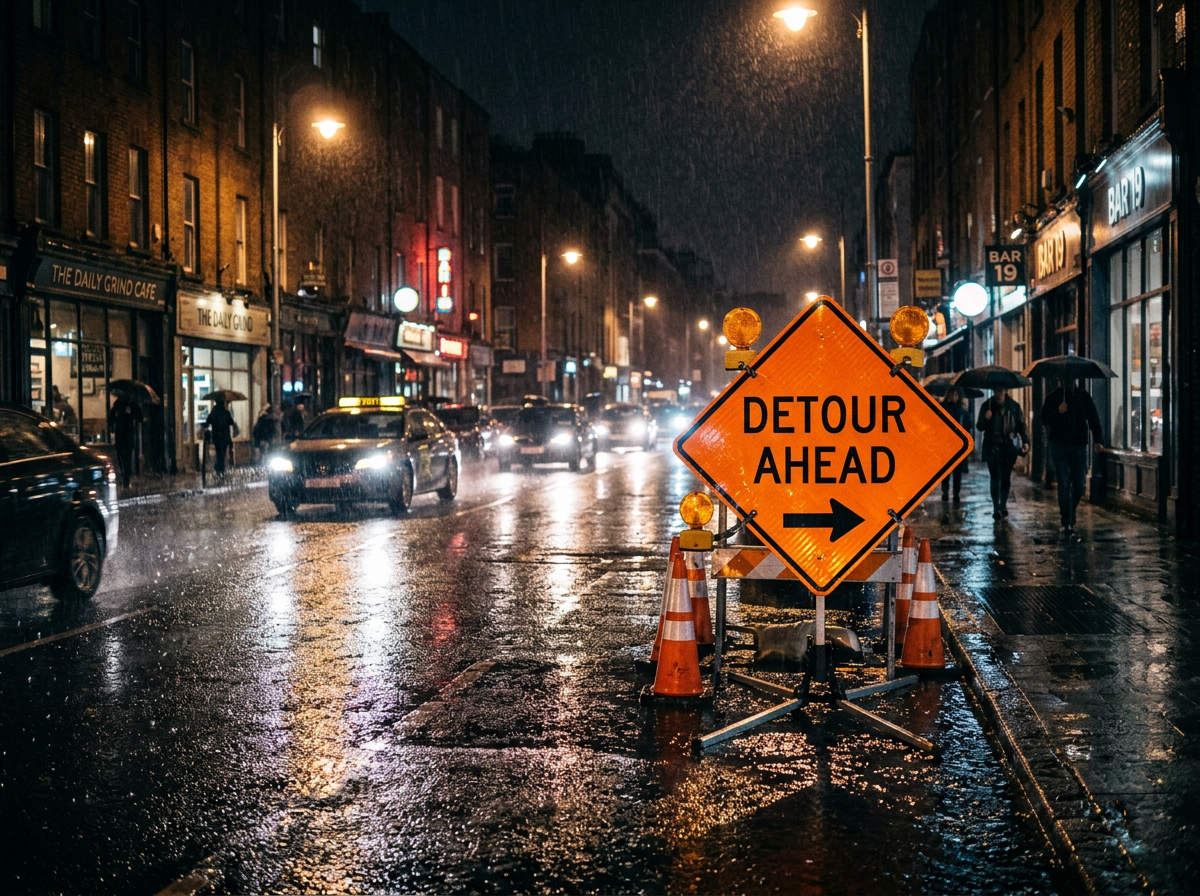
Category: About Life Choices & Potholes

  • Understanding Healing: Why Progress Isn’t Linear

    Understanding Healing: Why Progress Isn’t Linear

    Somewhere along the path of self-improvement and wellness, a seductive, yet fundamentally flawed, narrative took hold: the idea that healing, like a stock market graph, should demonstrate consistent, upward-trending progress. We absorbed an expectation that the journey should look like a clear trajectory—Up and to the right. We sought tangible, measurable evidence of recovery: Less pain. More clarity. Fewer bad days. This mindset demands a pristine, definitive “before” and a triumphant, settled “after.”

    But the profound, complex work of psychological and emotional mending simply doesn’t move with such sterile, mathematical precision. To witness true healing is to watch a process that defies the straight line.

    The Nature of the Spiral

    Healing moves in a spiral. It circles. It pauses. Crucially, it revisits places you were sure you had already fully navigated, understood, and outgrown.

    You will have those miraculous days—the ones where you feel steady, expansive, capable, and profoundly proud of the distance you’ve covered. And then—sometimes without discernible external trigger—you find yourself plunged back into a familiar ache. You might catch yourself exhibiting a reaction you thought you’d mastered, or gripped by a fear you genuinely believed you had made peace with months or even years prior.

    It is precisely in these moments that the old, linear paradigm compels us to call this a setback.

    It isn’t.

    This return is not a regression; it is a deepening.

    The Shift from Erasing to Integrating

    The misconception stems from viewing healing as an act of eradication—that the goal is to erase old wounds, trauma, or painful memories. But true healing is far less aggressive. It is about fundamentally changing your relationship with those internal experiences.

    And relationships, by their very nature, are fluid, ongoing, and dynamic. They require revisiting conversations from a new perspective, relearning boundaries as you evolve, and most importantly, offering a boundless supply of grace when frustration, self-judgment, or old habits creep back in.

    The fundamental mistake we make is expecting closure—a clean, final chapter—when what we are actually, perpetually practicing is integration.

    The past, and the versions of ourselves that endured it, do not simply vanish because we have conscientiously “worked through it” in therapy or through self-reflection. Instead, the past shows up differently. It becomes quieter. It is less demanding of your immediate attention or emotional resources. Sometimes, after deep work, it appears merely asking to be acknowledged as a part of your history, not solved as an urgent, present-day crisis.

    The Power of Revisiting

    The internal critique can be brutal: Why am I here again? Didn’t I already deal with this? This is the voice of the linear expectation, demanding efficiency from an inherently inefficient, human process.

    What I have learned is that this revisiting is not a failure; it is, in fact, the most potent sign of growth. It is the signature of the spiral.

    The difference lies in how you return to the familiar territory. Each return comes equipped with:

    The journey toward emotional maturity and self-acceptance can be tracked by a few key shifts in how you respond to pain and familiar emotional patterns:

    1. Significantly Heightened Awareness and Insight: The fog of confusion begins to lift. Where once you would be fully submerged and identified with the emotional state, you now possess a critical distance. You can identify the entire pattern—the subtle environmental or interpersonal trigger, the cascade of physical sensations, and the distinctive emotional signature (e.g., “Ah, this is the old ‘I am not enough’ narrative kicking in”)—almost instantly. This heightened awareness is not merely intellectual; it’s a deep, intuitive knowing that allows you to observe the internal storm without being swept away by it. This immediate recognition is the first step toward breaking the automatic response loop.
    2. A Profound Shift to Self-Compassion: When the familiar ache, insecurity, or self-defeating impulse arises, your default setting changes. You meet the pain not with the harsh, familiar drill sergeant of self-contempt, self-criticism, or an immediate attempt to suppress the feeling, but with genuine kindness and gentle inquiry. This compassion stems from clearly recognizing the wounded, vulnerable part of you that is still hurting—the younger self, perhaps, whose needs were unmet, or who internalized a damaging message. Instead of judging the feeling as a failure of progress, you treat it as a signal, gently acknowledging, “This hurts, and it’s okay that it hurts. I can be here with this feeling without needing it to go away right now.” This radical acceptance disarms the emotional intensity.
    3. A Release of the Urgency to Fix or Control: The instinctive, desperate panic subsides. The need to immediately execute an escape plan, distract yourself, suppress the feeling, or analyze it into oblivion lessens dramatically. You develop a deep, quiet understanding that this difficult state is temporary, transient, and will pass in its own time. Crucially, you recognize that a temporary emotional setback or the resurgence of an old feeling does not define the totality of your progress. One wave of insecurity does not erase months or years of growth and healing. This patient perspective allows the feeling to dissipate naturally, rather than amplifying it through resistance, thus embodying a true sense of inner stability and resilience.

    Writing and reflection become powerful tools here, allowing you to watch your own evolution happen in real-time. You see that your path is not a straight line, but a spiral—the same territory, yes, but viewed from a higher vantage point, with the wisdom and resilience accumulated from the previous rounds.

    The Permission Slip

    The enduring truth that “healing takes time” is much more than a tired platitude—it is a sacred permission slip. It grants you the freedom to move at your own, natural pace, to stop punishing yourself for not being “over it” yet, and to redefine your metrics for success.

    Stop measuring your growth by how little you feel—by the absence of pain, which is an impossible benchmark.

    Start measuring your growth by how gently you respond when the pain, the fear, or the old pattern inevitably returns.

    So, if today feels heavier than yesterday, or if this week feels like a surprising dip after a period of calm, it does not mean you are moving backward.

    It means you are deeply, beautifully human.

    And you are still in the work—the profound, circular, and utterly essential work of becoming whole.

    Reflective Prompt for the Spiral:

    What area of your life, relationship, or personal history are you currently judging as “unfinished” or “a failure”—when it might simply be an essential, necessary stage of unfolding, or a higher point on the spiral you are walking?

    Sit with that area. Write it out, detailing the specific feeling of “stuckness.” Allow the feelings to exist without analysis. No conclusions, solutions, or promises are required. Just acknowledgment.

    Cover of 'Diary of Cliches' featuring stylized text, floral decorations, and images of open books against a pink background.

  • Understanding Clichés: When Truth Meets Timing

    Understanding Clichés: When Truth Meets Timing

    The Undeniable Logic of the Cliché

    There is a profound, almost unavoidable reason for the persistence of clichés. We often mistake them for intellectual laziness—a convenient shorthand for a thought we couldn’t be bothered to finish. But the truth is far more complex and far more resonant. They are not merely lazy thoughts; they are overused truths.

    Phrases like, “Everything happens for a reason,” “Time heals all wounds,” “You just have to let go,” or “Trust the process,” have become cultural punchlines. They are the go-to offerings in moments of acute distress, often delivered with a saccharine smile or a vacant stare. We reflexively roll our eyes, especially when our lives are in freefall. In those moments, they feel less like comfort and more like a gentle, but infuriating, dismissal—the verbal equivalent of a pat on the head from someone who doesn’t want to sit with our discomfort or admit they simply don’t know what to offer.

    And yet, across countless human experiences, across cultures and generations, every single cliché in this Diary of Clichés has earned its place not by being clever, but by being painfully, annoyingly, and repeatedly true.

    The inherent flaw, the reason for our collective aversion, is rarely the message itself. The problem is almost always one of timing.

    Wisdom, like medicine, is highly dose-dependent. A profound truth delivered prematurely—before the recipient has done the hard, messy work of wrestling with their own reality—feels dismissive, like a teacher giving away the answer before the student has completed the equation. Conversely, a truth delivered too late feels frustratingly obvious, eliciting the groan of, “Well, of course,” once the lesson has already been learned and etched onto the soul.

    But a truth delivered at the exact moment the soul is ready to receive it—when the emotional defenses have finally crumbled, and the mind is open to synthesis—it doesn’t land as a worn-out phrase. It lands with the seismic force of a revelation.

    For years, many of us—driven by a hunger for intellectual sophistication and originality—rigidly rejected the common wisdom of the cliché. We demanded something smarter, sharper, more complex. Surely, our unique, personal agony required an explanation that had never been written, a philosophy more sophisticated than what fit on a bumper sticker.

    But what one eventually learns—a slow, humbling, and often reluctant lesson—is that we do not outgrow clichés; we grow into them.

    The true power of these phrases is not in their intellectual comprehension, but in their experiential integration.

    • You do not genuinely understand the concept of “self-love” until you have completely exhausted the destructive practice of self-sacrifice and discovered the hollowness it leaves behind.
    • You cannot truly believe the mantra “you’ll be okay” until you have survived a life-altering crisis—a moment you were absolutely certain would break you—and realized you are, impossibly, still standing.
    • You don’t accept the comfort of “this too shall pass” until you have stood in the middle of a torrential storm of suffering and, weeks or months later, watched the sky miraculously clear.

    Clichés, then, are not intellectual shortcuts. They are powerful summaries. They represent compressed wisdom, distilled and refined through the fiery crucibles of millions of lived experiences across history. They are not chasing us; they are waiting patiently for our individual lives to catch up to their universal truth.

    Diary of Clichés is not an academic attempt to reinvent or rebrand ancient wisdom. It is a simple, earnest invitation to stop, revisit, and re-examine the phrases we once so haughtily dismissed—and to honestly ask ourselves why, after all this time, they have suddenly begun to make sense.

    Reflective Prompt:

    Which cliché do you secretly hate—the one you’ve dismissed a thousand times—but know, deep down, is finally starting to feel true in your own life?

    Book cover for 'Diary of Cliches' featuring a pink textured background, decorative elements like flowers and open books, with the title prominently displayed in a mix of fonts.
  • Finding Clarity: Embracing Uncertainty for True Growth

    Finding Clarity: Embracing Uncertainty for True Growth

    For years, I was a devotee at the altar of Certainty. It wasn’t just a preference; it felt like the only respectable goal. My internal checklist for “successful adulthood” was simple:

    The contemporary cultural script often prescribes a relentless pursuit of total, unwavering certainty across the foundational pillars of existence. This expectation manifests acutely in three primary domains:

    • Career Certainty: The modern professional is often burdened with the expectation not just of competence, but of omniscience regarding their professional trajectory. This demands not simply a short-term plan, but the ability to know the next five rungs on the ladder—a predetermined, linear ascent free of deviation, sabbatical, or re-evaluation. It implies an unbroken chain of promotions, salary milestones, and ultimate vocational fulfillment, demanding the individual project an image of absolute conviction in their chosen path, dismissing the natural volatility and ambiguity of the modern job market. The subtext is that true success is only achieved by those who have mapped their entire working life from the outset, rendering any uncertainty as a sign of failure or lack of ambition.
    • Relational Certainty: The cultural myth of the “soulmate” extends far beyond romantic partnership to permeate all significant social bonds. The expectation is to be unshakably sure about your partner, your friendships, and your chosen community. This demands a commitment that is not merely enduring, but fundamentally unquestioning—a state of relational stasis where doubt, conflict, or the evolution of shared values are interpreted as critical flaws rather than natural elements of human connection. To express a reservation about a long-term partner, to let go of an old friend, or to critique one’s community is to fail the test of relational conviction, implying that genuine, profound connection is only possible when certainty is achieved and maintained in perpetuity.
    • Self-Certainty: Perhaps the most taxing demand is the expectation to possess a fully formed, unshakeable sense of self, impervious to doubt. This self is not a work in progress, but a completed masterpiece—a consistent, coherent identity that operates flawlessly. The individual must internalize the notion of doing this entire “life thing” right, adhering to an invisible, universally accepted standard of living. Any introspection that leads to confusion, any shifting of core beliefs, or any feeling of existential ambiguity is seen as a regression or a moral failure. This mandate prohibits the healthy, necessary confusion of self-discovery, instead demanding an immediate, definitive, and unassailable answer to the question, “Who am I?”—an identity that remains rigid and impervious to the natural erosive and transformative forces of experience.

    The world around me seemed to reinforce this obsession. My feed was a relentless highlight reel of people who had figured it out. They dispensed advice with the unwavering confidence of prophets; they posted captions that crystallized complex emotional states into five-word manifestos; they uttered clichés like “Trust the process” with a straight face, as if the process itself was a benevolent, clearly-labeled machine.

    I tried to wear their certainty. I adopted the posture, parroted the language, and forced a smile that said, “Yes, I am completely settled.”

    It was a poorly tailored garment. It chafed, it restricted movement, and ultimately, it didn’t fit the complicated, messy geometry of my actual life.

    What I have learned in the slow, often painful, and profoundly stubborn process of actual living is that Clarity is not the precursor to action; it is the residue of it.

    Clarity is not the lightning bolt that strikes the moment you wake up. It is the quiet, steady dawn that only arrives after you have sat on the hard ground of discomfort long enough to realize that running is more exhausting than facing the truth.

    It is forged in the fire of genuine internal reckoning:

    • Clarity comes after the spiral of frantic “what if” scenarios.
    • It shows up after the overthinking has exhausted itself into silence.
    • It emerges after the self-doubt you were terrified and embarrassed to admit has finally been named and acknowledged.

    The quest for certainty is the wrong question entirely. When you are lost in the woods, you instinctively ask, “What should I do?”—a question that demands an external map and an immediate, guaranteed path. The moment clarity begins to emerge is the moment you shift the inquiry to: “What do I know now that I didn’t know before I entered this specific moment of confusion?”

    This is the hinge point where honesty supersedes fear.

    The uncomfortable truth most of us evade is not that we are profoundly confused, but that we are profoundly afraid of what we already understand. The answer is often there, a dull ache beneath the surface, waiting for us to stop distracting ourselves long enough to feel it.

    Clarity asks for honesty. It requires you to look at the situation, your role in it, and your true desire without the filter of what others expect.

    Certainty asks for control. It is the ultimate seductive promise: safety, approval, a perfectly linear timeline, and the illusion that you can preemptively solve every future variable.

    Clarity offers none of these neat boxes. It offers alignment instead—a quiet, internal integrity where your actions match your values, even if they make no sense to the outside world. Alignment is less glamorous, less suitable for a boastful social media post, but it is infinitely more sustainable and resilient than the brittle facade of certainty.

    This central tension—the pull between chasing answers and learning to ask better questions—is the heartbeat of the exploration in Diary of Clichés. Growth is not about collecting definitive answers and stamping them “Solved.” It is about cultivating the kind of questions that are messy, vulnerable, and unfit for public performance, yet profoundly change the internal physics of how you move through your own life.

    So, if you are currently submerged in a sea of uncertainty, if the path ahead is obscured by fog, stop labeling yourself as “lost.”

    Perhaps you are simply in the vital, sometimes agonizing, middle of truly understanding something—a truth, a limit, a desire—that is so fundamental, you will never be able to unsee it once it fully crystallizes. This is the birthplace of clarity.

    Reflective Prompt for Deeper Alignment:

    Where in your personal or professional life are you expending energy chasing the illusion of certainty (an external guarantee), when the deeper, more sustainable need is for clarity (an internal reckoning)?

    (And if you were to fully trust the quiet clarity you already possess—the gut feeling, the persistent whisper, the truth you’ve been avoiding—what single, small action would change right now?)

    Cover design for 'Diary of Cliches' featuring the title in bold letters on a textured pink background, with plant illustrations and images of open books.
  • Overcoming Overthinking: The Power of Reflection

    Overcoming Overthinking: The Power of Reflection

    The Quiet Discipline of Reflection: Moving Beyond the Mental Loop

    For what felt like a lifetime, I mistook overthinking for reflection. I genuinely believed that my constant mental churn—the re-examination of every passing moment, the relentless replaying of conversations, the demanding cross-examination of why I did or said anything—was the mark of a deeply thoughtful, reflective mind.

    On the surface, they are twins born of the same mental process. Both require a journey back into the past. Both involve scrutinizing events. Both are an inward-facing investigation. Yet, their essence, and their ultimate effect on the self, are diametrically opposed. One is a liberation; the other, an elaborate, self-constructed cage.The Tyranny of Overthinking

    Overthinking is characterized by its noise. It is a frantic, rushed energy, a mental circuit that never closes. It is the obsessive re-circling of the same critical points without ever achieving a meaningful touchdown or resolution. The questions it poses are not genuine requests for insight; they are desperate pleas for reassurance. What if I had done X instead? Why did I say that stupid thing? What does their silence really mean? It is an echo chamber where doubt amplifies itself, a relentless loop with no designated exit, designed not to find clarity, but to sustain anxiety. It is effort without movement.The Gentle Power of Reflection

    Reflection, by contrast, is defined by its quiet.

    It is the deliberate act of slowing things down. It understands that insight is not summoned on demand. It possesses the patience to allow a thought, a feeling, or a past event to simply exist in the mind’s open space, without immediately launching a fatal interrogation. Reflection’s primary goal is not to “solve” or “fix” the self like a broken machine, but to cultivate a deep and empathetic listening. It is a process of observation, not judgment.The Role of Writing in Bridging the Gap

    I came to understand this crucial difference through the hard work of pulling myself out of late-night mental spirals and away from the pressure cooker of my own mind. My intellect was capable of holding a staggering volume of data—every past regret, every potential future catastrophe—but it was utterly incapable of imposing order upon it.

    This is where the physical act of writing became the vital mechanism that thinking alone could not be.

    When forced onto the page, overthinking loses its most dangerous weapon: its speed. It can no longer rush ahead, skipping critical steps. It is disciplined by the necessity of moving one sentence at a time, one concrete thought following the last. And in that deliberate, enforced slowness, a profound alchemy occurs:

    The Tranquil Triumvirate: Benefits of Observing the Overthinking Loop

    Breaking the cycle of obsessive rumination is a journey, but the simple act of conscious observation yields profound, predictable benefits. As you commit to stepping outside the mental storm, three core shifts fundamentally alter your relationship with your anxiety, leading not to a sudden cure, but to a sustainable sense of peace.

    1. Patterns Emerge: The Predictability Nullifies Panic
      The ceaseless churn of overthinking often feels like an unpredictable, chaotic force. However, as you repeatedly witness your own mental loops—the relentless “what ifs,” the spiraling narratives, the instant descent into worst-case scenarios—a hidden structure becomes visible. The repetitive nature of the loops is revealed; you start to recognize the cues that trigger them, the specific narratives they cling to, and the emotional states that fuel them. This shift from seeing the overthinking as a mysterious, overwhelming monster to a predictable, mechanical process is crucial. Once the process is predictable, it becomes far less frightening. You no longer react to the content with the same intensity because you know, with a certain certainty, that this is just “the loop” beginning again. This foreknowledge is power, stripping the overthinking of its element of surprise and, consequently, a significant portion of its terror.
    2. Priorities Clarify: The Signal Separates from the Noise
      When submerged in a state of constant rumination, all worries feel equally urgent, massive, and immediate. The mind treats a fleeting social awkwardness and a genuinely important financial decision with the same level of catastrophic alarm. However, the process of non-judgmental observation naturally introduces mental distance. From this vantage point, the trivial anxieties—the past conversations you can’t change, the hypothetical future events you can’t control—begin to thin out and lose their emotional weight. The truly important, actionable issues—the “signal”—separate themselves clearly from the vast field of “noise.” This clarification allows you to redirect your finite mental energy away from unproductive worry and toward constructive problem-solving, focusing only on the concerns that are genuinely within your sphere of influence and merit immediate attention.
    3. Observation Replaces Reaction: Assuming the Witness Posture
      This is perhaps the most transformative benefit. In the heat of overthinking, you are your thoughts; the feeling of anxiety and the thought that triggered it are an indistinguishable, reactive whole. The moment you choose to simply observe the thought process—to watch the anxiety arise without immediately engaging or trying to fix it—you create a critical gap between the stimulus (the thought) and the response (the panic). You step back from the emotional chaos and deliberately assume the posture of a non-judgmental witness, a neutral scientist studying a phenomenon. This act of disidentification means you are no longer the victim of your thoughts, but their temporary, objective custodian. The thoughts still occur, but you no longer feel compelled to dive into them. The energy that once drove the cycle—the intense emotional reaction—is starved, allowing the anxious thoughts to eventually dissipate on their own, like clouds passing across the sky.

    This shift moves the internal conversation from a self-indictment to an investigation. The accusatory, exhausted question of “What is wrong with me?” transforms into the curious, open-ended inquiry: 

    “What is this trying to teach me?”

    That simple pivot is the defining moment that changes everything about the mental landscape. It doesn’t promise an easier life—the challenges remain—but it guarantees a clearer one. It replaces the paralyzing chaos of noise with the empowering certainty of knowing.

    Now, the racing of my thoughts is not a sign to work harder at thinking, but a profound cue to stop and listen better. It is a signal to intentionally create mental space instead of applying destructive pressure. It is an invitation to cease the demanding search for immediate answers and to simply allow insight to arrive on its own terms.

    A Prompt Worth Pausing On:

    When was the last time your thoughts genuinely helped you move forward—to make a decision, to take positive action, or to find true peace—rather than just keeping your mind exhaustively busy?

    You don’t need to answer this immediately or intellectually. The power lies in the process. Just notice what rises to the surface when you commit the question to paper and let your hand write out the reply.That quiet commitment is the line that separates the deafening noise of anxiety from the profound knowing of self-awareness.

    Cover of the book 'Diary of Clichés' featuring the title in bold letters, floral elements, and open books on a textured pink background.

  • The Dangerous Difference Between Meaning and Rationalization

    The Dangerous Difference Between Meaning and Rationalization

    Book cover for '7 Sentences That Keep You Stuck' by Kay Jay, featuring a pink background with floral and natural elements, a question mark, and an image of a forest path.

    It is disorienting to realize that your decisions are coherent—and still constrained.

    We are fluent in the language of self-improvement. We know the right phrases to deploy after a setback. We call a relationship ending “redirection.” We frame a deep disappointment as “growth.” And when we’re exhausted, we label it “ambition.”

    This is the great self-trick of the intelligent, high-functioning adult: we become so efficient at reframing discomfort that we often miss the crucial signal the discomfort was trying to send. We call this ability to narrate our own hurt with composure strength.

    But sometimes, it is just endurance disguised as wisdom.

    The language we use to soften chaos is powerful. It creates what my work calls “narrative coherence”—a story that makes sense, where nothing is random. And narrative coherence feels like control.

    The problem? Clichés are not false. They are incomplete. And incomplete truths are the most persuasive kind.Are you confusing Endurance with Evolution?

    When you tell yourself “Everything Happens for a Reason,” what are you avoiding? Often, you are postponing the confrontation that is needed right now. You trust the benevolent plan of the universe more than you trust your own quiet intuition. 

    This is the difference:

    Endurance (The Cliché)Evolution (The Rewrite)
    Patience is confused with Postponement.Patience is a conscious choice, not a passive wait.
    Acceptance is confused with Resignation.Acceptance is what happens when you’ve fully processed a truth.
    Meaning is confused with Rationalization.Meaning evolves naturally; rationalization is often forced.

    If you have ever called something “fine” that quietly diminished you, you understand the tension between these columns. These unexamined sentences become the subtle forces that shape your entire life. They keep you stuck, small, and afraid to ask for more.

    Your Journey to Authorship Starts with a Pause

    The goal here is not rebellion. It is authorship. It is the power to pause before the inherited sentence completes itself and ask two simple questions:

    1. Where did this sentence originate?
    2. Does it still apply?

    That first moment of interruption—that flicker of self-awareness—is where all change begins.

    I created a sharp, insightful mini-ebook, “7 Sentences That Keep You Stuck,” to help you identify those invisible scripts and perform your first essential Rewrite. In this guide, you will see exactly how your most comforting phrases have been costing you power, clarity, and emotional ownership.

    This free guide is the awakening. It will open your eyes to the language that is running your life.

    If this exploration resonates and you want to continue the journey from passively living a borrowed sentence to actively writing your own, the full book, Diary of Clichés, is the definitive roadmap.

  • You Are Not Unlucky. You Are a Pessimistic Manifestor.

    You Are Not Unlucky. You Are a Pessimistic Manifestor.

    For a long time, I believed I had bad luck.

    Not dramatic, headline-worthy bad luck—just the kind that shows up in careers, timing, and relationships. Opportunities that almost land. Conversations that seem promising and then quietly fade. Doors that stay half-open but never quite swing wide.

    I told myself I was being realistic. Prepared. Sensible.

    What I didn’t realize was that I was rehearsing disappointment so consistently that it began to feel inevitable.

    Here’s the reframe that changed everything for me:
    I wasn’t unlucky. I was a very effective—if pessimistic—manifestor.


    Pessimism Isn’t a Lack of Belief. It’s Belief Pointed the Wrong Way.

    We tend to think manifestation belongs to optimists. Vision boards. Big affirmations. Unshakeable faith.

    But manifestation is really about focus.

    And my focus was sharp.

    I anticipated failure with detail.
    I planned emotionally for outcomes that hadn’t happened yet.
    I called it “being cautious,” but it was actually commitment—just to the wrong story.

    Fear, it turns out, is not passive.
    It is creative.


    Patterns Don’t Lie. They Reveal.

    When I looked back honestly, I noticed something uncomfortable:
    Many of the things I worried about did happen.

    Not because the world was against me—but because my nervous system expected things to fall apart. And expectations shape behavior, choices, energy, and timing more than we like to admit.

    The universe didn’t misunderstand me.
    It responded with precision.


    The Hidden Superpower of the Pessimistic Mind

    Here’s the part we rarely talk about:

    Pessimists often have strengths optimists don’t.

    We see patterns early.
    We anticipate downstream consequences.
    We imagine outcomes vividly.
    We are emotionally fluent in complexity and risk.

    That’s not weakness. That’s power.

    The issue isn’t the mind—it’s the direction it’s pointed in.


    What Changed (Without Pretending to Be “Positive”)

    I didn’t become an optimist overnight. That would’ve been inauthentic.

    What I did instead:

    • I stopped fighting fear and started questioning its certainty
    • I practiced neutral expectation instead of hope or doom
    • I redirected my imagination toward outcomes where I wasn’t bracing for impact
    • I noticed when things went right—and didn’t dismiss them as flukes

    Small shifts. Measurable impact.


    The Real Insight

    Your superpower isn’t optimism.
    It’s precision.

    If you can unconsciously rehearse worst-case scenarios with accuracy, you can consciously draft better ones.

    Not perfect.
    Not naïve.
    Just more spacious.

    So if you’ve ever thought, “Why does this always happen to me?”
    Try asking instead:

    What am I consistently rehearsing?

    Because rehearsal is manifestation in disguise.

    And once you see that—you stop calling yourself unlucky.

  • Navigating Life’s Potholes: Notes on Progress and Growth

    Navigating Life’s Potholes: Notes on Progress and Growth

    “I Thought I Was Making Progress. Turns Out I Was Just Taking Notes.”

    For a long time, I believed progress had a shape. It was linear. It moved forward. It came with milestones, approvals, and the quiet satisfaction of knowing you were doing life correctly. I mistook motion for momentum and optimism for clarity. When things didn’t work out, I told myself I was almost there—as if life were a badly signposted highway and I’d missed the exit by a few feet.

    What I didn’t account for were potholes.

    Not the dramatic kind—the ones that make for good stories later—but the small, daily craters that jolt you just enough to make you question your alignment. The job that seemed right until it wasn’t. The relationship that taught you more through its ending than its duration. The choice that looked sensible on paper and absurd in practice. None of these felt like failures at the time. They felt like detours. Temporary inconveniences. Notes I didn’t realize I was taking.

    I was convinced that if I just chose better—worked harder, waited longer, trusted sooner, trusted less—life would smooth itself out. That wisdom was something you acquired before the mess, not because of it. But hindsight has a cruel sense of humor. It reveals that the mess was the curriculum. The potholes weren’t interruptions to the journey; they were the journey, quietly shaping how I moved, what I noticed, and when I finally slowed down enough to listen.

    This book was not written from the vantage point of arrival. There is no triumphant before-and-after, no clean arc from confusion to certainty. It was written from the middle—from the place where you realize that every confident step you took was also a footnote in a longer story. A story about trying, recalibrating, and learning that progress is often only visible in reverse.

    Life Choices and Potholes is a record of those notes. Some are thoughtful. Some are sarcastic. Some were scribbled in moments when clarity felt wildly overrated. Together, they form a map—not of where I was going, but of how I learned to stay present while not knowing. And if there’s any progress worth claiming, it’s this: I no longer rush to pave over the potholes. I slow down, take better notes, and keep going anyway.

  • Embracing Clichés: A Journey Through Shared Human Experience

    Embracing Clichés: A Journey Through Shared Human Experience

    “I Rolled My Eyes at Every Cliché. Then I Lived All of Them.”

    I used to think clichés were for people who hadn’t thought deeply enough. They were shortcuts—phrases you reached for when you didn’t want to sit with complexity. Everything happens for a reason. Time heals all wounds. You’ll know when it’s right. I heard these lines the way one hears elevator music: vaguely familiar, mildly irritating, easily ignored.

    And then life, with impeccable timing, handed me the full set.

    There is a special kind of humiliation in realizing that the sentences you once mocked are now doing heavy emotional labor in your own head. That you have become the person nodding slowly, saying things like I needed that to happen or It taught me something. Worse, that these phrases—stripped of irony and said quietly—are sometimes… accurate. Not poetic. Not elegant. Just stubbornly true.

    Diary of Clichés began as resistance. I wanted to interrogate the language we use to smooth over discomfort, to poke holes in the platitudes we lean on when we don’t know what else to say. But somewhere along the way, the diary turned its gaze back on me. Each cliché I examined wasn’t an abstraction; it was a lived moment. Loss that insisted on being processed in its own time. Growth that refused to announce itself. Love that arrived without clarity and left behind better questions.

    What surprised me wasn’t that clichés exist, but that they endure. They survive because they are resilient containers for shared human experience. They show up when individuality fails us—when the feelings are too big, too common, or too old to belong to just one person. The problem isn’t that clichés are false. It’s that they’re incomplete. They flatten nuance. They skip the footnotes. They rarely admit how uncomfortable the truth feels while it’s happening.

    This book is an attempt to put the footnotes back.

    Diary of Clichés doesn’t try to retire these phrases; it holds them up to the light, rotates them slowly, and asks what they cost us—and what they give us—when we finally stop pretending we’re above them. If there’s humor here, it’s because self-awareness is funny in hindsight. If there’s tenderness, it’s because becoming a cliché usually means you’ve survived something.

    I no longer roll my eyes when I hear these lines. I listen. Not because they’re profound, but because they remind me that whatever I’m going through has been rehearsed by millions before me. And somehow, that makes it easier to keep writing it honestly.

  • Understanding Book Marketing: Why Is Nobody Buying It?

    Understanding Book Marketing: Why Is Nobody Buying It?

    “I Accidentally Became an Author. The Marketing Part Remains Unclear.”

    I didn’t set out to become an author in the way people imagine authors do. There was no lifelong declaration, no dramatic vow made in a notebook at age twelve. I wrote because something kept insisting on being written. Because stories have a way of piling up when ignored, and eventually they demand structure, titles, and ISBNs.

    What no one prepared me for was the moment after the book existed.

    The quiet shock of realizing that writing a book and having people read it are two entirely different skill sets. That passion does not automatically translate into discoverability. That the world does not pause, lean in, and say, Ah yes, we were waiting for this. Instead, it refreshes its feed and keeps scrolling.

    Why Is Nobody Buying My Book was born out of that uncomfortable gap—between creative inevitability and commercial invisibility. It’s the space where vulnerability meets analytics, where you oscillate between believing deeply in your work and wondering if you’ve misunderstood the assignment entirely. The question in the title is funny because it’s true, and dangerous because it’s personal.

    This book isn’t a complaint disguised as a manifesto. It’s an inquiry. What does it mean to create earnestly in an ecosystem that rewards noise, certainty, and repetition? How do you market something personal without flattening it into a slogan? At what point does self-promotion stop feeling like advocacy and start feeling like performance?

    I wrote this book for anyone who has ever poured themselves into something meaningful and then stared at the numbers, baffled. For the artists who were told to “just be authentic” and then handed a spreadsheet. For the writers who discovered—slightly too late—that visibility is a craft of its own, and not a particularly romantic one.

    If the earlier books were about making sense of life and language, this one is about reckoning with the systems that sit quietly underneath our creative dreams. It’s about learning to ask better questions than Why isn’t this working? and resisting the urge to let silence rewrite your self-worth.

    I’m still an author, whether or not the numbers agree. The stories are still coming. The learning hasn’t stopped. And if nothing else, this book stands as proof that confusion, too, can be documented—and sometimes, that documentation is the most honest work you can offer.

  • The Myth of Having It All Figured Out

    The Myth of Having It All Figured Out

    There’s a strange, pervasive pressure we absorb somewhere along the way—a silent, societal contract that dictates by a certain age, stage, or milestone, the chaotic mess of life should magically resolve itself. It’s the insidious idea that adulthood is synonymous with clarity, that the universe owes us a perfectly legible map once we cross the threshold of 30, or get that degree, or achieve that promotion.

    The expectation is that the pieces should fall neatly into place, interlocking like a complex, satisfying puzzle. That the profound, existential confusion should stop. That the relentless, sometimes paralyzing, torrent of questions should finally quiet down into a comfortable hum of certainty.

    They simply don’t.

    What does happen, though, is infinitely more valuable: we get better at living inside the questions. We evolve from seekers of answers to masterful inhabitants of ambiguity.

    For years, like so many others, I operated under the delusion that clarity was a finite resource you arrived at—a fixed destination. It was the next job title on LinkedIn. It was a specific city with a rent-controlled apartment. It was the tidy, easily defined relationship status. I treated uncertainty not as a natural state of human existence, but as a personal flaw I needed to fix—a temporary, embarrassing glitch in my life’s code that I desperately tried to hide or speed past.

    But life, in its infinite wisdom and gentle cruelty, has a way of violently interrupting that polished, linear narrative.

    It manifests in the big, jarring pivots: Moves that weren’t planned, necessitated by instinct or circumstance rather than a five-year strategy. Choices that looked entirely wrong on paper—defying the logic of every mentor and spreadsheet—but felt undeniably right and resonant in the body. Detours that didn’t come with tidy explanations, logical rationales, or a guaranteed outcome—only the messy, necessary gift of experience.

    Somewhere between the exhaustion of starting over and the profound relief of finally letting go of the need to explain and justify myself to the external world, I realized this essential, liberating truth: not knowing isn’t a failure of process or character. It is simply a phase of becoming. It is the fertile soil required for the next iteration of self.

    We rarely afford ourselves or others the grace to talk honestly about the quiet middle—the vast, murky space between who we were when we started this journey and who we are presently in the turbulent process of becoming. It is inherently uncomfortable. It is non-linear. It doesn’t photograph well for Instagram stories; it resists being condensed into neat, motivational captions.

    But it is precisely where the real, transformative work happens. It is the unglamorous, often lonely, crucible of growth.

    Reflection, I’ve learned, doesn’t demand a grand, sudden revelation delivered on a lightning bolt. Sometimes it’s just the quiet discipline of writing one honest sentence at a time, excavating the truth from beneath layers of performance. It’s about learning to ask better questions—questions that open doors instead of slamming them shut with premature conclusions. It’s about letting the old, tired clichés—like “trust the process” or “it takes time”—become genuine mirrors reflecting our reality, instead of just tired, dismissive punchlines.

    What if we collectively stopped treating uncertainty like an existential enemy to be conquered and instead started treating it like an invitation?

    An invitation to slow down the relentless pace. An invitation to write things out, not for an audience, but for the clarity of our own witness. An invitation to make profound sense of our own repeating patterns and complex contradictions, in our own language, on our own terms.

    That is where the most potent, most enduring growth hides—not in the smug satisfaction of having it all figured out, but in the radical vulnerability of being willing to sit quietly and patiently with what isn’t figured out.
    And in a world that constantly demands answers and certainty, maybe that willingness to simply be in the uncertainty is more than enough for today.