Blog

  • From Authority to Authenticity in Writing

    From Authority to Authenticity in Writing

    The importance of speaking from experience, not just authority.

    The traditional model of authority in publishing places the author on a pedestal. The signal is: “I am the expert. I have the credentials. Trust me because I know more than you do.” This model works for textbooks and academic journals, but it is fatally flawed in the attention economy, especially when the subject touches on personal pain, struggle, or transformation—like the isolating silence of a book launch.

    The Expert on the pedestal creates an immediate, unconscious barrier. The reader sees the polished success and thinks, “They have no idea how hard this is for me.” This skepticism repels the very connection your book needs to thrive.

    To break the silence, you must make a profound shift from Authority to Authenticity.

    The moment you acknowledge your own struggle—your own failure—you step off the pedestal and join the reader on the ground. You become the Traveler who knows the territory intimately because you were lost there, too. This is the truth that every invisible author must embrace:

    Readers don’t trust your authority; they trust your failures.

    Your credentials may get a reader to pause, but your vulnerability is what gets them to buy. When you openly share the scars of your journey—the specific, messy, human truth of the struggle you encountered before you found the answers in your book—you achieve two powerful things:

    1. You Validate the Reader’s Pain: By revealing your own 2 AM dashboard check or the shame of the zero sales number, you instantly validate the reader’s current wound. You transform their private, isolating confusion into a shared, recognizable struggle. They stop feeling alone and start feeling seen.
    2. You Transform Authority into Trust: Authority on a pedestal is hierarchical and cold. Authority earned through shared failure is intimate and magnetic. You are no longer a distant guru; you are the guide who came back with the map. This allows the reader to drop their skepticism and emotionally invest in the journey.

    The highest form of authority in the attention economy is not achieved by listing what you know, but by demonstrating how much you understand. Your book is not a decree from a mountain peak; it is a whispered instruction from the fellow traveler who walked the path just ahead of them. Stop leading with your credentials. Lead with the honest truth of your failures, and you will create the clearest, most irresistible signal of connection.

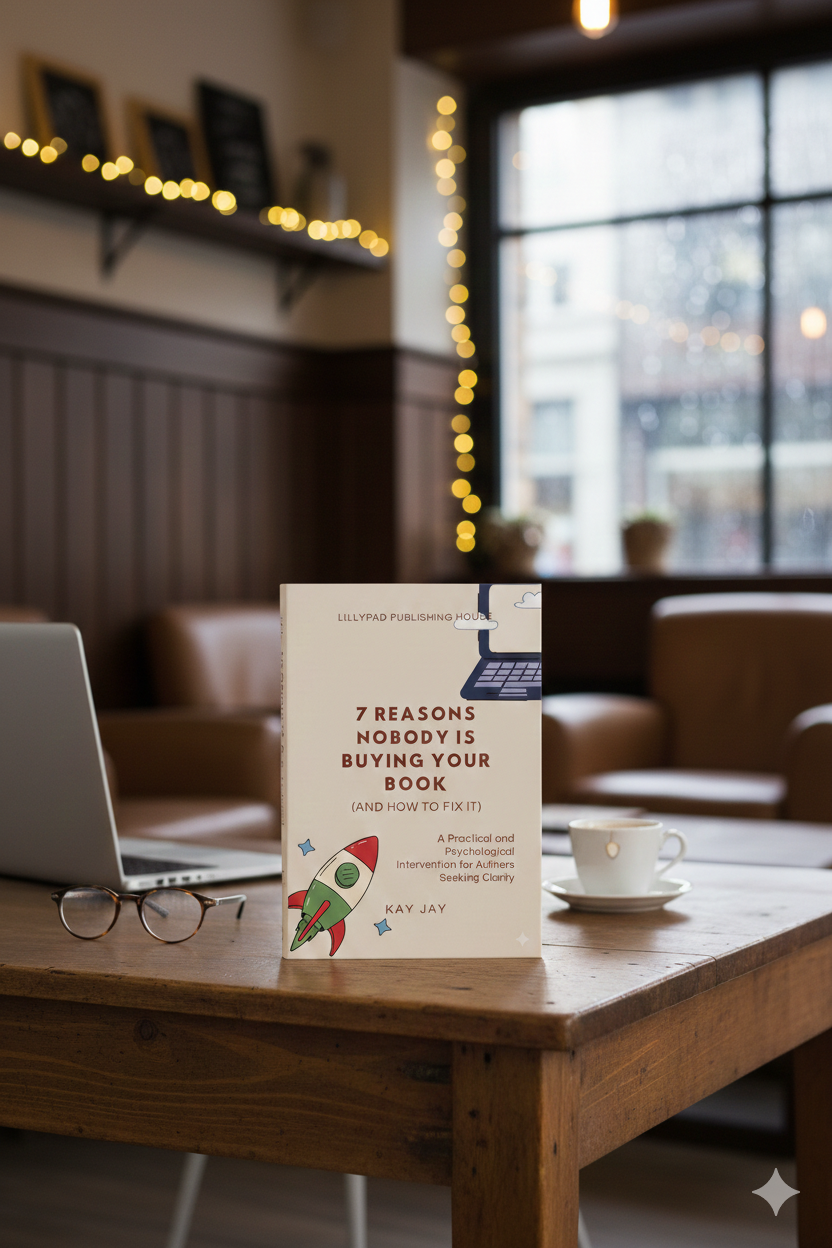
    7 Reasons Nobody Is Buying Your Book

    A cozy indoor setting featuring a book titled '7 Reasons Nobody Is Buying Your Book (And How to Fix It)' by Kay Jay, placed on a wooden table with a laptop, glasses, a cup of coffee, and a notebook. Soft lighting creates a warm atmosphere.
  • Why Your Scars Matter More Than Your Credentials

    Why Your Scars Matter More Than Your Credentials

    The importance of speaking from experience, not just authority.

    The traditional model of authority in publishing places the author on a pedestal. The signal is: “I am the expert. I have the credentials. Trust me because I know more than you do.” This model works for textbooks and academic journals, but it is fatally flawed in the attention economy, especially when the subject touches on personal pain, struggle, or transformation—like the isolating silence of a book launch.

    When an author stands on a pedestal, the reader’s immediate, unconscious reaction is one of skepticism and emotional distance. The pedestal creates a psychological barrier that says, “Your struggle is not my struggle. You were never where I am now.” This is the anti-signal; it repels the very connection your book needs to thrive.

    To break the silence, you must make a profound shift from Expert to Traveler.

    The Traveler is an author who speaks not just from a position of authority, but from a place of shared experience. The Traveler’s signal is: “I know this territory because I was lost here, too. These are the scars I picked up, and this is the map I found to get out.”

    Readers don’t trust your pedestal; they trust your scars.

    Your credentials may get a reader to pause, but your vulnerability is what gets them to buy. When you openly acknowledge the struggle, the confusion, and the failures you encountered before you wrote the book, you achieve two things instantly:

    1. You validate the reader’s pain. By showing your scars—your own 2 AM dashboard checks and moments of shame—you validate their current wound. They stop feeling alone and start feeling seen.
    2. You transform authority into trust. Authority on a pedestal is hierarchical and cold. Authority earned through shared struggle is intimate and magnetic. It allows the reader to drop their skepticism and emotionally invest in the journey.

    This is the true power of the signal. It is not about proving how much you know; it is about proving how much you understand. Your book is not a decree from a mountain peak; it is a whispered instruction from the guide who walked the path just ahead of them.

    Stop leading with your qualifications. Lead with your story. Lead with the specific, messy, human truth of the journey you undertook to find the answers in your book. Your readers are waiting not for an expert to lecture them, but for a trusted fellow traveler to hand them the map.

    7 Reasons Nobody Is Buying Your Book

    A cozy indoor setting featuring a book titled '7 Reasons Nobody Is Buying Your Book (And How to Fix It)' by Kay Jay, placed on a wooden table with a laptop, glasses, a cup of coffee, and a notebook. Soft lighting creates a warm atmosphere.
  • Finding Freedom: Decentralizing Your Identity in Relationships

    Finding Freedom: Decentralizing Your Identity in Relationships

    What Changes When a Connection Stops Being the Center of Your Identity

    There’s a subtle shift that happens when a relationship or connection is no longer the axis around which your world spins.

    At first, it feels like loss.
    Like gravity has gone missing.
    You panic because all your meaning seems tethered to their presence, attention, or approval.

    But slowly—if you allow it—a different kind of freedom emerges.


    The danger of centralizing someone else in your identity

    When someone else becomes the center of your emotional universe, you start living reactively:

    • You measure your self-worth by their behavior.
    • You monitor every interaction for hidden signs.
    • Your internal stability becomes conditional.

    Even love, which should feel expansive, begins to feel like a form of debt.


    The subtle liberation of decentralization

    When you stop making someone else the gravitational point of your identity, two things happen:

    1. Stability grows within
      Your moods, choices, and self-perception are no longer hostage to external variables.
      You start trusting your own inner compass instead of interpreting every look, word, or pause.
    2. Love becomes expansive rather than possessive
      You can appreciate their presence without craving it.
      You can honor their choices without taking them personally.
      You can love without needing the connection to define you.

    Why the change feels paradoxical

    It’s tempting to believe that stepping back emotionally is a loss of depth.

    It isn’t.

    Ironically, the moment the connection stops being your anchor, your heart often opens wider.
    You experience love without expectation.
    You feel intimacy without anxiety.
    You witness the other fully without feeling the need to hold or control.


    How this showed up in my life

    There was a period when I realized that a certain connection had been dominating my thoughts, emotions, and even daily rhythms.

    I wasn’t fully conscious of it at the time, but the dependency had built a cage around my internal life.

    The shift came when I stopped asking for validation from that presence and started grounding in my own self-worth.
    Suddenly, the same connection that once felt urgent now felt gentle, expansive, and alive without pressure.

    In Finding Noir, this principle guides the story: the characters discover that freedom doesn’t mean absence—it means recalibrating the center of gravity from the other to oneself.


    The ultimate lesson

    When a connection stops being the center of your identity, you don’t lose love—you gain perspective.

    You start to see the other person as a partner in experience, not a guarantor of your wholeness.
    You stop chasing meaning externally and find it within.
    And in that space, every connection—past, present, or future—becomes a mirror of growth rather than a measure of survival.

  • Why Authority Alone Can’t Sell Your Book

    Why Authority Alone Can’t Sell Your Book

    The importance of speaking from experience, not just authority.

    When you are struggling to break the silence and sell your book, the temptation is to adopt the persona of the Expert. This means speaking from a pedestal of perceived success and authority, leading with credentials and polished solutions. The core message is: “I know the answer. Trust me because I am above your struggle.”

    But in a marketplace saturated with experts, this approach fails. The pedestal creates an immediate, unconscious barrier. The reader sees the polished success and thinks, “They have no idea how hard this is for me.” This skepticism repels the very connection your book needs to thrive.

    The most powerful tool for connection is the Traveler Post.

    The Traveler Post is an act of profound vulnerability and service. It is communication crafted not from the height of the pedestal, but from the level of the hole you climbed out of. It relies on the deepest truth of your book’s origin: that you wrote it because you were once the lost and confused version of your ideal reader.

    The Traveler’s signal is: “I know this territory because I was lost here, too. I experienced the isolating shame of the 2 AM dashboard check, and this book is the map I found to get out.”

    Why Speaking from the Hole Works

    When you speak from the hole you climbed out of, you achieve two things instantly that no pedestal can offer:

    1. Immediate Trust and Validation: You validate the reader’s current pain. By sharing your own failures and confusion (your “scars”), you prove that their struggle is a shared, recognizable, and solvable experience. The reader stops feeling alone and starts feeling seen.
    2. Authority of Authenticity: You transform your authority from being hierarchical and cold into something intimate and magnetic. The reader is no longer being lectured by a guru; they are being guided by a trusted fellow traveler who is simply a few steps ahead.

    To create a genuine Traveler Post, stop leading with the solution. Lead with the struggle. Name the specific, embarrassing, human truth of the pain that led you to write the book. The moment you are brave enough to stand in the light of your own past confusion, you create a signal of authenticity that is irresistible. Readers don’t buy a book because the Expert wrote it; they buy it because the Traveler handed them the map.

    7 Reasons Nobody Is Buying Your Book

    A cozy indoor setting featuring a book titled '7 Reasons Nobody Is Buying Your Book (And How to Fix It)' by Kay Jay, placed on a wooden table with a laptop, glasses, a cup of coffee, and a notebook. Soft lighting creates a warm atmosphere.
  • Why Your Promotional Language Might Repel Readers

    Why Your Promotional Language Might Repel Readers

    A side-by-side comparison of promotional language that repels versus language that attracts.

    In the world of attention, every post, email, or ad you create is a signal. And that signal is instantly categorized by the reader as either a Product Post or a Purpose Post. This simple distinction determines whether your message is seen as noise to be scrolled past, or an invitation that creates unshakeable connection.

    Most authors, caught in the fear of invisibility, default to the Product Post.

    It is loud, urgent, and focused entirely on the author’s need. It speaks to the transaction. It is the language of:

    “My new book, 7 Reasons Nobody Is Buying Your Book, is out! Go buy it now and help me hit the charts! It’s packed with solutions to your sales problems.”

    This message is a flag of ego in the marketplace. It asks the reader to spend their valuable time and money to satisfy the author’s professional goal. Its underlying energy is: Help me, the author. This post repels connection because it asks for a favor before establishing any value. It treats the book as a product to be pushed, and the reader instantly registers it as transactional noise to be ignored.

    The truly successful signal, the one that breaks the silence, is the Purpose Post.

    It is clear, relevant, and focused entirely on the reader’s inner world. It speaks to the transformation. It is the language of:

    “Do you ever find yourself at 2 AM checking your sales dashboard, feeling that quiet, isolating shame? That ‘zero sales’ feeling is a specific signal of disconnection. Here’s the one truth I learned that breaks that cycle.”

    This message is a flag of recognition in the marketplace. It names a specific, hidden pain point the reader is experiencing (the 2 AM shame) and immediately offers a bridge to a solution. Its underlying energy is: I see your struggle, and I have the map. This post attracts gravity because it gives value first, transforming the book from a product into a tool for the reader’s relief. The reader is instantly drawn in because they feel understood.

    The Product Post makes the reader feel like a target. The Purpose Post makes the reader feel seen. The single shift that changes everything in your promotion is realizing the sale is a byproduct of connection. When you audit your posts by how clearly they help one person feel seen, the irresistible signal is created, and the purchase becomes a natural result of the gravity your purpose generates.

    7 Reasons Nobody Is Buying Your Book

    A cozy indoor setting featuring a book titled '7 Reasons Nobody Is Buying Your Book (And How to Fix It)' by Kay Jay, placed on a wooden table with a laptop, glasses, a cup of coffee, and a notebook. Soft lighting creates a warm atmosphere.
  • Transform Readers with Your Book’s Why Instead of What

    Transform Readers with Your Book’s Why Instead of What

    The gravity that meaning creates.

    When most authors launch a book, their promotional activity is focused on the What. What is the book about? What are the chapter titles? What are the features? This is the domain of the Performance Post, and it is a surface-level interaction that is easily ignored.

    To break the silence, you need to shift to the domain of the Why.

    The Origin Story is not a product announcement; it is an act of translation. It takes the months or years of internal struggle, personal breakthrough, and sheer meaning that drove you to write the book, and makes that vulnerability visible to the reader.

    The moment you share your Why—the original wound, the question you couldn’t answer, the realization that changed everything for you—you create an immense gravity. You move the conversation from logic (“Should I buy this?”) to emotional resonance (“I feel the same way”).

    Why Origin Trumps Product

    Readers don’t buy content. They buy the clarity and transformation that the content promises. And the most compelling proof of that transformation is the author’s own journey.

    • The Product Focus (What): “My book is out! It contains the 7-step system for fixing your sales problem.” (This is transactional.)
    • The Origin Focus (Why): “I was met with the same silence after launching my first book. I was at the 2 AM dashboard check, convinced I was a failure. I wrote this book because I couldn’t find the map I desperately needed to answer the question, ‘Why Is Nobody Buying My Book?’ This is the emotional journey to that clarity, and I want you to have it, too.” (This is transformational.)

    When you are brave enough to share the original pain and the internal shift that led to your book, you give the reader immediate, undeniable permission to trust you. They stop seeing a polished, impersonal product and start seeing a fellow human who is offering a bridge out of a struggle they share.The sale becomes a formality. The reader is not purchasing a book; they are enrolling in the journey you have just validated with your own story. The gravity of your genuine purpose is the clearest signal you can send in the attention economy. It is the proof that your book is not just good—it is necessary.

    7 Reasons Nobody Is Buying Your Book

    A cozy indoor setting featuring a book titled '7 Reasons Nobody Is Buying Your Book (And How to Fix It)' by Kay Jay, placed on a wooden table with a laptop, glasses, a cup of coffee, and a notebook. Soft lighting creates a warm atmosphere.
  • Why Separation Is Almost Always a Blessing—Even When It Breaks You First

    Why Separation Is Almost Always a Blessing—Even When It Breaks You First

    No one experiences separation as a gift in real time.

    It arrives as loss.
    As confusion.
    As a sudden collapse of meaning.

    When the connection that once felt like oxygen disappears—or becomes unreachable—the mind scrambles to make sense of the pain. We ask what went wrong. Who failed. What we should have done differently.

    But separation isn’t a punishment.
    It’s a recalibration.

    And almost always, it’s necessary.


    When closeness accelerates what you can’t yet hold

    Some connections move faster than the nervous system can integrate.

    They awaken parts of us that haven’t been stabilized—old trauma, dormant longing, unresolved identity fractures. When that happens, proximity becomes overwhelming rather than nourishing.

    The bond isn’t the problem.
    The pace is.

    Separation slows things down enough for the body and psyche to catch up.


    In my case, everything fell apart at once

    The unraveling didn’t limit itself to love.

    I was dealing with chronic physical pain.
    I was laid off from work.
    I had to change countries.
    My sense of continuity—career, health, geography—collapsed in parallel.

    At the time, it felt cruel. Excessive. Unnecessary.

    But distance from the relationship created space for something else to surface:
    a reckoning with how much of my life had been built around endurance rather than alignment.


    Absence reveals what presence can’t

    When someone is no longer available as an emotional anchor, all the unaddressed parts of you start speaking louder.

    Not because you’re failing—
    but because there’s finally room to hear them.

    Patterns become obvious.
    Dependencies show themselves.
    Parts of the self that were numbed by intensity come back online.

    It’s destabilizing.
    And it’s also clarifying.


    Why growth accelerates in this phase

    Without the option to regulate through the other, you’re forced inward.

    Not in a romantic way.
    In a practical one.

    You learn:

    • how to sit with discomfort without outsourcing it
    • how to rebuild identity from the inside out
    • how to let life reorganize around truth instead of habit

    Transformation that might have taken years gets compressed.

    Not because you’re special—
    but because the conditions demand it.


    The hidden role the other plays

    This is the part that’s hardest to accept.

    Sometimes a connection’s highest function isn’t to stay.
    It’s to initiate.

    To catalyze a collapse that reveals where your life was misaligned.
    To expose what needed to be dismantled.
    To step away so the work could actually begin.

    In Finding Noir, this is the unspoken undercurrent of the story—the recognition that presence lit the match, but absence did the refining.


    When you stop asking for it to end differently

    There’s a moment, usually much later, when the question changes.

    Not:
    “Why did this happen to me?”

    But:
    “What did this make possible?”

    When you see clearly how much inner ground you gained—clarity, strength, self-trust—the narrative of loss loosens its grip.

    The pain doesn’t vanish.
    But it stops feeling pointless.

    And that’s when separation quietly reveals itself—not as the opposite of love, but as one of its more severe expressions.

    Not kind.
    Not gentle.
    But precise.

  • Why Clarity Matters in Your Manuscript Presentation

    Why Clarity Matters in Your Manuscript Presentation

    A clear explanation of the difference between a high-quality manuscript and a clear message.

    The deepest frustration for any author is pouring your heart into a masterpiece, only to be met with silence. You know the work is good—the craft is flawless, the research is sound, and the message is necessary. But the sales dashboard remains at zero.

    As we’ve discussed, this is not a failure of quality; it is a failure of signal. Your book exists, but its message is not reaching the specific people who desperately need to hear it. The solution to breaking this invisibility is not to become louder, but to become profoundly clearer.

    Your book’s presentation—its title, subtitle, cover, and description—has mere seconds to cut through the noise of the endless scroll. To fix the failure of clarity, your presentation must immediately and unapologetically communicate three essential things to the distracted reader:

    1. The Signal of Relevance (Who Is This For?)

    Your signal must instantly name the specific, niche, and often embarrassing struggle of your ideal reader. The distracted reader’s first question is: “Is this for me?” If your title is generic or broad (e.g., The Road to Self-Improvement), it suggests it is for “everyone,” which in the attention economy means it is for no one.

    • The Fix: Be a sniper, not a shotgun. Name the specific pain: “The High-Achiever’s Guide to Not Feeling Broke,” or “Why You’re Still Tired.” This transforms the signal from a polite suggestion into an irresistible, personal shout of recognition.

    2. The Signal of Emotional Safety (Do You Understand Me?)

    The reader is not just looking for a solution; they are looking for a guide they can trust. Trust is built on empathy, not just expertise. The reader needs assurance that you understand the emotional, messy reality of their confusion—the “Shared Secret.”

    • The Fix: Your language must speak from shared experience (The Traveler), not from a distant pedestal (The Expert). Use the language of “we” and “you,” and validate the specific shame or frustration they are carrying. This signal creates a profound, instant bond that overrides skepticism.

    3. The Signal of Transformation (What Will I Become?)

    The reader is not buying content or information; they are buying the emotional and practical result. Your presentation must clearly articulate the after state, the change, the clarity, or the relief the book provides.

    • The Fix: Your description must sell Transformation Over Information. Stop listing chapters and start listing the benefits: “Move from confused, busy effort to clear, focused impact.” This reframes the purchase as an investment in a desired future, not a risk on an unknown product.

    The silence breaks when you stop battling for attention and start focusing on clear communication. A high-quality manuscript is your foundation, but the Authority of Clarity is the engine of its success. By ensuring your presentation delivers these three signals immediately, you transform your book from an invisible label into an undeniable invitation.

    7 Reasons Nobody Is Buying Your Book

    A cozy indoor setting featuring a book titled '7 Reasons Nobody Is Buying Your Book (And How to Fix It)' by Kay Jay, placed on a wooden table with a laptop, glasses, a cup of coffee, and a notebook. Soft lighting creates a warm atmosphere.
  • How to Capture Attention in a Crowded Content Feed

    How to Capture Attention in a Crowded Content Feed

    Analyzing what makes a signal irresistible in a crowded feed.

    In the current attention economy, your book has a new and more dangerous competitor than any other author: the endless scroll.

    The problem is not that readers are actively rejecting your book; it’s that they are barely seeing it. Your book exists inside an environment of overwhelming choice and perpetual distraction. Every phone swipe, every notification, every new piece of content is an appeal for attention.

    This is the reality of the marketplace. Your masterpiece, the thoughtful, well-edited book you poured your heart into, is competing against vacation photos, breaking news, and quick-hit entertainment. It is competing against distraction, and distraction is relentless.

    This introduces the Distracted Scroll Test:

    If a potential reader is scrolling quickly—not searching for a solution, but merely trying to ignore the noise—does your book’s presentation offer an immediate, clear, and emotional reason for them to stop?

    If your book requires the reader to slow down, click, and evaluate its quality, it has already failed the test. The modern reader will not accept the burden of translation. Your book must be instantly and relentlessly recognizable.

    Consider the difference in signals on a crowded feed:

    • Invisible Signal: A book cover featuring a calming landscape and a polite title, such as The Quiet Path to Self-Improvement. It suggests quality and a good topic, but it offers no specific, immediate reason to interrupt the scroll. Its message is generic and easily ignored.
    • Irresistible Signal: Another book, on the same fundamental topic, is titled, Why You’re Still Tired: The High-Achiever’s Guide to Reclaiming 3 Hours a Day. This signal is a shout of recognition. It names a specific, painful struggle (being tired despite being high-achieving) and promises a concrete result.

    The irresistible signal doesn’t rely on being “good.” It relies on being relevant to the point of being magnetic. It doesn’t ask the reader to buy a product; it interrupts their state of distraction to shout, “This is for you right now.”

    Your book’s presentation—your title, subtitle, and cover—must function as a clear, simple invitation that cuts through the noise. Stop designing for the reader who is actively searching, and start designing for the distracted reader who needs to be stopped cold by the emotional truth of your work. That immediate, specific signal of relevance is the only true lever for visibility.

    7 Reasons Nobody Is Buying Your Book

    A cozy indoor setting featuring a book titled '7 Reasons Nobody Is Buying Your Book (And How to Fix It)' by Kay Jay, placed on a wooden table with a laptop, glasses, a cup of coffee, and a notebook. Soft lighting creates a warm atmosphere.
  • Transformative Connections: Embrace Love Beyond Norms

    Transformative Connections: Embrace Love Beyond Norms

    Why Connections That Don’t Fit the Matrix’s Definition of Relationships Can Be the Most Transformative

    Most of us are taught to define relationships by visible markers:

    • exclusivity
    • longevity
    • social approval
    • milestones checked off in sequence

    These definitions create a framework we can manage, evaluate, and present to the world. They feel safe because they’re measurable.

    But some connections refuse to be measured. They refuse to fit neatly into schedules, labels, or expectations. And because of that, they feel destabilizing at first—sometimes terrifying.


    Want versus need

    The key difference is subtle: traditional relationships often operate on need.

    We need love, validation, stability, or belonging. The connection becomes a source of security, a way to fill internal gaps.

    Transformative connections operate on want.

    You want the presence of the other.
    You want their energy, their depth, their truth.
    But the connection doesn’t demand your stability or completion—it invites it.

    Want doesn’t create dependency. Need does.


    Why the discomfort is part of the work

    When a connection refuses to fit the matrix, the mind panics:

    • “Why isn’t this relationship normal?”
    • “Am I doing something wrong?”
    • “Should I give up?”

    This discomfort isn’t a mistake.
    It’s the mirror: it reflects your attachment patterns, your need for control, and your expectations of love.

    Through that reflection, you start to notice something vital: the connection’s value isn’t measured by conventional markers—it’s measured by its ability to catalyze inner growth.


    When love becomes a teacher

    In these kinds of connections, love doesn’t ask you to stay.
    It asks you to notice.
    To reflect.
    To expand.

    It stretches your comfort zones.
    It dissolves old narratives.
    It exposes what parts of yourself you were hiding from—sometimes even from yourself.

    And paradoxically, the more you surrender the need for a “normal” outcome, the more expansive and alive the connection becomes.


    How this manifested in my life

    There were periods where the connection I experienced made no sense externally.

    • Plans didn’t align.
    • Timelines didn’t exist.
    • Social and cultural differences made simple togetherness impossible.

    But internally, the connection forced clarity.
    It exposed old wounds.
    It invited presence.
    It taught me how to hold love without ownership.

    In Finding Noir, this principle is at the heart of the story: the characters are drawn to each other beyond societal frameworks, and the value of the connection lies in its capacity to transform, not in its conformity to expectation.


    Reframing the matrix

    The lesson is simple but profound:

    Love that doesn’t fit the matrix isn’t broken.
    It’s advanced.
    It’s designed to meet you where you are, challenge your internal patterns, and catalyze transformation that traditional definitions could never reach.

    Once you embrace that, the discomfort fades.
    You stop asking, Why isn’t this normal?
    You start asking, What am I learning about myself?

    And that question opens the door to growth that no conventional connection could provide.