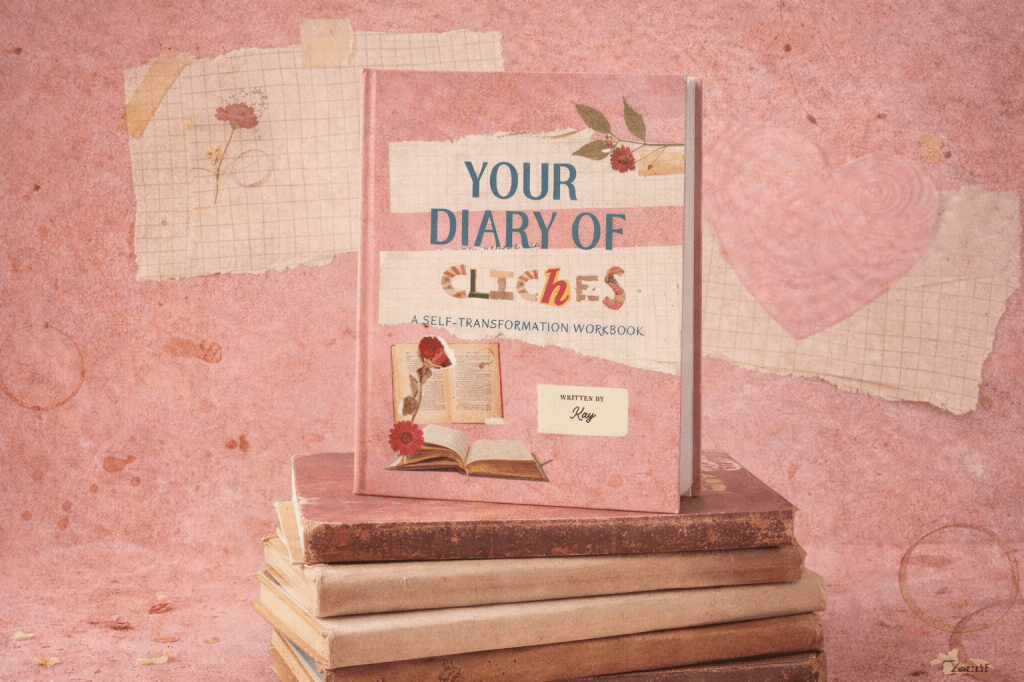
“I Rolled My Eyes at Every Cliché. Then I Lived All of Them.”
I used to think clichés were for people who hadn’t thought deeply enough. They were shortcuts—phrases you reached for when you didn’t want to sit with complexity. Everything happens for a reason. Time heals all wounds. You’ll know when it’s right. I heard these lines the way one hears elevator music: vaguely familiar, mildly irritating, easily ignored.
And then life, with impeccable timing, handed me the full set.
There is a special kind of humiliation in realizing that the sentences you once mocked are now doing heavy emotional labor in your own head. That you have become the person nodding slowly, saying things like I needed that to happen or It taught me something. Worse, that these phrases—stripped of irony and said quietly—are sometimes… accurate. Not poetic. Not elegant. Just stubbornly true.
Diary of Clichés began as resistance. I wanted to interrogate the language we use to smooth over discomfort, to poke holes in the platitudes we lean on when we don’t know what else to say. But somewhere along the way, the diary turned its gaze back on me. Each cliché I examined wasn’t an abstraction; it was a lived moment. Loss that insisted on being processed in its own time. Growth that refused to announce itself. Love that arrived without clarity and left behind better questions.
What surprised me wasn’t that clichés exist, but that they endure. They survive because they are resilient containers for shared human experience. They show up when individuality fails us—when the feelings are too big, too common, or too old to belong to just one person. The problem isn’t that clichés are false. It’s that they’re incomplete. They flatten nuance. They skip the footnotes. They rarely admit how uncomfortable the truth feels while it’s happening.
This book is an attempt to put the footnotes back.
Diary of Clichés doesn’t try to retire these phrases; it holds them up to the light, rotates them slowly, and asks what they cost us—and what they give us—when we finally stop pretending we’re above them. If there’s humor here, it’s because self-awareness is funny in hindsight. If there’s tenderness, it’s because becoming a cliché usually means you’ve survived something.
I no longer roll my eyes when I hear these lines. I listen. Not because they’re profound, but because they remind me that whatever I’m going through has been rehearsed by millions before me. And somehow, that makes it easier to keep writing it honestly.



 Kay’s Odyssey
Leave a comment