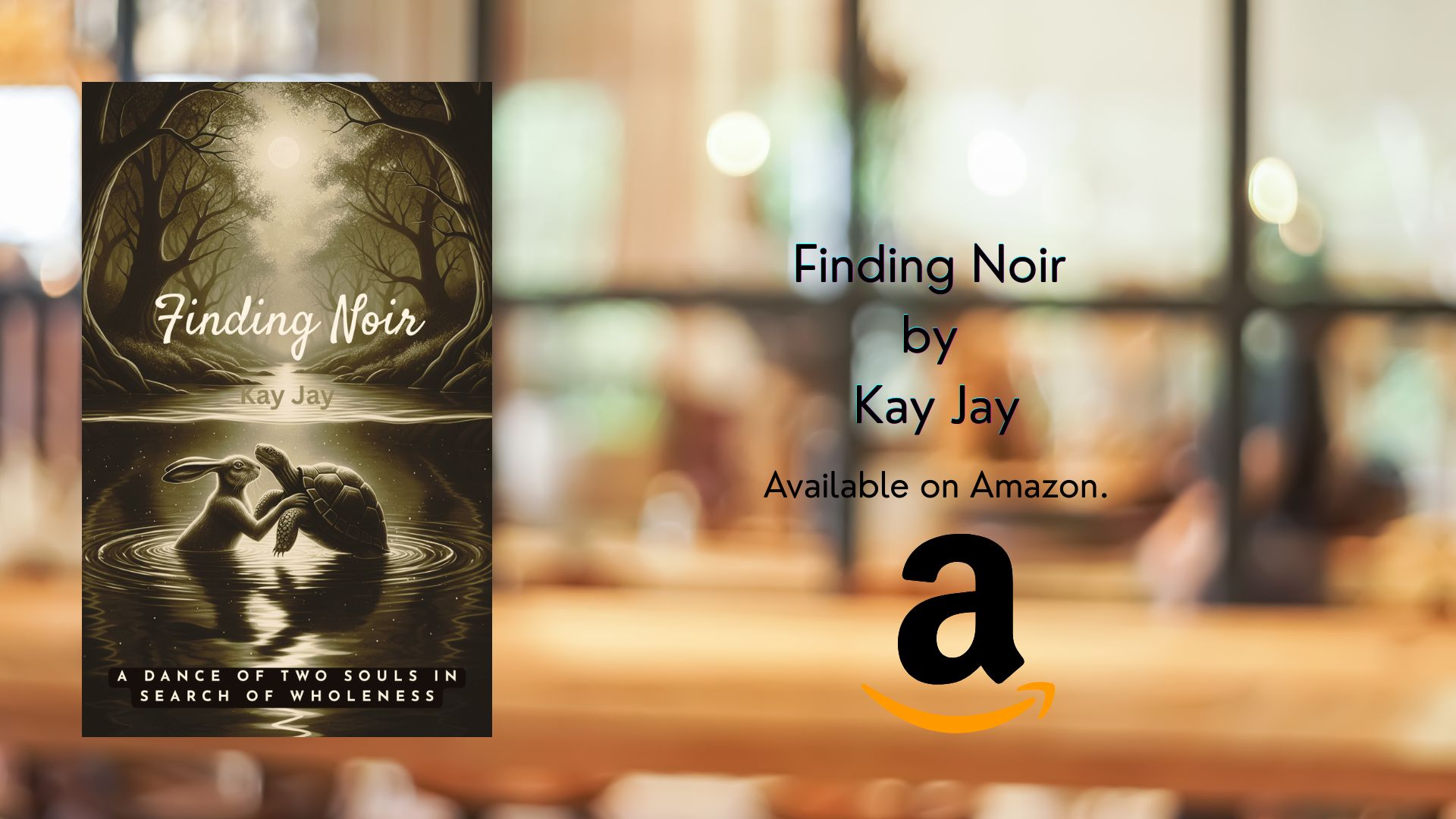
Finding Noir by Kay Jay
I know the spiral well. It starts in the silence—that “quiet violence of unanswered messages”—and it ends in an autopsy of the self.
You replay every sentence, every pause, every “almost.” You convince yourself that if you had only moved a different piece on the chessboard of the relationship, the ending would have changed. You tell yourself you should have been softer, braver, less intense, or more mysterious. You treat your own honesty like a liability and your depth like a defect.
But I want to offer you a quieter, more dangerous question: What if you didn’t do anything wrong—what if you were simply brave enough to feel everything?
The Seduction of Control
Asking “What could I have done differently?” is seductive because it implies control. It suggests that love is a strategic game rather than a collision. We want to believe that if we edit ourselves perfectly, we can secure an outcome—longevity, commitment, or return.
In Finding Noir, I explore what happens when you stop editing yourself for an outcome that was never available. Many of our most intense connections are not meant to be secured; they are meant to act as catalysts. They arrive to rearrange the internal furniture of our lives, to ask questions instead of offering futures.
Activation vs. Intimacy
Often, we blame ourselves for “failing” at a connection that lived vividly in the interior world but failed spectacularly in the physical one. We mistake intensity for alignment and activation for intimacy. Our nervous systems can confuse the high-voltage triggers of our past with the quiet depth of a shared future.
When you feel like you “messed up,” consider that the connection might have simply reached its capacity to teach you. Sometimes, the only thing you could have done differently was leave the story earlier—before it taught you everything it came to teach.
Love as a Mirror, Not a Promise
If we treat love as a mirror rather than a promise, the “wrongness” disappears. A mirror doesn’t tell you if you are a “good” or “bad” partner; it shows you who you become in the presence of another. It exposes your unhealed hunger, your projections, and the parts of yourself you have been reluctant to face.
If you were “too much” or “too honest,” perhaps you weren’t failing at a relationship; perhaps you were succeeding at an awakening. You were finally standing in your own raw, visceral truth.
The Freedom of Recognition
This work doesn’t offer closure—it offers recognition. It is for anyone who felt chosen in private and abandoned in reality.
If you find yourself standing at the edge of this realization, know that your intensity is not a liability. Your willingness to feel is your greatest strength. Some encounters are not meant to last because their purpose is not companionship, but consciousness. They arrive to interrupt the architecture of who you think you are so that something truer has a chance to emerge.
You didn’t do anything wrong. You were just brave enough to step into the clearing and look at the reflection without flinching. And in that stillness, you might finally find the one thing you were actually searching for: yourself.




Leave a Reply