Author: Kay’s Corner

  • Building on Rented Land: A Journey of Identity and Reinvention

    Building on Rented Land: A Journey of Identity and Reinvention

    For twenty years, I believed I was building a fortress, only to realize I had been building on rented land. This wasn’t just about the physical apartments I occupied in San Francisco or the temporary rental I moved into upon returning to Mumbai; it was a metaphor for my entire existence—my career, my legal status, and my very identity were all subject to the whims of landlords, immigration officers, and corporate algorithms.

    In the United States, the land I stood on was literally rented from the government. I spent two decades building a life, paying taxes, and forging deep communities, only to be reminded by a “BOOM” moment from an immigration officer that I didn’t truly belong. Visa rules are not just immigration policy; they are life policy. They dictated whether I could keep my home, my stability, and my dignity. When that “rented” legal status was challenged, the two decades of sweat and heart I had invested felt like they counted for nothing.

    My professional identity was similarly built on borrowed soil. I viewed my high-flying tech career as my “badge of honor” and the tangible evidence of my worth. I used my corporate title to justify everything from my San Francisco rent to my self-esteem. But when the “thunderbolt” of a layoff hit, I was thrust into an “existential abyss”. I realized I had been a mere “cog in a vast, impersonal machine,” and without the “life rafts” of meetings and KPIs, I was suddenly unmoored. I was an inhabitant of an “uncharted territory” of free time, mourning a person I no longer was.

    Returning to India offered no immediate solid ground. I found that the house I grew up in—the silent witness to my entire childhood—had been demolished for redevelopment. My past was unceremoniously discarded to make way for a “shinier” future, and I was forced into a rental apartment that felt “borrowed” and sterile. Here, the “rented land” took the form of Mrs. D, the landlord from hell. Renting in India felt like entering a long-term relationship with someone I didn’t even like, where privacy was a myth and my family’s habits were under constant “psychological warfare”. Whether it was the “Crow-Feeding Incident” or unannounced inspections, I was treated like an “untrustworthy babysitter” in a space that was supposed to be my sanctuary.

    The breaking point came when I realized I could no longer live at the mercy of others’ rules—whether they were the “Byzantine seller policies” of Amazon or the “eviction threats” of a petty landlord. I finally understood that I had spent years trying to outrun unpredictability, choosing the structure of the West over the “madness of home,” only to find that stability is often an illusion.

    I am now learning to build on the only land I truly own: myself. Reinvention has taught me that “home” is not a zip code or a corporate title, but the “slow, patient work of belonging to yourself”. I am finding my footing through “small, inconsequential acts”—shared laughter during family meals, the “playful dinner-time negotiations” with my dog Sauli, and the simple pleasure of hot chai on a rainy day. The potholes I encountered were not just obstacles; they were “unanticipated mentors” guiding me toward a version of myself that can laugh at absurdities and find peace in the “messy middle”. I have stopped looking for a “guaranteed key” to someone else’s door and have started the work of finally building a home within.

    Listen to the full episode on the Diary of Cliches Podcast

    Illustration for Built on Rented Land, accompanying a reflective essay about identity, displacement, and learning to create a sense of home within oneself.
  • Discomfort is Art: Why I Write for the Messy and Unvarnished

    Discomfort is Art: Why I Write for the Messy and Unvarnished

    I have a confession to make: I don’t write to flatter my readers. I don’t set out to craft love stories dressed in “neat little packages” or polished bows. Instead, I am drawn to the raw, messy edges of emotion—the places where longing feels “raw, unfiltered, and humiliating.” In my literary world, I have come to believe a singular truth: discomfort is the art.

    The Honesty in the “Nuts”

    Book cover of Beautiful Men with bold, visually striking cover artwork.
    Book cover for Beautiful Men: The Dog Walker.

    When my first book, The Dog Walker, was released, it sparked quite a divide. One critic famously called the protagonist, Sarah, “absolutely nuts” for her humiliating attempts to connect with a man while navigating her grief. They labeled the book a “narrative failure.”

    When I read those words, I actually smiled. That reaction meant the story had done exactly what I intended. Sarah’s flaws, her delusions, and her awkwardness weren’t mistakes; they were the story. I believe that awkwardness is the honesty of the human condition. If you felt uncomfortable reading Sarah’s journey, it’s because real longing—the kind that isn’t sanitized for a movie screen—is inherently cringeworthy and painful.

    Sitting with the “Lead Apron”

    This philosophy of intentional discomfort followed me into the kitchen in The Chef. Here, the discomfort isn’t just about social awkwardness; it’s about the “lead apron” of depression. I wanted to force readers to sit with Kevin as he performs the role of a confident, Michelin-starred chef while his “inner world was crumbling.”

    There is a profound unease in watching someone we want to root for disappear or fail to answer a message because the weight of their own mind is too heavy. But I refuse to tidy that away. True connection doesn’t happen in spite of our brokenness; it happens because of it. Intimacy is not a “flawless performance”; it is the quiet courage to show up—hungry, imperfect, and willing to be fed.

    The Labyrinth of “Tomorrow”

    In Fever Dreams, I explored a more modern form of discomfort: the “existential claustrophobia” of the digital age. I wanted to capture that “shimmering mirage” of belonging we feel through dating apps, which often only deepens our solitude.

    The discomfort in Dev and Mira’s story comes from the blurring of reality and illusion. I purposefully created a “delayed tomorrow,” a loop where meeting in person is a mirage that perpetually recedes. It’s an unsettling space to inhabit, both for the characters and the reader. It asks a question we are often afraid to answer: Is our “online self” an accurate reflection of identity, or just another mask that keeps us from being truly known?

    Embracing the Cringe

    As an author, I am basically daring you to embrace the cringe. I want you to squirm a little, to recognize the unvarnished parts of yourself in my characters’ humiliations and their “nuts” behavior.

    We live in a world obsessed with digital validation and curated perfection. By leaning into discomfort, I hope to create a “pathway to connection” based on our shared human imperfection. Thank you for having the courage to walk with me into these shadows; I hope that in the awkwardness, you find a spark of recognition for your own quiet courage.

    Watch the latest episode of Beautiful Men to see the full video!

  • When You Know It Won’t Work

    When You Know It Won’t Work

    Finding Noir by Kay Jay

    There is a specific kind of grief that lives in the realization that a story has reached its natural conclusion before you were ready to put it down. It isn’t always marked by a dramatic explosion or a final, cinematic goodbye. More often, it is the quiet violence of unanswered messages and a body that understands the truth long before the mind is willing to admit it: this is it.

    In these moments, we are seduced by the question: “What could I have done differently?”. We replay the pauses, the “almosts,” and every sentence spoken, convincing ourselves that if we had moved a different piece on the chessboard, the ending would change. But love is a collision, not a game of strategy, and sometimes the only thing you could have done differently was leave the story earlier—before it taught you everything it came to teach.

    The Failed Physicality vs. The Vivid Interior

    We are taught to measure the legitimacy of a connection by its outcomes—longevity, commitment, and return. When a connection fails to manifest in the physical world, we label it a failure. However, my work explores the connections that live vividly in the interior world while failing spectacularly in the physical one.

    When you know it won’t work, it is often because the encounter was never intended to be a “promise” of a shared future. Instead, it was a mirror—a reflective surface that showed you not who the other person was, but who you became in their presence. These connections don’t arrive to soothe or stabilize us; they arrive to rearrange the internal furniture and ask questions instead of offering futures.

    Recognition Over Closure

    The modern pursuit of “closure” is often just a disguised attempt to edit ourselves for an outcome that was never available. My mission is not to offer you closure, but recognition.

    • Activation is not Intimacy: Often, when we feel a connection is “fated” but impossible, it is because our nervous system is confusing activation with intimacy.
    • The Catalyst: The unreachable other is often a placeholder—a catalyst meant to reveal your own unhealed hunger rather than a partner meant to accompany you.
    • The Somatic Truth: Your body knows when a connection is meant for consciousness rather than companionship.

    Finding the Strength to Stay Still

    If you find yourself standing at the edge of this realization, understand that you didn’t do anything wrong; you were simply brave enough to feel everything. The “Hare” will always run, and the “Tortoise” must eventually realize that her stillness is not a passive wait for a return, but an active cessation of the need for external validation.

    When you know it won’t work, the journey shifts. It is no longer about chasing a silhouette into the trees. It is about the Sacred Marriage of the self—finding the strength not to find someone else to complete you, but to complete yourself. The most powerful connections are not always the healthiest, but they are almost always the most revealing. When the mirror has shown you what you need to see, it is okay to let it break.

    Finding Noir a novel by Kay Jay
    A Dance of Two Souls in search of wholeness
  • Unlocking Book Sales: 7 Key Reasons for Low Visibility

    Unlocking Book Sales: 7 Key Reasons for Low Visibility

    The true beginning of clarity.

    If you are holding this guide, you have almost certainly known the silence. You know the unique, isolating grief of pouring your heart, soul, and years into a manuscript, only to watch it disappear into the quiet, indifferent existence of the marketplace. You’ve asked yourself the dangerous, desperate questions: Was it not good enough? Was I not good enough?

    After launching my first book, Diary of Cliches, I searched for the answer outside of myself. I scoured the internet for marketing tricks, sales hacks, and instant formulas that would solve the problem of zero sales. But the answer was never “out there.” The silence only deepened, and the shame of invisibility grew.

    The true breakthrough—the one realization that changed the entire trajectory of my work and became the foundation of this book—came with a profound internal shift. I had to stop looking at the marketplace and start looking at my own mind.

    I finally understood the simple, unshakeable truth: The problem was never the book itself. It was my relationship with visibility, value, and connection.

    This realization was a moment of internal clarity that stretched my mind, allowing me to finally see the invisible barriers I had inadvertently created.

    • Visibility: I had focused on Performance (making noise) instead of Clarity (sending a resonant signal).
    • Value: I had fallen into the Hesitant Price Trap, communicating low value through my own discomfort with money.
    • Connection: I had tried to sell a product from an Expert’s Pedestal instead of offering a map as a Fellow Traveler.

    This discovery—that selling a book is not just a technical process, but a deeply human one rooted in confidence, empathy, and service—changed everything. It was the moment I stopped battling the marketplace and started serving the reader. Understanding why your book is not selling is not the end of the journey; it is the true beginning of clarity.This book, 7 Reasons Nobody Is Buying Your Book And How to Fix It, is the map born from that realization. It explores the deeper forces that truly shape a book’s destiny—money, psychology, emotional resonance, and the authority of authenticity. Because once you understand that your book is a Living Entity and your signal is a service, everything changes, and your story finally gets the chance to travel.

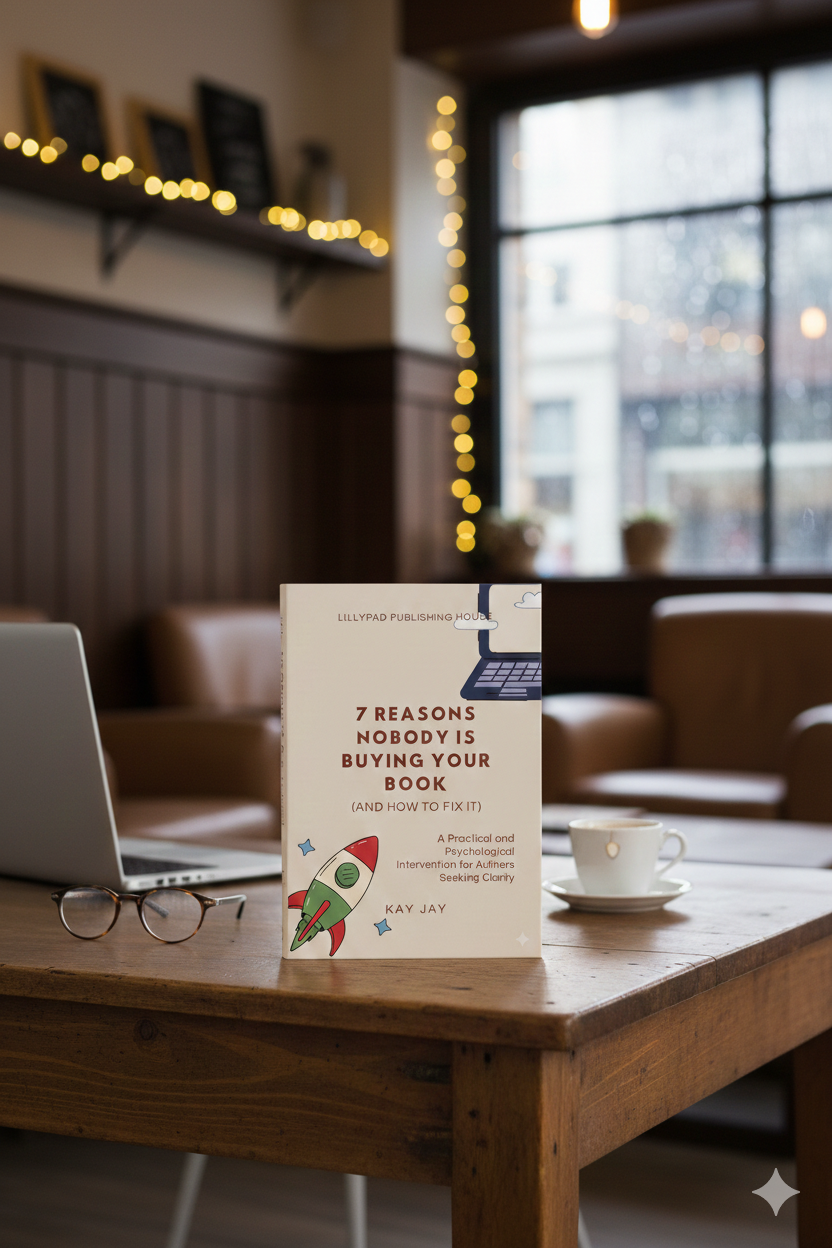
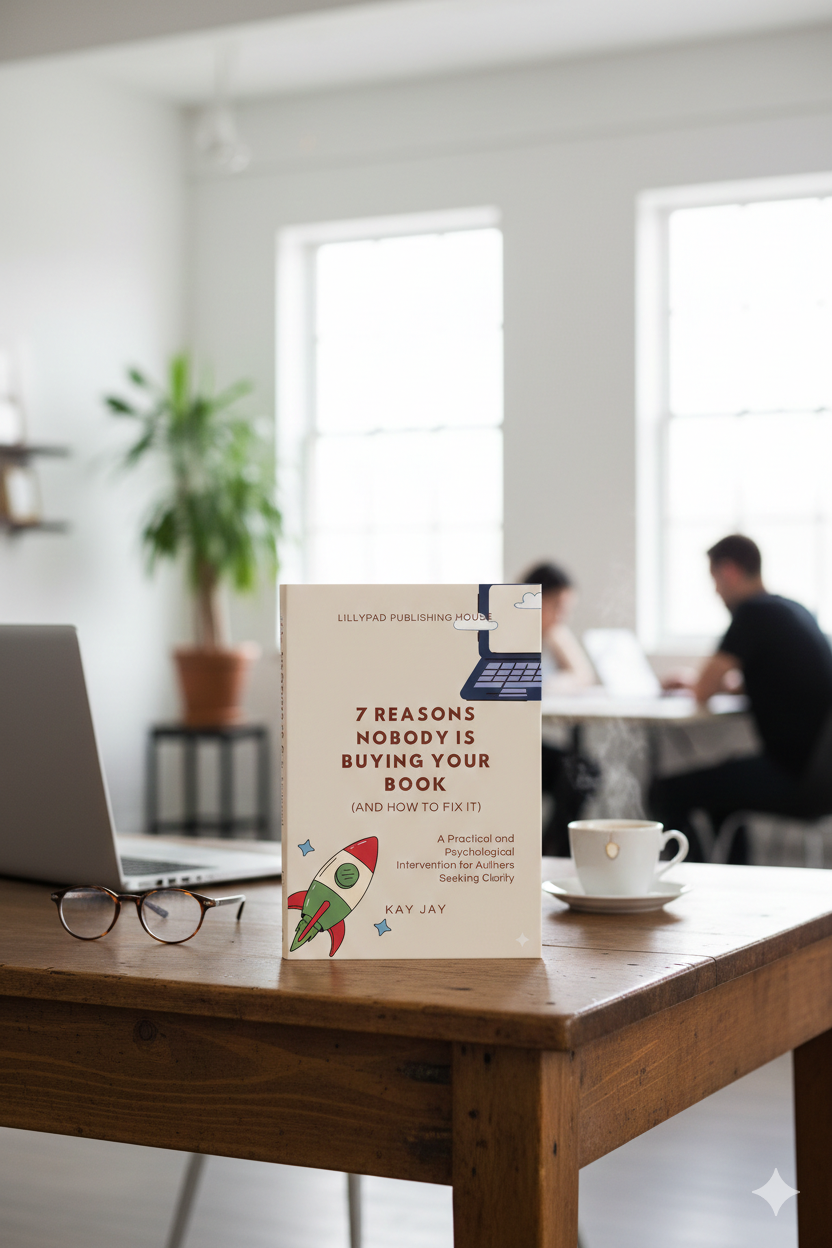
    7 Reasons Nobody Is Buying Your Book

    A cozy indoor setting featuring a book titled '7 Reasons Nobody Is Buying Your Book (And How to Fix It)' by Kay Jay, placed on a wooden table with a laptop, glasses, a cup of coffee, and a notebook. Soft lighting creates a warm atmosphere.
  • Why Radical Career Pivots Often Fail

    Why Radical Career Pivots Often Fail

    For years, I believed that if my life hit a deep enough pothole, the only way out was a radical, cinematic pivot. When the “thunderbolt” of a corporate layoff shattered my Silicon Valley identity, I didn’t just want a new job; I wanted a completely new soul. I stepped into an “existential abyss” where my worth, previously measured by “KPIs and quarterly goals,” had vanished overnight. My immediate instinct was to perform a 180-degree turn, attempting to leap from high-level data strategy to selling holistic herbs on Amazon or hand-pouring artisanal candles. But as I navigated the “messy middle” of this transition, I realized why these radical pivots often fail: they are frequently a desperate attempt to satisfy someone else’s definition of success rather than our own.

    My pivot into “tangible” businesses was largely fueled by my father, a mechanical engineer who dismissed software as “digital nonsense” and an “imaginary profession”. He believed “real engineers” built bridges and dams, not lines of code. In my vulnerability, I tried to bridge this generational chasm by dreaming up “real-tangible-products”—like matcha-infused chai lattes or gourmet paneer masala burgers—hoping that a physical product would finally make me a success in his eyes. Pivots fail when they are a reaction to external devaluation rather than an internal evolution. I was trying to build a “machinery” career to fix a feeling of invisibility, but the “Byzantine seller policies” and the “existential dread of inventory management” only added new layers of chaos to my already fractured life.

    Another reason radical pivots falter is the expectation of a “montage moment.” We are conditioned by movies to believe that starting over comes with a sudden burst of clarity and a quick resolution. In reality, reinvention is a “perpetual pothole-ridden road trip” where the familiar signposts vanish and the road is rarely paved. I found myself sitting on a suitcase in an airport, mourning the person I used to be while having no idea who I was becoming. When we expect a clean break, we are unprepared for the “liminal space between darkness and light” where we feel like a visitor in our own lives.

    Furthermore, radical pivots often fail because we use them to outrun our own unpredictability. I spent years trying to choose the structure of the West over the “madness of home,” only to realize that the “potholes” followed me across continents. Whether it was my dog Sauli’s dramatic “Mission Impossible” escape attempts or the “psychological warfare” of a landlord from hell, life refused to be neatly re-categorized into a new, efficient business plan. I learned that we often seek “comfort more than connection,” clinging to the illusion of a new career or a new city to avoid the “raw reality” of our own grief.

    Ultimately, I discovered that my pivot from “code to copy”—from building digital systems to writing—was successful only because it wasn’t a total abandonment of myself. It was a “quiet recalibration of values” where I stopped trying to find a “guaranteed key to unlock any door” and instead focused on the “patient work of belonging to myself”. Radical pivots fail when we try to fly over the potholes; they succeed when we accept that the potholes are the very paths that lead us home. Success is not a final destination or a prestigious new title; it is the steady decision to keep showing up for yourself on the scenic, unpredictable route.

    Listen to the full episode on the Diary of Cliches Podcast!

    The piece argues that radical life or career pivots often fail when they come from panic, external pressure, or the desire to prove something rather than genuine inner change. Using a personal story after a corporate layoff, it shows how dramatic reinvention can become a way to chase validation, escape grief, or expect a clean cinematic transformation. The core takeaway is that lasting change usually comes not from abandoning who you are, but from a slower, more honest realignment of your values and identity.
  • Transform Your Book into a Living Entity

    Transform Your Book into a Living Entity

    Committing to your book’s long-term journey.

    The most limiting belief an author holds is that their book is a one-time product. This perspective is a direct consequence of the sprint mindset: you pour your heart into the writing, hit ‘publish,’ and view the book as a final, static object ready to be sold in a single, urgent burst of promotion.

    When the launch sprint fails and the silence hits, the author is left with a profound sense of finality. The product has failed. The work is done. This leads to burnout and retreat, mistakenly concluding that the book itself was a mistake.

    To break the silence for good, you must make a profound shift in mindset: Your book is not a one-time product. It is a Living Entity—the starting point of a cumulative, career-long conversation.

    A Living Entity requires sustained nourishment and continuous interaction. This shift in perspective transforms the entire post-launch journey:

    1. From Product to Relationship: The book is not an object to be pushed; it is the physical manifestation of a core message that acts as the magnet for your ideal reader. The goal is no longer a single transaction, but the ongoing cultivation of a deep, trusting relationship with the person who needs your map.
    2. From Finality to Iteration: The conversation doesn’t end on launch day. Every piece of content you create—every Service Post, every essay, every email—is an iteration of your book’s core truth. It is a continuous effort to clarify the signal, a new piece of the map, or a way to help one person feel seen today. This continuous clarity is the compounding force of the marathon.
    3. From Scarce to Abundant: When you view the book as a static product, you hoard its ideas, fearing you’ll give too much away. When you view it as a Living Entity, you realize that every shared piece of its core message (the Purpose Post) only serves to prove the transformation and build the unshakeable trust that drives the eventual sale.

    The silence breaks when you commit to this long-term view. Your book needs a clear, consistent signal over the course of a full year, not just a frantic burst in the first month. This commitment to a cumulative conversation—this steady, intentional nurturing of your book’s message as a Living Entity—is the only way to ensure your story finally travels and finds its true, lasting audience.

    7 Reasons Nobody Is Buying Your Book

    A cozy indoor setting featuring a book titled '7 Reasons Nobody Is Buying Your Book (And How to Fix It)' by Kay Jay, placed on a wooden table with a laptop, glasses, a cup of coffee, and a notebook. Soft lighting creates a warm atmosphere.
  • Navigating Identity Crisis After Job Loss

    Navigating Identity Crisis After Job Loss

    For two decades, my life was a carefully constructed fortress built on the bedrock of a corporate title. In the high-stakes tech world of San Francisco, my job was not merely a source of income; it was my “badge of honor” and the primary justification for every choice I made. I used my position to validate my existence, from the exorbitant rent on my apartment to the years of therapy and countless sleepless nights I endured to keep climbing the ladder. I was a creature of structure, finding safety in the “constant hum of work responsibilities” that acted as a protective layer, keeping deeper heartaches at bay through sheer busyness.

    Then, the “thunderbolt” hit. A corporate layoff—delivered via a sterile email beginning with the dreaded “We regret to inform you”—shattered my foundation. Suddenly, I was standing at the edge of an “existential abyss,” an ominous void of uncertainty and doubt. I was forced to confront a terrifying question: who was I outside of “KPIs and quarterly goals”?. Without the “life rafts” of meetings, emails, and presentations, I felt unmoored and adrift, a mere visitor in my own life.

    The process of looking for a new anchor only deepened the crisis. I entered a “soul-crushing ritual” where I felt reduced to a “keyword-optimized resume” or a series of checkboxes on an online form. I was fighting against “endless algorithms” that chose my fate before I could ever have a human conversation, making me feel like a disposable “cog in a vast, impersonal machine”. Even when I returned to my roots in India, the “absurdity of resumes” followed me; interviewers viewed my international success with suspicion, treating my return as a “red flag” rather than an asset.

    My sense of professional legitimacy was further hollowed out by the “Real Engineer” debate with my father. A mechanical engineer by trade, he dismissed my entire career as “digital nonsense” and an “imaginary profession” because it lacked a physical manifestation like a bridge or a dam. In his eyes, I wasn’t an engineer; I was just someone doing a “programmer’s job,” and despite my years in Silicon Valley, I felt like a failure.

    I am now navigating what I call the “messy middle” of reinvention. It is a liminal space where I am simultaneously mourning the person I was while trying to figure out who I might become. I have had to learn that rebuilding a life happens one “small, inconsequential act at a time”—setting up a new workspace, learning the layout of a new neighborhood, or finding the perfect cup of chai.

    I’ve realized that the “potholes” of job loss and identity crisis weren’t just obstacles; they were “unanticipated mentors” guiding me toward a deeper understanding of my own resilience. I am slowly unlearning the idea that my worth is tied to a zip code or a corporate title. Instead, I am doing the quiet, patient work of belonging to myself. Success, I’ve found, is not a final destination on a freshly paved highway, but the steady decision to keep showing up for yourself on the scenic, pothole-ridden route.

    Watch the full episode on the Diary of Cliches Podcast!

    Alt text: Illustration or featured image for a reflective post about job loss, career identity, corporate layoffs, reinvention, resilience, and rebuilding self-worth beyond professional titles.

  • The Marathoner’s Mindset: How to handle the sales dashboard without losing your energy.

    The Marathoner’s Mindset: How to handle the sales dashboard without losing your energy.

    The emotional work of staying present for the long game.

    Every author knows the ritual: the quiet, late-night login to the sales dashboard. You scroll past the zeros, or the quiet, indifferent numbers, and in that moment, the exhaustion of the work hits. The mind immediately asks the most dangerous question: If I’m working this hard, why isn’t the needle moving?

    The sales dashboard is not a tool for motivation; it is a profound risk to your energy. When you operate with a Sprint Mindset, you treat that dashboard as the finish line, demanding an instant, explosive reward for your effort. When the reward doesn’t materialize, the lack of immediate sales acts as an emotional vacuum, sucking all the creative energy out of you. This leads to burnout and retreat—the final failure of the invisible author.

    To thrive in the long game of publishing, you must adopt the Marathoner’s Mindset toward the dashboard. This is a commitment to a sustainable, emotionally grounded approach that transforms the numbers from a judgment into an instruction.

    The Shift: From Judgment to Instruction

    The marathoner knows the race is won through consistent pacing and internal fortitude, not explosive bursts. The sales dashboard, therefore, is not a reflection of your worth, but a signal for clarity:

    1. Detach Your Worth: The first step is to emotionally detach your personal value from the numbers. The Zero Sales figure is not a statement about your talent; it is simply a signal of disconnection. It means the bridge between your book and the person who needs it is not yet clear enough.
    2. Focus on the Process, Not the Outcome: The marathoner focuses on the mile they are running right now. The author focuses on the Service Post they are creating today. The goal is not a massive spike; the goal is to maintain a clear, consistent signal (the Gravity of Meaning) every single week. Consistent clarity is the only thing that compounds over time.
    3. Use It as a Compass, Not a Verdict: Check the dashboard only to inform your strategy, not to dictate your mood. If the numbers are low, it is an instruction to go back to your Position → Package → Signal sequence. It means: My signal needs to be clearer. I need to be more specific about the pain I solve. It is an instruction to recommit to your Purpose Post and speak to the Traveler who is still lost.

    Your energy is finite. You cannot afford to lose it to the emotional turmoil of a transactional mindset. The Marathoner’s Mindset treats publishing as the starting line of a long, rewarding race. By using the sales dashboard as a dispassionate compass for clarity, and by relentlessly focusing on the emotional work of serving your reader, you protect your energy and ensure you stay present long enough for your clear, sustained signal to finally break the silence.

    7 Reasons Nobody Is Buying Your Book

    A cozy indoor setting featuring a book titled '7 Reasons Nobody Is Buying Your Book (And How to Fix It)' by Kay Jay, placed on a wooden table with a laptop, glasses, a cup of coffee, and a notebook. Soft lighting creates a warm atmosphere.
  • Why Sustained Presence Beats Impulse in Book Promotion

    Why Sustained Presence Beats Impulse in Book Promotion

    Setting expectations for sustained presence over time.

    When a book launches, the author is often caught in a powerful, dangerous delusion: The False Hope of Impulse. This is the belief that one massive burst of promotional effort—a single, urgent, highly-visible event—will magically break the silence and catapult the book to success. It is the sprint mentality: If I just push hard enough for 7 days, I will win the attention lottery.

    But the attention economy has rendered this impulse obsolete. A single, large impulse of volume will create a momentary spike, but it is instantly overwhelmed by the perpetual, relentless flow of distraction. That massive effort fades, leaving the author exhausted and the book exactly where it started: invisible.

    The reality is that enduring success is a marathon won by sustained, small signals.

    The attention economy does not reward the loudest voice; it rewards the most consistent and resonant frequency. A sustained, small signal is a Service Post—a concise, clear, and valuable piece of the map—that is delivered to the reader week after week, month after month.

    Why Impulse Fails and Sustained Signals Win:

    1. Impulse is Transactional; Sustained is Relational: An impulse signal (the sprint) is almost always urgent and focused on the transaction (“Buy now!”). This repels connection. A sustained signal (the marathon) is focused on consistent service, building an unbreakable relationship of trust and recognition over time.
    2. Impulse is Easily Ignored; Sustained is Unavoidable: A single, loud burst can be missed during a busy day or filtered out as transactional noise. A steady, clear signal—a consistent presence that names the reader’s pain every week—becomes an unavoidable, dependable fixture in their world. It creates a cumulative effect that cuts through the distraction.
    3. Impulse is Fragile; Sustained is Magnetic: The sales spike from an impulse post relies on a moment of persuasion. The steady stream of sustained, small signals relies on recognition. It compounds trust, making the eventual purchase an act of self-recognition that the reader initiates, rather than a sale the author has to force.

    Your book is not a lottery ticket. It is a long-term asset that solves a perpetual problem. Stop chasing the emotional high and fleeting visibility of the impulse sprint. Commit to the emotional work of staying present and sending clear, consistent, small signals. That steady, relentless focus on service over impulse is the only force that breaks the silence for good.

    7 Reasons Nobody Is Buying Your Book

    A cozy indoor setting featuring a book titled '7 Reasons Nobody Is Buying Your Book (And How to Fix It)' by Kay Jay, placed on a wooden table with a laptop, glasses, a cup of coffee, and a notebook. Soft lighting creates a warm atmosphere.
  • The Marathon Mindset: Sustaining Your Book’s Presence

    The Marathon Mindset: Sustaining Your Book’s Presence

    Setting expectations for sustained presence over time.

    When you hit ‘publish,’ you have just completed the writing sprint—the intense, focused effort of creation. The immense, isolating disappointment that often follows is because you are expecting a sprint’s reward from what is, in reality, a marathon’s journey.

    The true challenge of book success is not the writing itself, but the Emotional Work of Staying Present for the long game.

    The marketplace of attention is a constant, endless scroll. A single, powerful burst of promotion will fade almost instantly. To break the silence for good, you need to develop the emotional fortitude of a marathoner—the capacity to maintain a clear, consistent signal over twelve months, not just twelve days.

    This requires a deep, internal commitment to three emotional shifts:

    1. The Commitment to Clarity Over Volume: The sprinter’s instinct is to become louder, to push more urgent transactional posts. The marathoner commits to clarity. They understand that one clear, resonant Service Post per week—one small, specific piece of the map—is infinitely more powerful over time than ten loud, generic Product Posts in a single day.
    2. The Commitment to Purpose Over Sales: The emotional work involves detaching your sense of self-worth from the daily sales dashboard. The sprinter checks the numbers obsessively; the marathoner focuses on the Gravity of Meaning. They recommit daily to the book’s Origin Story: “I wrote this because I wished someone had handed me the map.” This service-focused purpose is the fuel that allows you to show up, even when the numbers are quiet.
    3. The Commitment to Consistency Over Perfection: The initial burst of enthusiasm is easy. The sustained, quiet presence—the consistent effort to name the reader’s hidden pain and offer the map over the course of a full year—is the true mark of a marathoner. This consistency builds an unconscious, powerful trust that an intermittent sprint cannot. It turns your signal into a dependable fixture in the reader’s world.

    Your book is not a lottery ticket designed for a single win; it is a long-term asset designed for sustained connection. The silence breaks not with a massive, one-time burst, but with the quiet, relentless, and emotionally grounded commitment to a clear signal, day after day. Committing to the full year is the only way to transform your work from an invisible product into an irresistible, enduring presence.

    7 Reasons Nobody Is Buying Your Book

    A cozy indoor setting featuring a book titled '7 Reasons Nobody Is Buying Your Book (And How to Fix It)' by Kay Jay, placed on a wooden table with a laptop, glasses, a cup of coffee, and a notebook. Soft lighting creates a warm atmosphere.