Category: writing

  • The Gravity of Meaning: How purpose, not features, is the real secret to attracting readers.

    The Gravity of Meaning: How purpose, not features, is the real secret to attracting readers.

    The gravity that meaning creates.

    When most authors launch a book, their promotional activity is focused on the What. What is the book about? What are the chapter titles? What are the features? This is the domain of the Product Post, and it is a surface-level interaction that is easily ignored because it lacks depth.

    To break the silence, you need to shift the entire weight of your communication to the Why.

    The Gravity of Meaning is the irresistible force created when you openly share the authentic purpose that compelled you to write the book. This purpose is not a marketing strategy; it is the ultimate act of vulnerability and service. It is the Origin Story of your book, and it takes the reader’s focus away from the features and places it on the transformation.

    Why Purpose Trumps Features

    The features of your book (the content, the steps, the number of pages) are logical data points. They engage the skeptical, calculating part of the reader’s brain, which is already conditioned to ignore most transactional noise.

    But the reader is not buying a list of features; they are buying the emotional and practical result. They are buying the bridge out of their specific pain.

    • Features Post (The Product): “My book is out! It contains the 7 reasons your sales are stuck and the 7 steps to fix them.” (This is transactional.)
    • Purpose Post (The Meaning): “I wrote this book because I was at the 2 AM dashboard check, convinced my entire effort was a mistake. I couldn’t find a map that spoke to the human shame of invisibility. This guide is the journey to clarity I desperately wished I had. I want you to escape that pain, too.” (This is transformational.)

    The Purpose Post generates gravity. It moves the conversation from the logical question, “Should I buy this?” to the emotional imperative, “I feel the same way—I need this map.” The reader stops seeing a product and starts seeing a fellow human who is offering a rescue.

    The moment you are brave enough to share the original pain and the internal shift that led to your book, you give the reader immediate, undeniable permission to trust you. That conviction—the Gravity of Meaning—is the clearest signal you can send in the attention economy. It is the proof that your book is not just good—it is necessary.

    7 Reasons Nobody Is Buying Your Book

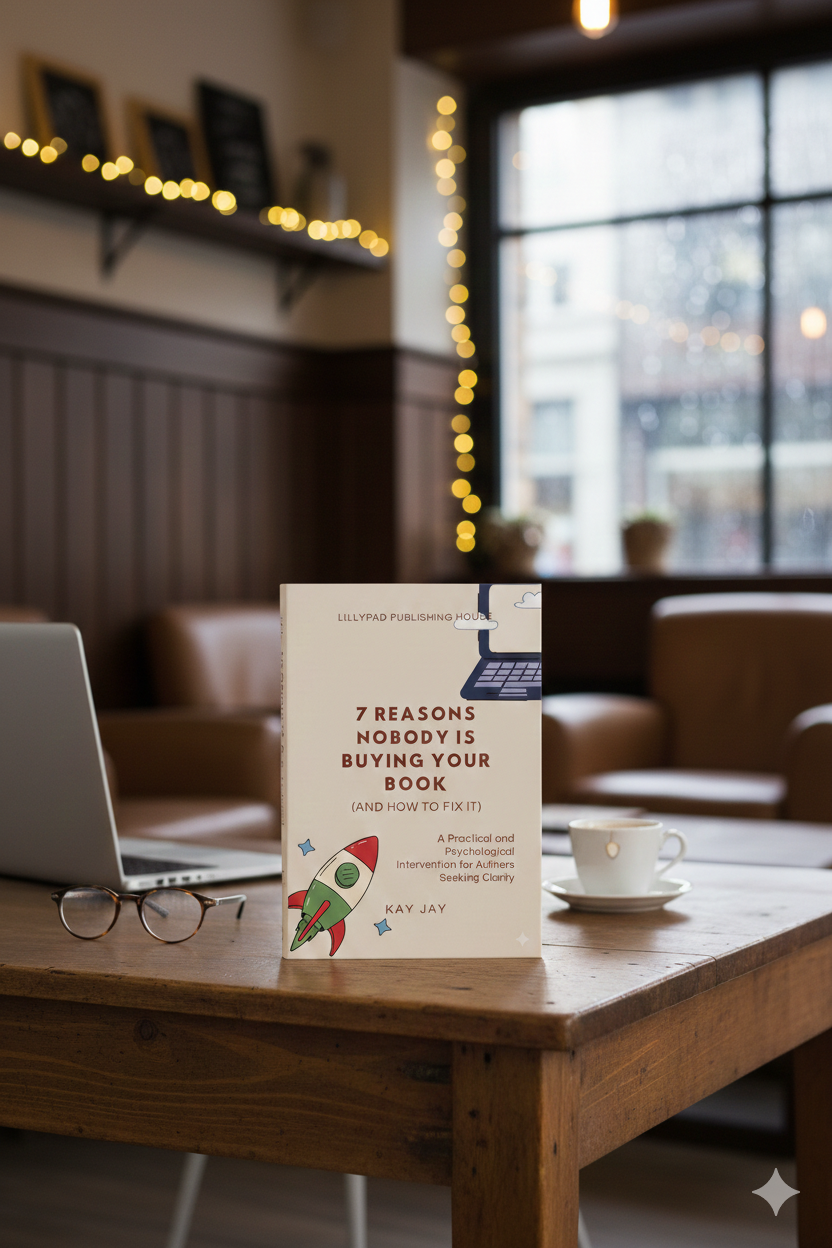
    A cozy indoor setting featuring a book titled '7 Reasons Nobody Is Buying Your Book (And How to Fix It)' by Kay Jay, placed on a wooden table with a laptop, glasses, a cup of coffee, and a notebook. Soft lighting creates a warm atmosphere.
  • Transforming Your Book from System to Personal Guide

    Transforming Your Book from System to Personal Guide

    The single most important perspective shift to break the silence.

    When an author finally finishes their book, the natural instinct is to view it as a Definitive System. It is a polished, comprehensive product—the final word on the subject. This perspective is understandable, but it is one of the most powerful reasons for invisibility.

    The “Definitive System” mindset leads to a language of authority, perfection, and impersonal data: “This book is the ultimate, definitive, comprehensive guide to problem X.” This creates the Expert on the Pedestal barrier, repelling the emotional connection readers desperately need.

    The breakthrough that fundamentally breaks the silence is the shift from selling a Definitive System to offering a Personal Guide.

    Your book is not a flawless, objective textbook. It is a Map—the very guide you desperately wished someone had handed you ten years ago, when you were lost, confused, and struggling with the exact problem your book solves.

    When you frame your book as the “Map I Wish Someone Handed Me,” you transform its signal instantly:

    1. From Expert to Traveler: You step off the pedestal. You stop claiming to know everything and start sharing the messy, human truth of the journey. The reader is no longer being lectured; they are being guided by a trusted fellow traveler who is only a few steps ahead.
    2. From Product to Bridge: The book ceases to be an object to be sold and becomes the fastest, clearest, safest route out of the reader’s current pain. It’s no longer a risk to buy; it’s an urgent necessity.
    3. From Logic to Emotion: The core message becomes intensely personal and emotionally resonant. You are not selling a system; you are selling the clarity and relief you found on the other side of the confusion.

    The most powerful sales post you can ever write is one that focuses on your past self. “This guide contains the three things I wish I knew when I was checking my sales dashboard at 2 AM, convinced I was a failure. It’s the map that breaks the cycle of silence, and I’m handing it to you now.”

    The reader doesn’t need another definitive system. They need a guide who understands the territory. Stop trying to sell the perfect, finished product. Start sharing the honest, hard-won map that saved you. That act of service is the single most powerful signal that moves a book from invisible to irresistible.

    7 Reasons Nobody Is Buying Your Book

    A cozy indoor setting featuring a book titled '7 Reasons Nobody Is Buying Your Book (And How to Fix It)' by Kay Jay, placed on a wooden table with a laptop, glasses, a cup of coffee, and a notebook. Soft lighting creates a warm atmosphere.
  • Emotional Honesty: Bridging the Gap with Readers

    Emotional Honesty: Bridging the Gap with Readers

    The importance of speaking from experience, not just authority.

    The traditional model of authority in publishing demands perfection. It asks the author to present a seamless narrative of success, standing on a pedestal of expertise, where the final product is a logical, flawless solution. This presentation, while technically professional, creates a profound intellectual distance between you and the reader.

    When you present as the perfect Expert, the reader sees the solution but struggles to see themselves in your journey. Their unconscious thought is: “That’s great for them, but they’ve never been where I am now.” The book becomes an object of admiration, not a bridge of shared experience. The emotional connection—the core of the sale—is repelled.

    To break the silence, you must eliminate this intellectual distance with emotional honesty.

    This is the Truth of Your Scars.

    Your scars—the specific, messy, human failures you experienced before writing the book—are the single most powerful tool you have for connection. They are the undeniable proof that you are the Traveler who was lost in the same confusing territory, not the detached Expert who arrived by helicopter.

    When you openly share the shame of your own failures—the truth of your 2 AM dashboard check or the fear that your entire effort was a mistake—you achieve two critical things:

    1. You Eliminate Distance: You step off the pedestal and stand beside the reader. Your vulnerability is the ultimate act of trust, which the reader instantly reciprocates. The intellectual barrier collapses as the emotional connection takes over.
    2. You Transform Authority: Your authority ceases to be a credential on a wall and becomes a map of escape. The reader is no longer trusting your title; they are trusting the lived experience that gave you the map. This is the Authority of Authenticity.

    Readers do not buy a logical solution; they buy the emotional relief of feeling seen. The moment you are brave enough to present the truth of your scars, your book ceases to be an object and becomes an intimate, magnetic invitation. That emotional honesty is the only signal that consistently eliminates the distance and creates an irresistible connection.

    7 Reasons Nobody Is Buying Your Book

    A cozy indoor setting featuring a book titled '7 Reasons Nobody Is Buying Your Book (And How to Fix It)' by Kay Jay, placed on a wooden table with a laptop, glasses, a cup of coffee, and a notebook. Soft lighting creates a warm atmosphere.
  • The Language of Shared Confusion: What to say to readers to make them feel truly seen.

    The Language of Shared Confusion: What to say to readers to make them feel truly seen.

    The importance of speaking from experience, not just authority.

    The most critical error an author makes when trying to break the silence is adopting the wrong vocabulary. They speak the Language of Authority, which is logical, objective, and focuses on the solution. This language sounds like a lecture from a distant expert on a pedestal.

    But the reader who is scrolling—the one living inside the isolating confusion of an invisible book—doesn’t need a lecture. They need a rescue.

    The only language that creates an irresistible signal is the Language of Shared Confusion. This is the vocabulary of the Traveler—the author who speaks directly from the hole they climbed out of. Its fundamental purpose is not to inform the reader of the facts, but to make them feel profoundly, instantly seen.

    This language is built on empathy and vulnerability, not credentials. It transforms your message from a transactional pitch into an act of profound recognition.

    The Shift in Language

    To speak the Language of Shared Confusion, you must replace the abstract, authoritative words with specific, messy, human words:

    Language of Authority (Repels)Language of Shared Confusion (Attracts)
    ProblemThe isolating shame of the 2 AM dashboard check
    SolutionThe map out of the hole I climbed out of
    InformationThe truth I was too embarrassed to admit
    You will learnYou are not alone in feeling this way
    I am an expertI know this territory because I was lost here, too
    The objective truth is…That confusing pain is not a failure of your talent…

    The power of this language is its ability to name the reader’s Shared Secret—the specific fear they are carrying, like the fear of being “good enough” but still ignored. When you use the Language of Shared Confusion, you stop asking the reader to trust your title. You create a moment where the reader thinks, “Only someone who has felt this exact way could write this sentence.”

    This moment of recognition is the source of all connection. It is the authority of clarity. When your language validates the reader’s internal world, the reader’s logical defenses drop, and the sale becomes a natural, emotional imperative. Stop speaking like the Expert on the pedestal. Start speaking the language of the lost Traveler who came home with the map.

    7 Reasons Nobody Is Buying Your Book

    A cozy indoor setting featuring a book titled '7 Reasons Nobody Is Buying Your Book (And How to Fix It)' by Kay Jay, placed on a wooden table with a laptop, glasses, a cup of coffee, and a notebook. Soft lighting creates a warm atmosphere.
  • From Authority to Authenticity in Writing

    From Authority to Authenticity in Writing

    The importance of speaking from experience, not just authority.

    The traditional model of authority in publishing places the author on a pedestal. The signal is: “I am the expert. I have the credentials. Trust me because I know more than you do.” This model works for textbooks and academic journals, but it is fatally flawed in the attention economy, especially when the subject touches on personal pain, struggle, or transformation—like the isolating silence of a book launch.

    The Expert on the pedestal creates an immediate, unconscious barrier. The reader sees the polished success and thinks, “They have no idea how hard this is for me.” This skepticism repels the very connection your book needs to thrive.

    To break the silence, you must make a profound shift from Authority to Authenticity.

    The moment you acknowledge your own struggle—your own failure—you step off the pedestal and join the reader on the ground. You become the Traveler who knows the territory intimately because you were lost there, too. This is the truth that every invisible author must embrace:

    Readers don’t trust your authority; they trust your failures.

    Your credentials may get a reader to pause, but your vulnerability is what gets them to buy. When you openly share the scars of your journey—the specific, messy, human truth of the struggle you encountered before you found the answers in your book—you achieve two powerful things:

    1. You Validate the Reader’s Pain: By revealing your own 2 AM dashboard check or the shame of the zero sales number, you instantly validate the reader’s current wound. You transform their private, isolating confusion into a shared, recognizable struggle. They stop feeling alone and start feeling seen.
    2. You Transform Authority into Trust: Authority on a pedestal is hierarchical and cold. Authority earned through shared failure is intimate and magnetic. You are no longer a distant guru; you are the guide who came back with the map. This allows the reader to drop their skepticism and emotionally invest in the journey.

    The highest form of authority in the attention economy is not achieved by listing what you know, but by demonstrating how much you understand. Your book is not a decree from a mountain peak; it is a whispered instruction from the fellow traveler who walked the path just ahead of them. Stop leading with your credentials. Lead with the honest truth of your failures, and you will create the clearest, most irresistible signal of connection.

    7 Reasons Nobody Is Buying Your Book

    A cozy indoor setting featuring a book titled '7 Reasons Nobody Is Buying Your Book (And How to Fix It)' by Kay Jay, placed on a wooden table with a laptop, glasses, a cup of coffee, and a notebook. Soft lighting creates a warm atmosphere.
  • Why Your Scars Matter More Than Your Credentials

    Why Your Scars Matter More Than Your Credentials

    The importance of speaking from experience, not just authority.

    The traditional model of authority in publishing places the author on a pedestal. The signal is: “I am the expert. I have the credentials. Trust me because I know more than you do.” This model works for textbooks and academic journals, but it is fatally flawed in the attention economy, especially when the subject touches on personal pain, struggle, or transformation—like the isolating silence of a book launch.

    When an author stands on a pedestal, the reader’s immediate, unconscious reaction is one of skepticism and emotional distance. The pedestal creates a psychological barrier that says, “Your struggle is not my struggle. You were never where I am now.” This is the anti-signal; it repels the very connection your book needs to thrive.

    To break the silence, you must make a profound shift from Expert to Traveler.

    The Traveler is an author who speaks not just from a position of authority, but from a place of shared experience. The Traveler’s signal is: “I know this territory because I was lost here, too. These are the scars I picked up, and this is the map I found to get out.”

    Readers don’t trust your pedestal; they trust your scars.

    Your credentials may get a reader to pause, but your vulnerability is what gets them to buy. When you openly acknowledge the struggle, the confusion, and the failures you encountered before you wrote the book, you achieve two things instantly:

    1. You validate the reader’s pain. By showing your scars—your own 2 AM dashboard checks and moments of shame—you validate their current wound. They stop feeling alone and start feeling seen.
    2. You transform authority into trust. Authority on a pedestal is hierarchical and cold. Authority earned through shared struggle is intimate and magnetic. It allows the reader to drop their skepticism and emotionally invest in the journey.

    This is the true power of the signal. It is not about proving how much you know; it is about proving how much you understand. Your book is not a decree from a mountain peak; it is a whispered instruction from the guide who walked the path just ahead of them.

    Stop leading with your qualifications. Lead with your story. Lead with the specific, messy, human truth of the journey you undertook to find the answers in your book. Your readers are waiting not for an expert to lecture them, but for a trusted fellow traveler to hand them the map.

    7 Reasons Nobody Is Buying Your Book

    A cozy indoor setting featuring a book titled '7 Reasons Nobody Is Buying Your Book (And How to Fix It)' by Kay Jay, placed on a wooden table with a laptop, glasses, a cup of coffee, and a notebook. Soft lighting creates a warm atmosphere.
  • Why Authority Alone Can’t Sell Your Book

    Why Authority Alone Can’t Sell Your Book

    The importance of speaking from experience, not just authority.

    When you are struggling to break the silence and sell your book, the temptation is to adopt the persona of the Expert. This means speaking from a pedestal of perceived success and authority, leading with credentials and polished solutions. The core message is: “I know the answer. Trust me because I am above your struggle.”

    But in a marketplace saturated with experts, this approach fails. The pedestal creates an immediate, unconscious barrier. The reader sees the polished success and thinks, “They have no idea how hard this is for me.” This skepticism repels the very connection your book needs to thrive.

    The most powerful tool for connection is the Traveler Post.

    The Traveler Post is an act of profound vulnerability and service. It is communication crafted not from the height of the pedestal, but from the level of the hole you climbed out of. It relies on the deepest truth of your book’s origin: that you wrote it because you were once the lost and confused version of your ideal reader.

    The Traveler’s signal is: “I know this territory because I was lost here, too. I experienced the isolating shame of the 2 AM dashboard check, and this book is the map I found to get out.”

    Why Speaking from the Hole Works

    When you speak from the hole you climbed out of, you achieve two things instantly that no pedestal can offer:

    1. Immediate Trust and Validation: You validate the reader’s current pain. By sharing your own failures and confusion (your “scars”), you prove that their struggle is a shared, recognizable, and solvable experience. The reader stops feeling alone and starts feeling seen.
    2. Authority of Authenticity: You transform your authority from being hierarchical and cold into something intimate and magnetic. The reader is no longer being lectured by a guru; they are being guided by a trusted fellow traveler who is simply a few steps ahead.

    To create a genuine Traveler Post, stop leading with the solution. Lead with the struggle. Name the specific, embarrassing, human truth of the pain that led you to write the book. The moment you are brave enough to stand in the light of your own past confusion, you create a signal of authenticity that is irresistible. Readers don’t buy a book because the Expert wrote it; they buy it because the Traveler handed them the map.

    7 Reasons Nobody Is Buying Your Book

    A cozy indoor setting featuring a book titled '7 Reasons Nobody Is Buying Your Book (And How to Fix It)' by Kay Jay, placed on a wooden table with a laptop, glasses, a cup of coffee, and a notebook. Soft lighting creates a warm atmosphere.
  • Why Your Promotional Language Might Repel Readers

    Why Your Promotional Language Might Repel Readers

    A side-by-side comparison of promotional language that repels versus language that attracts.

    In the world of attention, every post, email, or ad you create is a signal. And that signal is instantly categorized by the reader as either a Product Post or a Purpose Post. This simple distinction determines whether your message is seen as noise to be scrolled past, or an invitation that creates unshakeable connection.

    Most authors, caught in the fear of invisibility, default to the Product Post.

    It is loud, urgent, and focused entirely on the author’s need. It speaks to the transaction. It is the language of:

    “My new book, 7 Reasons Nobody Is Buying Your Book, is out! Go buy it now and help me hit the charts! It’s packed with solutions to your sales problems.”

    This message is a flag of ego in the marketplace. It asks the reader to spend their valuable time and money to satisfy the author’s professional goal. Its underlying energy is: Help me, the author. This post repels connection because it asks for a favor before establishing any value. It treats the book as a product to be pushed, and the reader instantly registers it as transactional noise to be ignored.

    The truly successful signal, the one that breaks the silence, is the Purpose Post.

    It is clear, relevant, and focused entirely on the reader’s inner world. It speaks to the transformation. It is the language of:

    “Do you ever find yourself at 2 AM checking your sales dashboard, feeling that quiet, isolating shame? That ‘zero sales’ feeling is a specific signal of disconnection. Here’s the one truth I learned that breaks that cycle.”

    This message is a flag of recognition in the marketplace. It names a specific, hidden pain point the reader is experiencing (the 2 AM shame) and immediately offers a bridge to a solution. Its underlying energy is: I see your struggle, and I have the map. This post attracts gravity because it gives value first, transforming the book from a product into a tool for the reader’s relief. The reader is instantly drawn in because they feel understood.

    The Product Post makes the reader feel like a target. The Purpose Post makes the reader feel seen. The single shift that changes everything in your promotion is realizing the sale is a byproduct of connection. When you audit your posts by how clearly they help one person feel seen, the irresistible signal is created, and the purchase becomes a natural result of the gravity your purpose generates.

    7 Reasons Nobody Is Buying Your Book

    A cozy indoor setting featuring a book titled '7 Reasons Nobody Is Buying Your Book (And How to Fix It)' by Kay Jay, placed on a wooden table with a laptop, glasses, a cup of coffee, and a notebook. Soft lighting creates a warm atmosphere.
  • Transform Readers with Your Book’s Why Instead of What

    Transform Readers with Your Book’s Why Instead of What

    The gravity that meaning creates.

    When most authors launch a book, their promotional activity is focused on the What. What is the book about? What are the chapter titles? What are the features? This is the domain of the Performance Post, and it is a surface-level interaction that is easily ignored.

    To break the silence, you need to shift to the domain of the Why.

    The Origin Story is not a product announcement; it is an act of translation. It takes the months or years of internal struggle, personal breakthrough, and sheer meaning that drove you to write the book, and makes that vulnerability visible to the reader.

    The moment you share your Why—the original wound, the question you couldn’t answer, the realization that changed everything for you—you create an immense gravity. You move the conversation from logic (“Should I buy this?”) to emotional resonance (“I feel the same way”).

    Why Origin Trumps Product

    Readers don’t buy content. They buy the clarity and transformation that the content promises. And the most compelling proof of that transformation is the author’s own journey.

    • The Product Focus (What): “My book is out! It contains the 7-step system for fixing your sales problem.” (This is transactional.)
    • The Origin Focus (Why): “I was met with the same silence after launching my first book. I was at the 2 AM dashboard check, convinced I was a failure. I wrote this book because I couldn’t find the map I desperately needed to answer the question, ‘Why Is Nobody Buying My Book?’ This is the emotional journey to that clarity, and I want you to have it, too.” (This is transformational.)

    When you are brave enough to share the original pain and the internal shift that led to your book, you give the reader immediate, undeniable permission to trust you. They stop seeing a polished, impersonal product and start seeing a fellow human who is offering a bridge out of a struggle they share.The sale becomes a formality. The reader is not purchasing a book; they are enrolling in the journey you have just validated with your own story. The gravity of your genuine purpose is the clearest signal you can send in the attention economy. It is the proof that your book is not just good—it is necessary.

    7 Reasons Nobody Is Buying Your Book

    A cozy indoor setting featuring a book titled '7 Reasons Nobody Is Buying Your Book (And How to Fix It)' by Kay Jay, placed on a wooden table with a laptop, glasses, a cup of coffee, and a notebook. Soft lighting creates a warm atmosphere.
  • Why Clarity Matters in Your Manuscript Presentation

    Why Clarity Matters in Your Manuscript Presentation

    A clear explanation of the difference between a high-quality manuscript and a clear message.

    The deepest frustration for any author is pouring your heart into a masterpiece, only to be met with silence. You know the work is good—the craft is flawless, the research is sound, and the message is necessary. But the sales dashboard remains at zero.

    As we’ve discussed, this is not a failure of quality; it is a failure of signal. Your book exists, but its message is not reaching the specific people who desperately need to hear it. The solution to breaking this invisibility is not to become louder, but to become profoundly clearer.

    Your book’s presentation—its title, subtitle, cover, and description—has mere seconds to cut through the noise of the endless scroll. To fix the failure of clarity, your presentation must immediately and unapologetically communicate three essential things to the distracted reader:

    1. The Signal of Relevance (Who Is This For?)

    Your signal must instantly name the specific, niche, and often embarrassing struggle of your ideal reader. The distracted reader’s first question is: “Is this for me?” If your title is generic or broad (e.g., The Road to Self-Improvement), it suggests it is for “everyone,” which in the attention economy means it is for no one.

    • The Fix: Be a sniper, not a shotgun. Name the specific pain: “The High-Achiever’s Guide to Not Feeling Broke,” or “Why You’re Still Tired.” This transforms the signal from a polite suggestion into an irresistible, personal shout of recognition.

    2. The Signal of Emotional Safety (Do You Understand Me?)

    The reader is not just looking for a solution; they are looking for a guide they can trust. Trust is built on empathy, not just expertise. The reader needs assurance that you understand the emotional, messy reality of their confusion—the “Shared Secret.”

    • The Fix: Your language must speak from shared experience (The Traveler), not from a distant pedestal (The Expert). Use the language of “we” and “you,” and validate the specific shame or frustration they are carrying. This signal creates a profound, instant bond that overrides skepticism.

    3. The Signal of Transformation (What Will I Become?)

    The reader is not buying content or information; they are buying the emotional and practical result. Your presentation must clearly articulate the after state, the change, the clarity, or the relief the book provides.

    • The Fix: Your description must sell Transformation Over Information. Stop listing chapters and start listing the benefits: “Move from confused, busy effort to clear, focused impact.” This reframes the purchase as an investment in a desired future, not a risk on an unknown product.

    The silence breaks when you stop battling for attention and start focusing on clear communication. A high-quality manuscript is your foundation, but the Authority of Clarity is the engine of its success. By ensuring your presentation delivers these three signals immediately, you transform your book from an invisible label into an undeniable invitation.

    7 Reasons Nobody Is Buying Your Book

    A cozy indoor setting featuring a book titled '7 Reasons Nobody Is Buying Your Book (And How to Fix It)' by Kay Jay, placed on a wooden table with a laptop, glasses, a cup of coffee, and a notebook. Soft lighting creates a warm atmosphere.