
Category: writing

  • How to Capture Attention in a Crowded Content Feed

    How to Capture Attention in a Crowded Content Feed

    Analyzing what makes a signal irresistible in a crowded feed.

    In the current attention economy, your book has a new and more dangerous competitor than any other author: the endless scroll.

    The problem is not that readers are actively rejecting your book; it’s that they are barely seeing it. Your book exists inside an environment of overwhelming choice and perpetual distraction. Every phone swipe, every notification, every new piece of content is an appeal for attention.

    This is the reality of the marketplace. Your masterpiece, the thoughtful, well-edited book you poured your heart into, is competing against vacation photos, breaking news, and quick-hit entertainment. It is competing against distraction, and distraction is relentless.

    This introduces the Distracted Scroll Test:

    If a potential reader is scrolling quickly—not searching for a solution, but merely trying to ignore the noise—does your book’s presentation offer an immediate, clear, and emotional reason for them to stop?

    If your book requires the reader to slow down, click, and evaluate its quality, it has already failed the test. The modern reader will not accept the burden of translation. Your book must be instantly and relentlessly recognizable.

    Consider the difference in signals on a crowded feed:

    • Invisible Signal: A book cover featuring a calming landscape and a polite title, such as The Quiet Path to Self-Improvement. It suggests quality and a good topic, but it offers no specific, immediate reason to interrupt the scroll. Its message is generic and easily ignored.
    • Irresistible Signal: Another book, on the same fundamental topic, is titled, Why You’re Still Tired: The High-Achiever’s Guide to Reclaiming 3 Hours a Day. This signal is a shout of recognition. It names a specific, painful struggle (being tired despite being high-achieving) and promises a concrete result.

    The irresistible signal doesn’t rely on being “good.” It relies on being relevant to the point of being magnetic. It doesn’t ask the reader to buy a product; it interrupts their state of distraction to shout, “This is for you right now.”

    Your book’s presentation—your title, subtitle, and cover—must function as a clear, simple invitation that cuts through the noise. Stop designing for the reader who is actively searching, and start designing for the distracted reader who needs to be stopped cold by the emotional truth of your work. That immediate, specific signal of relevance is the only true lever for visibility.

    7 Reasons Nobody Is Buying Your Book

    A cozy indoor setting featuring a book titled '7 Reasons Nobody Is Buying Your Book (And How to Fix It)' by Kay Jay, placed on a wooden table with a laptop, glasses, a cup of coffee, and a notebook. Soft lighting creates a warm atmosphere.
  • The Inventory List Trap: Why readers don’t buy content, they buy change.

    The Inventory List Trap: Why readers don’t buy content, they buy change.

    A challenging essay on auditing your current book description for emotional connection.

    When a potential reader lands on your book’s sales page, they are asking a single, silent question: How will this change my life?

    The mistake most authors make is responding to this question with an Inventory List.

    Your book description—the single most important piece of marketing copy you have—is often written like a course syllabus or a table of contents. It details the features: “This book covers X, Y, and Z steps to a better life.” It is factually correct. It is logical. And in the attention economy, it is functionally invisible.

    This is because readers do not buy content; they buy change. They are not looking for a list of what your book contains, they are looking for a clear promise of what your book will help them change or achieve.

    The moment a reader decides to buy is not a logical evaluation of chapters. It is an emotional imperative. It happens when something in your description makes them feel seen, understood, and hopeful.

    The Core Audit: Logic vs. Emotion

    Take a hard, honest look at your current book description and ask yourself this challenging question: Are you selling an inventory list, or are you selling an emotional journey?

    • The Inventory List focuses on the book’s contents. It uses phrases like: “You will learn,” “Chapter 3 discusses,” “Included are.” This language makes the reader think, I’ll have to do a lot of work to absorb this information. It relies on logic, but logic is easily dismissed.
    • The Emotional Journey focuses on the reader’s before and after. It names their hidden pain points and promises an emotional result. It uses phrases like: “If you’ve ever felt this way,” “You’re tired of seeing this number,” “Finally understand why,” “Move from confusion to clarity.” This language makes the reader think, This person knows my struggle, and this book is the map. It relies on emotional recognition, which is an irresistible call to action.

    The True Test of Connection

    If your description primarily uses the phrase “this book” instead of describing the “you,” you are selling a product instead of a bridge.

    Readers don’t care that your book has ten chapters. They care that you understand the isolating silence they feel after hitting ‘publish.’ They don’t need a summary of your content; they need an emotional anchor that promises them a change in their inner world.

    To shift your description from an inventory list to an emotional journey, stop explaining and start connecting. Write directly to the person who is feeling the most pain your book is designed to solve. When they read your words, the decision to buy won’t be a purchase; it will be a moment of self-recognition.

    7 Reasons Nobody Is Buying Your Book

    A cozy indoor setting featuring a book titled '7 Reasons Nobody Is Buying Your Book (And How to Fix It)' by Kay Jay, placed on a wooden table with a laptop, glasses, a cup of coffee, and a notebook. Soft lighting creates a warm atmosphere.
  • Sell the Transformation: Emotion Over Logic

    Sell the Transformation: Emotion Over Logic

    How to focus on the emotional result rather than the contents list.

    When a potential reader lands on your book’s sales page, they are standing at a crossroads. They are not asking a logical, factual question about your book’s content. They are asking a single, deeply personal, and emotional question: How will this change my life?

    The most common mistake authors make—and the one that keeps most brilliant work invisible—is answering that question with a plea to the reader’s logic. They create descriptions based on information.

    This is the description as an inventory list: “This book will teach you X, Chapter 3 discusses Y, and Z steps are included.” This approach is logical. It is factually correct. And in the attention economy, it is utterly ineffective because it fails to move the needle on the only thing that matters: the reader’s emotional imperative to buy.

    The truth is, the decision to purchase a book is, at its core, an emotional one.

    Readers do not pull out their wallets because a book is objectively good or because it lists a comprehensive table of contents. They buy because something in the presentation—your title, your description—resonates with a deep, private need and sparks a moment of recognition and hope. The purchase is a response to the heart’s reasons, not the brain’s calculations.

    A logic-based description forces the reader to perform a complex, labor-intensive act of translation: they have to read your list of features and then logically deduce how those facts will solve their emotional struggle. This places the burden of translation on the scrolling reader, a burden they will never accept. They will simply move on to the next, clearer signal.

    Your description must be selling the Transformation, not the information. It must be focused relentlessly on the reader’s emotional journey.

    • The Logical Description (Fails): Describes what the book contains (e.g., “Covers five steps to a better life”).
    • The Emotional Description (Succeeds): Describes the emotional result and validates the pain (e.g., “If you’re tired of feeling busy but still behind, this guide shows you the 3-step system to finally climb out”).

    Stop writing for the logical, skeptical brain, and start speaking directly to the heart that is searching for a map. The sale is not an act of persuasion; it is an act of emotional recognition. When your description names the pain and promises the transformation, you stop selling a product and start offering an irresistible bridge. That is the only signal the heart will respond to.

    7 Reasons Nobody Is Buying Your Book

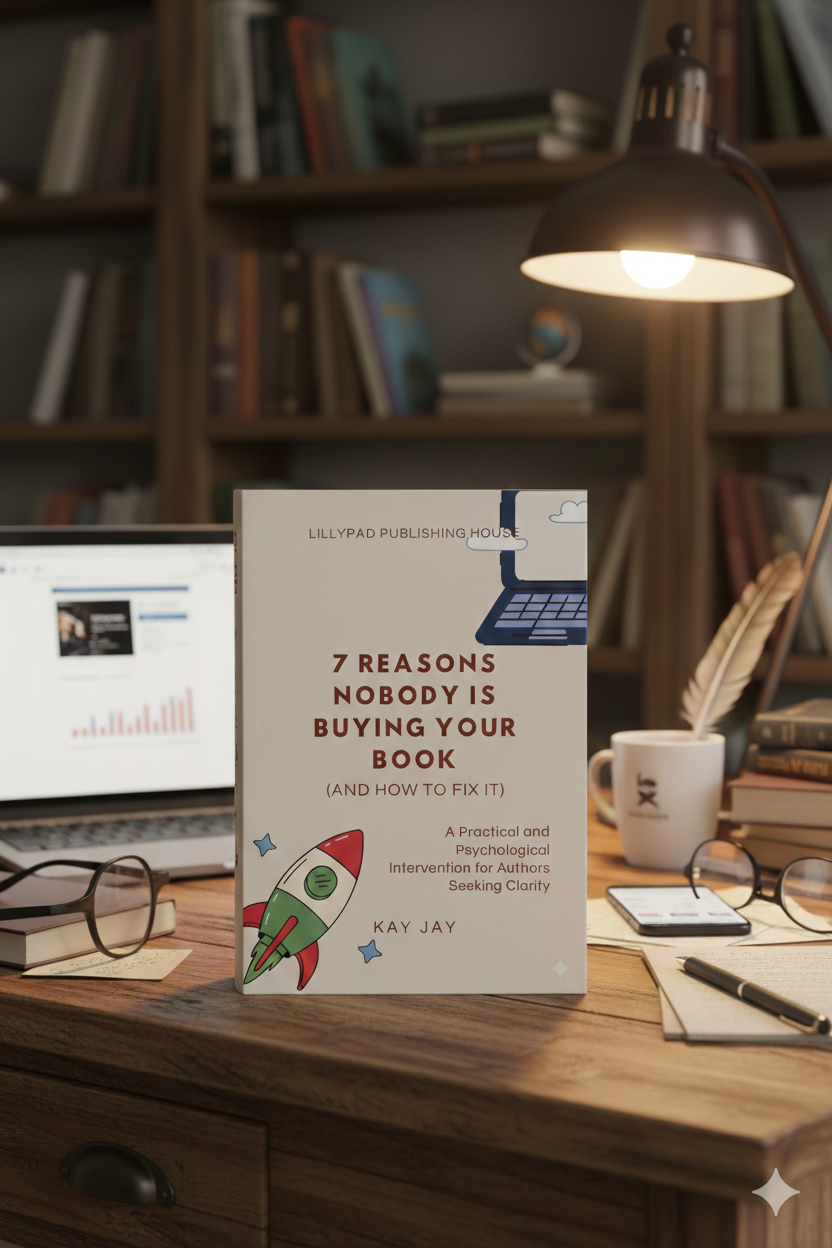
    A cozy workspace featuring a book titled '7 Reasons Nobody Is Buying Your Book (And How to Fix It)' by Kay Jay, placed on a wooden table alongside a laptop, glasses, and a cup of coffee, with warm lighting and decorative string lights in the background.
  • Why Your Book Title Needs to Address Hidden Fears

    Why Your Book Title Needs to Address Hidden Fears

    The secret to creating immediate emotional curiosity.

    In the battle for a reader’s attention, your book’s title is your single most important piece of marketing copy. Yet, most authors approach it with a fundamental miscalculation, causing their book to become instantly invisible.

    The miscalculation is this: they believe their title must name a Topic.

    A title that names a topic is factual, broad, and objective. It makes a logical statement: “This book is about X.” Examples include titles like The Guide to Productivity or Effective Financial Strategies. These titles are polite and accurate, but they are easily ignored because they do not interrupt the reader’s scroll. They only inform the reader about the subject matter, forcing the reader to perform a logical analysis of its relevance.

    The true secret to creating an irresistible signal is to use your title to name a Hidden Fear.

    A Hidden Fear is the specific, emotional pain point or secret struggle that your ideal reader is currently living inside—the one they are often too embarrassed to admit in public. It is the unsaid truth of their problem.

    When you name the Hidden Fear, your title bypasses the reader’s logical brain and goes straight to the emotional core. It doesn’t inform them about the topic; it validates their private reality.

    Consider the power of this shift:

    1. Title Naming a Topic (Logical): The reader thinks, “I know about that topic. Maybe I’ll check it out later.” (Easily dismissed.)
    2. Title Naming a Hidden Fear (Emotional): The reader thinks, “Wait, how did they know I felt that way? Only someone who has been inside my head could write that. I must read this.” (An immediate, magnetic pull.)

    The moment you use your title to articulate the reader’s hidden fear—whether it’s the shame of “feeling broke” despite a good salary, or the confusing pain of being “busy but still behind”—you create immediate emotional curiosity. You transform the book from a product to be judged into a whispered secret to be urgently discovered.

    Your credentials may get a reader to pause, but your empathy is what gets them to buy. Stop naming the topic of your book. Start naming the specific, emotional pain your reader is trying to escape. That is the only signal clear enough to cut through the noise and make the sale an inevitable act of self-recognition.

    A cozy indoor scene featuring a book titled '7 Reasons Nobody Is Buying Your Book (And How to Fix It)' by Kay Jay, placed on a wooden table with a laptop, glasses, a notebook, and a coffee cup, illuminated by warm lamp light and backdrop of blurred city lights.

  • Why Your “Good” Title is an Invisible Label

    Why Your “Good” Title is an Invisible Label

    The difference between informing and inviting the reader.

    The most pervasive trap for an author is the belief that their book’s title must be “good” in a traditional sense: factual, comprehensive, and accurate. This leads to titles that function as Technical Labels.

    A Technical Label is an objective description of the book’s contents: A Comprehensive Guide to Modern Leadership. It is an accurate statement. It is a “good” title. And in the attention economy, it is functionally invisible.

    This invisibility occurs because a Technical Label only informs the reader about the product. It makes a logical statement: “This book contains information on Topic X.” This forces the reader to pause their scroll, click, and perform a labor-intensive logical analysis to answer their real question: “How does this information apply to my deep, hidden pain?”

    The modern reader is drowning in information and will not accept the burden of that translation.

    To break the silence, your title must be an Emotional Invitation.

    An Emotional Invitation is a concise signal that bypasses the reader’s logical brain and speaks directly to their inner world—their secret fear or their most intense desire. It is a title designed not to inform, but to invite them in by proving you already know their struggle.

    Consider the difference between a technical and emotional approach to the same subject:

    1. Technical Label (Informing): The Definitive Guide to Financial Planning for Young Adults. (Focuses on the Topic.)
    2. Emotional Invitation (Inviting): Taming Your First Real Paycheck: A Millennial’s Guide to Not Feeling Broke. (Focuses on the Pain Point.)

    The Technical Label is politely waiting to be chosen. The Emotional Invitation is a magnetic shout of recognition that makes the decision to buy an emotional imperative, not a logical choice. It instantly creates a bridge of trust by saying: “I see your struggle, and I have the map.”

    Your title has just three seconds to prove its worth. Stop focusing on making it a “good,” accurate, and polite label. Start making it a clear, specific, and emotionally resonant invitation. The moment you achieve that clarity, you transform your book from an invisible product into an irresistible connection.

    A cozy indoor scene featuring a book titled '7 Reasons Nobody Is Buying Your Book (And How to Fix It)' by Kay Jay, placed on a wooden table with a laptop, glasses, a notebook, and a coffee cup, illuminated by warm lamp light and backdrop of blurred city lights.

  • The Irresistible Signal: How to make a reader stop scrolling in 3 seconds.

    The Irresistible Signal: How to make a reader stop scrolling in 3 seconds.

    Analyzing what makes a signal irresistible in a crowded feed.

    In the current attention economy, your book faces a test more immediate and more brutal than any one-star review: The 3-Second Scroll Test.

    The reality is that your potential reader is scrolling quickly, distracted, and their mind is actively filtering out every generic, polite, or non-urgent piece of content. If your book’s presentation—your title, cover, and subtitle—does not deliver a clear, emotional jolt of relevance in three seconds, it will be missed. It will become part of the noise.

    To pass the 3-Second Scroll Test, your book needs an Irresistible Signal.

    An Irresistible Signal is a concise, emotional shout of recognition. It does not demand the reader’s time for evaluation; it instantly validates their pain and promises a specific, desired transformation. It is the core difference between a technical label and an emotional invitation.

    Consider the stark choice a distracted reader faces in their feed, as illustrated by the comparison between two hypothetical books:

    1. The Definitive Guide to Financial Planning for Young Adults: This signal is factual, broad, and objective. It is quality-focused. It says, “This is a good book on a topic.” The reader has to pause, click, and logically figure out if it’s for them. This fails the test because it places the burden of translation on the reader.
    2. Taming Your First Real Paycheck: A Millennial’s Guide to Not Feeling Broke: This signal is specific, emotional, and uses insider language (“feeling broke”). It is connection-focused. It shouts, “This book is for me, and it understands how I feel right now.”

    The first book relies on the dangerous lie of “Build it and they will come.” The second book is an Irresistible Signal. It cuts through the noise because it names a specific, hidden pain (feeling “broke” despite a paycheck) and offers a clear, resonant result (taming the paycheck). It doesn’t ask, “Am I a good book?” It asks, “Am I relentlessly relevant to this person’s struggle?”

    To create an Irresistible Signal, your book’s presentation must prioritize relevance over objective quality, and emotion over logic. Every element—from the choice of words in your title to the colors on your cover—must be designed to perform one singular action: interrupt the reader’s distraction by proving, in three seconds flat, that you are the guide who knows their journey intimately. That moment of perfect clarity is the only signal that readers today will stop for.

    A cozy indoor scene featuring a book titled '7 Reasons Nobody Is Buying Your Book (And How to Fix It)' by Kay Jay, placed on a wooden table with a laptop, glasses, a notebook, and a coffee cup, illuminated by warm lamp light and backdrop of blurred city lights.
  • Your Book Isn’t Competing with Other Books—It’s Competing with This

    Your Book Isn’t Competing with Other Books—It’s Competing with This

    Understanding the real battlefield: a reader’s overwhelming distraction.

    As an author, you are naturally conditioned to think of your competition in terms of other books. You track the bestseller lists, you analyze the covers and descriptions of similar titles, and you measure your craft against the work of your peers. The assumption is that your book is placed in a ring with ten others, and you must prove yours is the best book on the topic.

    This is a profound misunderstanding of the modern marketplace, and it is a key reason your book may be invisible.

    Your book is not competing with other books. Your book is competing with This: the endless, relentless, overwhelming force of Distraction.

    The problem is not that readers are actively evaluating your book and choosing a competitor instead. The problem is that they are barely seeing it. Your masterpiece, the thoughtful, well-edited work you poured your heart into, is not fighting for attention against a similar book on financial planning. It is competing against:

    • A hilarious cat video.
    • A breaking news alert.
    • A notification from a friend.
    • The immediate, dopamine-fueled satisfaction of the endless social media scroll.

    This is the real battlefield. The reader’s default state is not search or evaluation; it is distraction and moving on. The modern reader is perpetually overwhelmed, and their cognitive load is maxed out. They are looking for reasons to ignore everything.

    If your book requires the reader to slow down, click, and logically evaluate its quality, it has already lost the battle. They will move on to the next, easier, more immediately gratifying piece of content.

    This is why the clarity of your signal is non-negotiable. You must design your book’s presentation—title, subtitle, and cover—not to look “nice” next to other books, but to perform a single, aggressive, essential action: stop the scroll cold.

    Your book’s signal must cut through the noise of vacation photos and memes by shouting a specific, emotional truth that the reader cannot ignore. It must say, “Stop. I know exactly how you feel about [specific pain point], and this is the map out.”

    Shift your focus immediately. Stop worrying about the quality of the competition. Start obsessing over the relentless velocity of the distraction. The moment you design your signal to compete against the scroll, you stop being invisible and start earning the reader’s most precious commodity: their attention.

    A cozy indoor scene featuring a book titled '7 Reasons Nobody Is Buying Your Book (And How to Fix It)' by Kay Jay, placed on a wooden table with a laptop, glasses, a notebook, and a coffee cup, illuminated by warm lamp light and backdrop of blurred city lights.
  • Your Book Is Invisible, Not Unwanted

    Your Book Is Invisible, Not Unwanted

    The crucial difference between lacking quality and lacking recognition.

    When your book is met with silence, the mind immediately jumps to the most dangerous and damaging conclusion: It was not good enough. This conclusion frames the silence as a form of mass rejection—that countless readers saw your work, made a conscious judgment on its quality, and decided to move on.

    But here is the truth that every invisible author needs to hear: Your book is not being rejected. It is simply not being recognized.

    There is a crucial, profound difference between the two.

    Rejection hurts, but it gives you information. It tells you someone saw your work and made a definitive decision about it. Invisibility, however, is far more confusing. It gives you nothing. It creates a vacuum where your effort disappears without trace or explanation, forcing you to battle the illusion that the problem is a fundamental failure of your talent.

    The reason for this lies in the nature of the attention economy. The world is full of extraordinary, objectively brilliant books that never found their audience, and equally full of very ordinary books that reached millions. The marketplace is not primarily a reward system for quality; it is a response system for connection.

    Readers today live in an environment of overwhelming choice. Millions of books, posts, and pieces of content are published every day. In this chaotic flow, readers do not stop to evaluate every book carefully. They respond to immediate, clear signals: Signals of relevance, signals of emotional safety, signals that shout, “This book is for you, and it understands how you feel.”

    If your book’s signal is polite, generic, or too broad—even if the manuscript itself is a masterpiece—it will be missed. It is quickly passed over, not because it lacks value, but because the reader cannot immediately translate its presentation into relevance for their own life.The failure is not one of quality; it is a failure of signal. Your masterpiece exists, but its signal is too weak to pierce the overwhelming noise of distraction. Once you stop fearing the phantom of rejection and start working to clarify the signal of recognition, everything begins to change. The invisibility breaks not with volume, but with a clear, specific, and emotionally resonant message.

    A cozy indoor scene featuring a book titled '7 Reasons Nobody Is Buying Your Book (And How to Fix It)' by Kay Jay, placed on a wooden table with a laptop, glasses, a notebook, and a coffee cup, illuminated by warm lamp light and backdrop of blurred city lights.
  • Overcoming the Fear of Zero Book Sales

    Overcoming the Fear of Zero Book Sales

    A raw, personal story about the fear of the “zero sales” number and what it really signifies.

    There is a moment every author reaches, but few talk about. It is an isolating, silent ritual of the soul.

    It usually happens late at night. The house is quiet, the digital world is asleep, and you are alone with your doubt. You open your laptop. You log into your sales dashboard. You tell yourself not to expect anything, you steel your heart against disappointment.

    And still, you hope. You refresh the page.

    Then you see it. Zero sales. Or one. Or the same quiet, indifferent number you saw yesterday. The number does not change, but in that moment, something inside you shatters a little.

    I know this moment intimately. I lived it after publishing my very first book, Diary of Cliches. It wasn’t just disappointing; it was a profound, disorienting silence. Because you did everything right: you poured your heart into the writing, you polished the prose, you went through the months of editing and publishing. You created value. And yet, the marketplace responded with an empty, echoing void.

    That zero is a vacuum that sucks all the creative energy out of you. It’s not just a sales figure; it becomes a judgment. The mind, searching for an explanation, immediately asks the most dangerous question: Was I wrong? Was this effort a mistake?

    This is the moment the great illusion takes hold—the belief that the problem lies in the quality of the book.

    But here is the truth that finally set me free from that 2 AM panic: That zero is not a judgment of your worth. It is simply a signal of disconnection.

    The problem is not that readers saw your book and rejected it. The problem is that your book’s signal is not piercing the noise of the attention economy to be recognized by the people who need it. That zero is not a statement about the content you created; it’s a reflection of the bridge you have yet to build.

    It has nothing to do with your talent, and everything to do with perception, psychology, and connection. Once you stop fearing the number and start seeing it as an immediate call for more clarity in your signal, everything changes. The zero sales number becomes an instruction, not a verdict.

  • The Non-Linear Path to Building Reader Trust

    The Non-Linear Path to Building Reader Trust

    A summary of the non-linear path to reader trust and sales.

    When an author looks at the process of getting a book to market, they almost always imagine a linear, logical sequence: Write the Book → Polish the Manuscript → Launch the Product → Pray for Sales. This is the traditional model, and for the vast majority of authors in the attention economy, it is a sequence designed for failure and silence.

    This linear path treats the book as the starting point. But in a world saturated with “good” content, the book itself is no longer the most important asset. The most important asset is the Signal.

    The only publishing sequence that consistently breaks the silence and leads to natural, sustained sales is a non-linear path focused on connection first. It is a sequence of clarity: Position → Package → Signal.

    1. Position: The Internal Clarity (Before the Book)

    This is the single most important step, and it is almost universally skipped. Position is your internal, unshakeable clarity on the intersection of three things:

    • Your Past Pain: The specific struggle you overcame to write the book.
    • The Reader’s Current Pain: The Shared Secret your ideal reader is embarrassed to admit.
    • Your Book’s Transformation: The single, clear bridge you provide from that specific pain to the ultimate “after” state.

    If you cannot articulate your Position in a single, emotional sentence, your book will be invisible. This is the phase of internal work—reconnecting with your past self to find your book’s true, irresistible message.

    2. Package: The External Invitation (The Presentation)

    Once your Position is clear, you must translate it into an external, magnetic invitation. This is the stage where the book becomes the Map, Not the Product. Your Package is all the external elements a scrolling reader sees in the first three seconds:

    • The Title & Subtitle: They must function as an Emotional Invitation, not a Technical Label.
    • The Cover: It must evoke the reader’s specific pain and promise a transformation.
    • The Description: It must sell Transformation Over Information.

    The Package’s job is not to describe how good the book is, but to shout how ruthlessly relevant it is to the one person scrolling.

    3. Signal: The Consistent Service (The Promotion)

    With a clear Position and a magnetic Package, the Signal becomes the easiest part. The Signal is the consistent, non-urgent, Service-focused communication that guides the reader through the 4 Steps of Discovery.

    • Focus: Every post, email, or ad is a Service Post aimed at helping one person feel seen, not a Performance Post aimed at telling people to buy.
    • Clarity: It is the relentless repetition of your Position, ensuring that the unique authority you earned as the Traveler cuts through the noise.

    This sequence is non-linear because you may need to revisit your Position even after your Package is complete. But when followed, it ensures that by the time you ask for a sale, you are not persuading a stranger; you are simply handing a desperately needed map to a fellow traveler. The sale becomes the natural byproduct of a perfectly clear signal.